

Every month, studio owners and fitness enthusiasts ask about building their own reformer. The idea of a build your own pilates reformer project is appealing: DIY plans circulate online, and the cost of commercial reformers can seem high. But the reality of a home-built machine is more complex than the plans suggest. This guide covers what it takes to build your own pilates reformer, the honest cost and safety picture, and when buying commercial-grade equipment is the smarter choice.
1. What It Takes to Build Your Own Pilates Reformer
A reformer is a precision exercise machine, which is the first thing to understand before you decide to build your own pilates reformer. The carriage must glide smoothly on rails, the springs must provide consistent resistance, and the frame must hold rigid under dynamic load. Building your own pilates reformer means replicating that precision with off-the-shelf parts\u2014which is harder than it looks in photos.
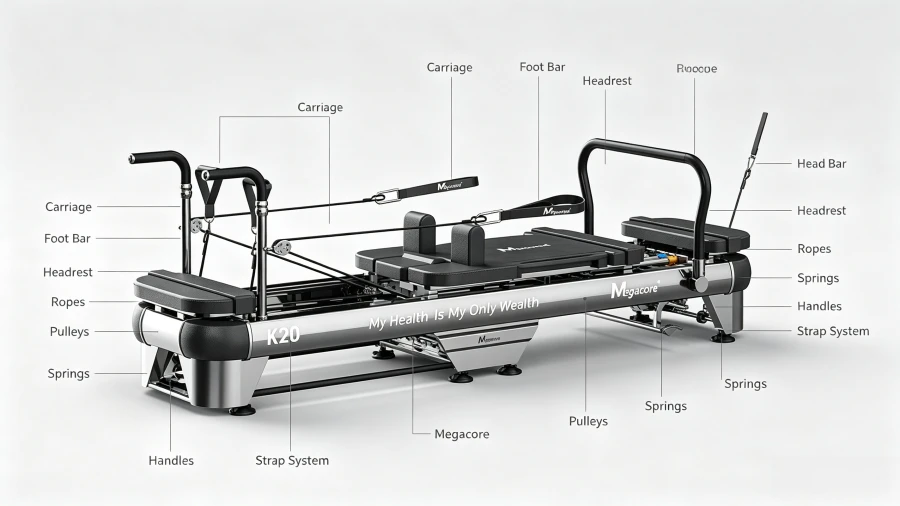
The critical components in any build your own pilates reformer plan are: a rigid frame, a low-friction carriage system, springs with calibrated resistance, ropes and pulleys, and a footbar that holds under repeated force. Each component is straightforward alone; the challenge is making them work together with the smoothness and safety clients or you expect from a commercial machine.
2. Materials and Costs
DIY reformer builds typically use wood or steel frames, and the choice shapes the whole build your own pilates reformer experience. Wood is cheaper and easier to work with, but it flexes more and wears faster under load. Steel requires welding or bolted fabrication and specialized tools, raising both cost and skill requirements.
| Komponenta | DIY Approach | Typical DIY Cost |
|---|---|---|
| Okvir | Wood or steel fabrication | $100-400 |
| Carriage and rails | Bearing rails, plywood platform | $80-200 |
| Vzmeti | Purchased spring sets | $60-150 |
| Ropes, pulleys, hardware | Hardware store components | $50-120 |
| Upholstery and padding | Foam and vinyl | $50-150 |
| Total | $340-1,020 |
The DIY cost looks attractive against a $2,000-4,000 commercial reformer. But the comparison is incomplete: labor hours, tools, trial-and-error, and the risk of rework push the true cost up, and the result rarely matches commercial performance.
3. Time and Skills Needed to Build Your Own Pilates Reformer
Building your own pilates reformer is a weekend project only for experienced makers; for everyone else it is a multi-week commitment. Realistic timelines for a build your own pilates reformer run 20-60 hours for a first attempt, including planning, sourcing parts, fabrication, assembly, and adjustment. Without woodworking or metalworking experience, expect a longer learning curve and multiple iterations.
The adjustment phase is the most underestimated part of any build your own pilates reformer project. Springs need calibration, the carriage needs smooth alignment, and the whole system needs to feel right under load. This tuning is where DIY builds typically struggle, because precision is hard to achieve with hand tools.
4. Safety Risks of DIY Reformers
Safety is the decisive argument against DIY reformers. A commercial reformer is engineered, tested, and documented for load ratings and failure modes. A DIY build has none of that assurance. Springs can snap, frames can flex or fail under load, and the carriage can derail\u2014all with a client or you on the machine.
For studios, a build your own pilates reformer introduces liability that is difficult to justify: client injuries from equipment failure expose the business to claims that documented commercial equipment would not. Even for home use, the risk of serious injury from a failed build outweighs the cost savings.
5. Performance Differences You Will Notice
Even a successful DIY build differs from commercial equipment in daily use. Commercial reformers use high-carbon springs with consistent tension across thousands of cycles; DIY springs degrade unevenly. Commercial carriages use precision roller bearings; DIY glides develop friction and noise. These differences affect exercise quality and the overall experience.
If the reformer is for personal use and you enjoy the build itself, these compromises may be acceptable. If it is for a business, clients will notice the difference\u2014and the difference reflects on your studio.
6. When DIY Makes Sense
There are legitimate cases for building your own pilates reformer, and they are narrower than the DIY forums suggest. Prototyping and learning are the strongest reasons to build your own pilates reformer: makers who want to understand the mechanics deeply, instructors developing their own equipment concepts, and hobbyists who value the build as much as the use. For these purposes, a DIY build is a worthwhile project.
DIY also makes sense for accessories and upgrades rather than the core machine, and that is where most people who want to build your own pilates reformer should start: building a jump board, a box, or a platform extender for an existing commercial reformer is lower-risk and delivers real value.
7. When Buying Beats Building Your Own Pilates Reformer
For studios, instructors serving clients, and anyone who values safety and reliability, a commercial reformer is the right investment. The cost difference narrows when you count labor, tools, and the value of a documented, warrantied machine. Commercial reformers deliver consistent performance, load-rated safety, and support that a DIY build cannot match.
Megacore builds commercial reformers with Q235 steel frames rated for 350 kg, high-carbon 50,000-cycle springs, and precision roller bearing carriages, backed by a 3-year warranty on frame and machine and a quality inspection certificate and test report (report number GZHL2601000020601SP) with every unit.
8. The Verdict
Can you build your own pilates reformer? Technically, yes. Should you? Only for learning, prototyping, or personal experimentation. For anything that involves clients, safety, or consistent performance, the answer is no\u2014the risk and quality gap are not worth the savings.
If budget is the constraint, look at entry-level commercial models or factory-direct options rather than DIY. The total cost of ownership of a commercial machine, spread over a decade of reliable service, beats a DIY build that needs constant repair.
Pogosta vprašanja
Q1: Is it possible to build a reformer at home?
Da, če imate znanje s področja obdelave lesa ali kovin ter 20–60 ur dela. Izdelek bo sicer deloval, vendar je težko doseči enako natančnost in varnost kot pri komercialnih izdelkih, če uporabljate ročno orodje in serijske dele.
Q2: How much does a DIY reformer cost?
Stroški materiala znašajo običajno $340–1.020, brez orodja in dela. Dejanski stroški, vključno s časom in popravki, se približujejo tržnim cenam za kakovosten rezultat.
Q3: Are DIY reformers safe?
Ne dosegajo standardov profesionalne opreme. Pri vzmetih, okvirjih in vozičkih niso bili opravljeni preskusi obremenitve in analize okvar, kar predstavlja resno tveganje pri uporabi, zlasti pri strankah.
Q4: Can I use a DIY reformer in my studio?
Ni priporočljivo. Poškodbe strank zaradi opreme brez certifikata izpostavljajo podjetje odgovornosti, ki je pri dokumentirani komercialni opremi ne bi bilo.
Q5: What is the cheapest safe option?
Osnovni komercialni reformatorji ali modeli, ki se prodajajo neposredno iz tovarne. Imajo navedene nosilnosti, garancije in dokumentacijo o kakovosti, česar izdelki za samostojno sestavo ne morejo zagotoviti.
Q6: What warranty comes with commercial reformers?
Megacore commercial reformers carry a 3-year warranty on frame and machine, with a quality inspection certificate and test report (report number GZHL2601000020601SP) per unit.
Zaključek
Zaključek
Building your own pilates reformer is an interesting project and a poor investment for most people. The precision, safety, and durability that make a reformer worth using come from engineered commercial manufacturing, not a weekend build.
If the project appeals to you, build for learning or build accessories. For the machine itself, invest in commercial-grade equipment with documentation and warranty\u2014your safety and your clients’ safety are worth it.
Get Commercial Reformer Pricing From Megacore
Povezani vodniki
- Commercial Pilates Reformer Cost
- Pilates Reformer Safety Standards
- Pilates Reformer Platform Extender Guide
- Pilates Reformer Cleaning Guide
Industry references: Pilates Method Alliance industry standards, OSHA workplace safety guidelines, and CDC: Nadzor okužb v okolju.