
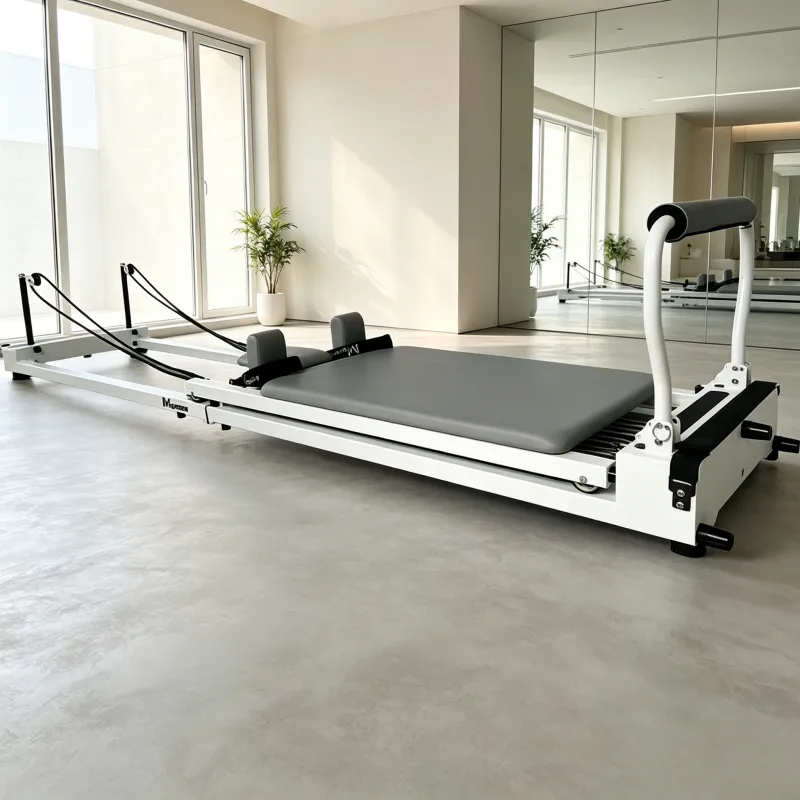
Adapting Reformer Pilates for Senior Clients: Equipment and Programming
Why Choose a Pilates Reformer for Seniors
Selecting the right Pilates reformer for seniors is essential for ensuring safety and effectiveness during low-impact workouts. The Pilates reformer for seniors should offer easy entry and exit, adjustable spring tension, and smooth carriage movement. Many studio owners are now investing in specialized Pilates reformer for seniors equipment to tap into the growing senior fitness market.
Key Features of a Pilates Reformer for Seniors
A well-designed Pilates reformer for seniors includes wider carriages, lower platforms, and extra padding for joint comfort. When you recommend a Pilates reformer for seniors in your studio, look for models with adjustable headrests and shoulder rests that accommodate limited mobility. The best Pilates reformer for seniors also features lightweight springs for gentle resistance progression.
Safety Considerations for a Pilates Reformer for Seniors
Safety is paramount when using a Pilates reformer for seniors. Ensure the frame is stable and the carriage lock mechanism is easy to operate. A Pilates reformer for seniors should have non-slip footbars and clearly marked spring settings. Many manufacturers now offer Pilates reformer for seniors packages with additional safety accessories such as padded shoulder rests and head cushions.
Adapting Reformer Exercises for Senior Clients
When teaching on a Pilates reformer for seniors, start with basic footwork and gradually introduce more complex movements. The Pilates reformer for seniors allows instructors to control resistance precisely, making it ideal for rehabilitation and gentle conditioning. A Pilates reformer for seniors program can include seated exercises, light stretching, and balance training to improve overall mobility.
The aging population represents a growing market segment for Pilates studios, and reformers are exceptionally well-suited to the needs of older adults. The spring-loaded resistance provides safe, controlled loading that supports joint health, balance training, and functional strength development. However, serving senior clients effectively requires specific equipment features and programming modifications that differ from standard reformer class design. This article covers the practical aspects of making a reformer studio welcoming and effective for clients aged 60 and older.
Equipment Modifications for Accessibility
The first consideration for senior-friendly reformers is the platform height. Standard reformers with a platform height of 45–50 cm require older clients to lift their legs higher to mount the carriage, which can be a significant barrier for those with reduced hip mobility or knee flexion. Low-profile reformers with platform heights of 30–35 cm are strongly preferred for senior populations because they reduce the mounting effort and create a lower center of gravity that feels more stable.
Footbar adjustability is equally important. A footbar that adjusts through a wide range — from very low (for easy foot entry) to moderately high (for seated work) — accommodates clients with limited ankle dorsiflexion who cannot comfortably position their feet on a high footbar. The adjustment mechanism should be smooth and easy to operate with reduced hand strength — a spring-loaded pin mechanism is ideal because it requires minimal grip force compared to screw-type adjusters.
Spring Tension for Low-Impact Loading
Senior clients generally begin with the lightest spring tensions available — 0.5–1.0 kg per spring. A reformer intended for multi-generational use should include at least two ultra-light springs (1.0 kg or less) in its standard spring set so that instructors can offer true minimal resistance for first-time or deconditioned older clients. The spring selection should allow for increments of 0.5 kg or smaller — the difference between 1.0 kg and 1.5 kg of resistance is significant for an 80-year-old client with age-related muscle loss.
The springs themselves should have smooth engagement — no sudden catch or initial slack that requires a jerky movement to load the spring. High-quality springs with pre-tensioned initial coils provide immediate resistance at the start of carriage travel, eliminating the “dead zone” that can destabilize clients during the first few degrees of movement. Our quality inspection certificate (GZHL2601000020601SP) includes spring engagement testing to verify smooth resistance from the first millimeter of carriage travel.
Carriage Ride Characteristics for Joint Comfort
The smoothness of the carriage ride is more critical for older clients because they are more sensitive to jarring or catching movements. Carriage bearings should be sealed cartridge type with polyurethane or nylon rollers that provide silent, vibration-free travel. The carriage rails should be precision-ground stainless steel with a surface finish of Ra 0.4 μm or smoother — rougher surfaces create micro-vibrations that transmit through the carriage to the client’s spine.
Carriage pad thickness and density also affect comfort. A thicker carriage pad (5 cm minimum) with medium density foam (45–55 kg/m³ IFD 25–30) provides adequate cushioning for clients with reduced subcutaneous tissue over bony prominences. Memory foam overlays are a popular aftermarket add-on for senior-focused studios, though they require more frequent replacement because the foam compresses permanently under repeated use.
Programming Principles for Senior Reformer Classes
Reformer programming for seniors follows different principles than general population classes. The emphasis shifts from challenge and progression to safety, confidence building, and functional outcomes. A typical senior reformer session includes: 10–15 minutes of breath-coordinated warm-up movements at the lightest spring tension, focusing on spinal articulation and ribcage mobility; 15–20 minutes of lower body strengthening — footwork, leg presses, and hamstring curls — at moderate tension that allows 10–15 controlled repetitions per set; 10 minutes of upper body and core work emphasizing posture muscles and scapular stability; and 5–10 minutes of cool-down stretching on the carriage with minimal spring assistance.
Rest periods between exercises should be longer for senior classes — 60–90 seconds rather than the 30–45 seconds typical of general reformer classes. This allows heart rate and blood pressure to stabilize between sets, reducing the risk of post-exercise hypotension. Instructors should monitor for signs of dizziness or lightheadedness, particularly after exercises that involve head-down positions or rapid position changes.
Balance Training Applications
Fall prevention is one of the most valuable outcomes a reformer program can offer senior clients. The reformer’s spring-loaded carriage provides an inherently unstable surface that challenges balance in a controlled environment. Exercises that involve single-leg stance on the carriage, lateral weight shifts, or reaching movements while maintaining carriage stability all train the proprioceptive and neuromuscular systems that decline with age.
Progression for balance training on the reformer follows a structured path: start with bilateral footwork where both feet are on the footbar and both hands hold the straps (full base of support), progress to unilateral footwork with the non-working foot on the carriage (reduced base of support), then to exercises that involve releasing one hand from the strap (further reduced support), and finally to eyes-closed variations of basic exercises (vestibular challenge). Each progression level should be mastered before advancing — typically 2–4 weeks per level for older clients.
Environmental Considerations for Senior Studios
The studio environment matters as much as the equipment for senior clients. Adequate lighting — at least 500 lux at floor level — reduces fall risk during transitions between exercises. Non-slip flooring under and around each reformer is essential. Clear, high-contrast markings on the footbar adjustment positions and spring pegs help clients with reduced visual acuity operate the equipment independently. Temperature control should keep the studio at 22–24°C — older clients cool more quickly than younger exercisers and may be uncomfortable in the 18–20°C range typical of mainstream fitness studios.
Equipment for Multi-Generational Studios
For studios serving a wide age range, consider a mixed fleet with a few low-profile reformers specifically designated for senior sessions alongside standard-height machines for the general population. The low-profile machines also benefit pregnant clients and those returning from injury, so they serve multiple purposes. Megacore Pilates offers low-profile reformer models with 32 cm platform height, extra-thick carriage pads, and ultra-light spring options that are specifically designed for senior-friendly and rehabilitative programming. Pilates Reformer for Physical Therapy: W Pilates Reformer for Physical Therapy: W