
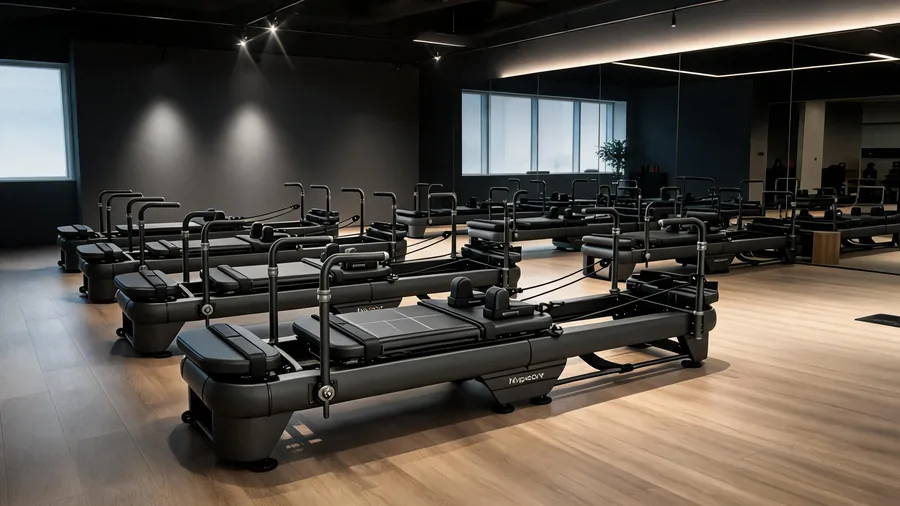
Buying a commercial pilates reformer is a bigger decision than it looks. Studio owners tend to compare two or three models on price and call it done, then spend the next five years managing the consequences: springs that lose calibration, upholstery that fails in year two, and a warranty that does not cover the part that broke.
This guide is for anyone outfitting a studio, clinic, gym or hotel, and it covers the spec that actually decides whether a machine lasts, the warranty terms worth insisting on, and what drives the price. It is written for buyers who will live with the machine for a decade, not for people comparing home machines on a website.
1. What “Commercial” Actually Means
The word gets used loosely. In practice, a commercial reformer is one built for continuous use by many different people, day after day, with the strength and serviceability to survive it.
Three things separate commercial from home machines, and none of them is the frame colour.
Duty rating. A commercial machine is designed for hours of daily use and a wide range of client body weights. A home machine is designed for one or two users a few times a week. The frame gauge, bearings and springs differ accordingly.
Serviceability. Springs, wheels and upholstery are wear parts. On a commercial machine they are standardised and replaceable. On a home machine they are often proprietary and, when they fail, the machine is effectively done.
Consistency across units. If you buy ten machines, they should feel identical to clients and staff. That is a manufacturing discipline, not a feature on a spec sheet. Our overview of commercial reformers covers this in more depth.
2. The Frame: Steel, Aluminium or Wood
The frame decides how the machine feels and how long it lasts. Each material has a trade-off.
| Frame | Feel | Best for | Watch out for |
|---|---|---|---|
| Baja | Heavy, solid, minimal flex | High-traffic studios, heavy use | Weight and shipping cost; rust if the finish is poor |
| Aluminium | Lighter, still rigid | Studios wanting easier moving and lower freight | Flex in low-grade builds; check the wall thickness, not just the alloy |
| Wood | Warm, traditional, slight give | Aesthetic studios, lighter use | Humidity and warping; higher maintenance |
For a busy commercial studio, steel and high-grade aluminium are the safe choices. Our frame materials guide compares them in detail. What matters more than the material is the build quality: wall thickness, welds and finish. A thin, low-grade steel frame flexes more than a good aluminium one.
3. Springs Decide Your Maintenance Bill
Springs are the part most buyers overlook and the part that costs the most over time. They are wear items. They stretch, they lose tension, and a calibrated colour code drifts until “use the green spring” no longer means what it did.
Two things matter here. First, can the springs be replaced quickly and in matching sets, so a machine is not out of rotation for long. Second, does the colour coding stay reliable, or does it drift within months under heavy use. Our spring tension guide and the panduan penggantian pegas explain how to check and change them.
A reformer with low-grade, non-standard springs is a machine you will fight with. Ask how often springs should be replaced in a commercial setting, and expect a serious answer.
4. Carriage, Bearings and Upholstery
The carriage is where clients actually live, and where low-grade machines give themselves away.
Bearings and glide. A carriage should move smoothly under load without wobble or grit. Sealed or shielded bearings protect against dust and sweat, which matters in a studio. Low-grade open bearings feel fine for a month and then get noisy.
Upholstery. Commercial vinyl over dense foam is the baseline. The failure points are the seams and the foam loft. In high-traffic or warm studios, upholstery ages faster, and replaceable panels save you from re-upholstering a whole carriage. See our carriage pad guide.
Foot bar and adjustments. These are handled hundreds of times a week. If a lock slips or a lever sticks, it wears out the client experience as much as the machine.
5. Weight Capacity and Client Range
Commercial studios serve a wide range of clients, and the machine must handle the top of that range safely. Weight capacity is a hard spec, so check it against your real client mix rather than assuming it is generous. Our weight capacity guide explains how the figure is measured and what to look for.
Also check adjustability for taller clients. Foot bar and headrest positions should suit long limbs without compromise. This is a small detail with an outsized effect on whether a tall client feels comfortable or cramped.
6. Warranty: Get It in Writing, by Component
A warranty that says “three years” and covers nothing you will actually replace is marketing. When you buy commercial, insist on component-level terms.
- Frame: should carry the longest cover, because it is the part least likely to fail.
- Springs: aggressive spring warranties are often the distinguishing sign of a good commercial machine.
- Upholstery and padding: usually shorter, because it is a wear item.
- Bearings and wheels: confirm they are covered and that spares are stocked.
Our warranty guide covers what to check and how to compare terms across suppliers.
7. What Drives the Price
Commercial reformers sit in a wide price band, and the difference is rarely about one feature. It is a mix of frame material and build quality, spring system, upholstery grade, carriage components, brand positioning and what you are buying through, factory or distributor.
Be wary of two failure modes. A very low price usually means a lighter build, home-grade springs or thin upholstery, and the savings get eaten by replacements. A very high price is not always better hardware; sometimes it is paid for the brand and the service network. Our breakdown of commercial reformer cost covers the ranges and what moves them.
Compare on total cost over five years, not sticker price. A machine that needs a spring set every year and new upholstery in year two is not the saving it looks like, whatever it cost.
8. Factory Direct, Distributor or Reseller
Where you buy changes the price and the support you get.
Factory direct. Usually the lowest cost at volume and the most flexibility on spec and branding, but you carry more of the import and logistics work. Our notes on factory vs local supplier cover the trade-offs.
Distributor or local reseller. Higher price, but they hold stock, handle delivery and take responsibility for service. For a single site with no logistics appetite, that can be worth it.
Neither is wrong. The mistake is buying factory direct to save money and then discovering you have no spare-parts support when something fails.
9. Ordering, Lead Times and Freight
For a commercial order, plan the logistics early. Confirm lead times in writing, ask what happens if a component changes between orders, and plan freight and duties before you commit. Our air and sea freight guide compares speed and cost, which matters more at volume.
If you are buying used to save money, weigh it carefully. Our new vs used comparison covers the consistency and warranty problems that used machines introduce at scale.
10. Buying Checklist
- Confirm the duty rating and that the machine is built for daily, multi-client use.
- Confirm frame material and, more importantly, build quality: wall thickness, welds, finish.
- Confirm springs are standardised, replaceable and stay calibrated.
- Confirm carriage bearings are sealed and the glide is smooth under load.
- Confirm upholstery is commercial-grade with replaceable panels.
- Confirm weight capacity suits your client mix and adjustability suits tall clients.
- Get warranty terms in writing, broken down by component.
- Confirm spare parts are stocked and priced, with lead times.
- Confirm lead times, freight and duties before you sign.
Our best reformers for studios guide and the studio equipment checklist cover the wider build. Professional bodies such as the Aliansi Metode Pilates are a useful reference for instructor standards that should influence your equipment choices.
If you are comparing commercial machines for a studio or multi-site build, talk to our team about spec, pricing and support before you decide.
Frequently Asked Questions
What makes a pilates reformer commercial grade?
A commercial reformer is built for continuous daily use by many clients. That means a heavier, more rigid frame, standardised replaceable springs and wear parts, sealed bearings, commercial upholstery and component-level warranty support.
How much does a commercial pilates reformer cost?
Prices vary widely with frame material, build quality, springs, upholstery and where you buy. Factory-direct is usually less expensive at volume; distributors charge more but include service. Compare total five-year cost, not the sticker price.
Is a commercial reformer worth it over a home one?
For any setting with regular multi-client use, yes. A home machine wears out fast, has proprietary parts and gives inconsistent feel between units. A commercial machine lasts years and can be serviced.
Steel or aluminium frame for a studio reformer?
Both work. Steel is heavier and very rigid, ideal for high-traffic studios. Aluminium is lighter and less expensive to ship, and a high-grade build is plenty rigid. Build quality matters more than the material.
How long do commercial reformer springs last?
It depends on class volume and how hard they are worked. In heavy commercial use, expect to check tension regularly and replace springs well before a home machine would. Confirm the replacement interval and cost before buying.
What warranty should a commercial reformer have?
Get component-level terms in writing. Frames should carry the longest cover, springs should be covered generously, and upholstery and bearings should be clearly specified with stocked spares.
Should I buy a reformer direct from a factory or a distributor?
Factory direct is usually less expensive at volume with more spec flexibility, but you handle logistics and parts. A distributor costs more but provides stock, delivery and local service. Choose based on how much support you want.
How many reformer springs should a studio machine have?
Most commercial reformers use a graded set of springs, commonly five to six, that combine to give a range of resistance. What matters is that they are standardised, colour-calibrated and easy to replace.