

Most studio owners start shopping for equipment the same way. They search for a pilates equipment manufacturer, open a handful of tabs, and compare prices. That works right up until the first container lands and you need a spare part that never ships.

I have spent years on the factory side of this conversation, and the pattern is boringly consistent. The supplier you keep for a decade and the one you regret are almost never separated by price. They are separated by what the supplier actually owns, what they control, and whether their answers survive a second question.
This guide is for buyers who order in volume: studio owners, boutique gym chains, rehab clinics and distributors. If you are buying one reformer for a spare room, most of this is overkill, and our pilates reformer buying guide is the better read.
1. What a Pilates Equipment Manufacturer Actually Is
The label “manufacturer” covers three very different businesses, and the gap between them is where most of the confusion starts.
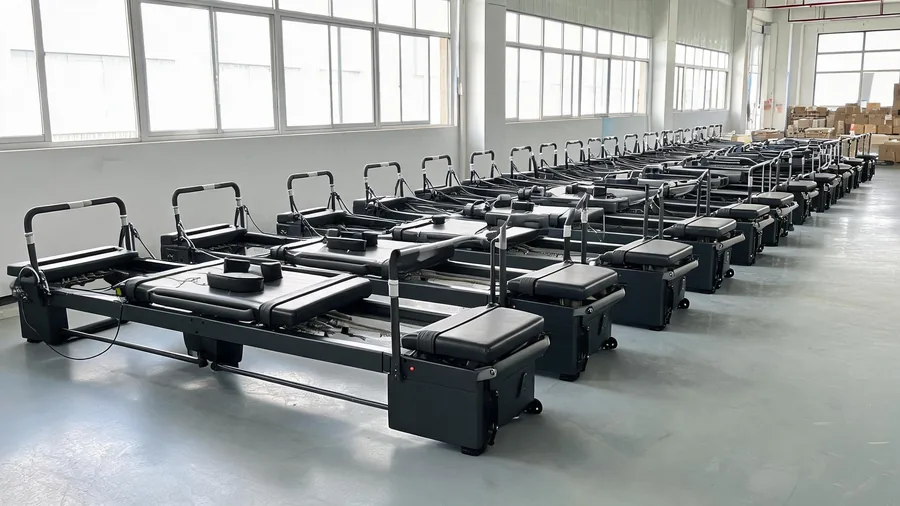
A factory owns the tooling. It welds the frames, cuts and stitches the upholstery, winds and tests the springs, and assembles the finished units. When something goes wrong, the factory can fix it, because the process belongs to them.
A trading company owns none of that. It buys finished reformers, adds a margin, and passes your order to whichever factory will take it. Some trading companies are excellent operators who genuinely save you time and language headaches. Others vanish the moment a batch fails inspection.
A brand sells a name and a warranty. The hardware may come off the same production lines everyone else uses. That is not automatically a problem. It just tells you what part of your invoice is paying for design, marketing and support rather than steel and labour.
None of the three is wrong on its own. The mistake is paying factory-direct prices to a trader, or expecting retail-level hand-holding from a factory that has never dealt with an end customer.
2. The Equipment List a Studio Actually Buys
New buyers often treat “pilates equipment” as a synonym for “reformer.” In practice a full studio is a package, and buying the pieces separately in the wrong order is how budgets blow out. The reformers carry the classes, everything else supports them.
| Equipment | Typical studio ratio | What to check before buying |
|---|---|---|
| リフォーマー | 1 per 1–2 class stations | Frame thickness, spring range, carriage travel |
| Tower / half-trap | 1 per 2–3 reformers | Spring attachment points, mat compatibility |
| Cadillac / trapeze table | 1 per studio, shared | Build quality, footprint, ceiling clearance |
| Wunda chair | 1–3 per studio | Pedal tension range, stability under load |
| Barrels (ladder / spine) | 2–4 per studio | Foam density, curve shape, stitching |
| Small props and spares | Continuous | Whether parts are standard or proprietary |
A supplier who can quote all of it from one production floor is easier to manage than one who sources each item somewhere different. Fewer suppliers means fewer lead times, fewer invoices and one person to call when a spring hook snaps the week before a class launch. That last point is not hypothetical. It is the single most common reason studios change suppliers.
3. How to Vet a Pilates Equipment Manufacturer
Every supplier says the same words in an email. The checks below reveal which ones mean it. Ask for all of them early, before you discuss price, because a supplier who is slow to answer these will be slow about everything else.
| Check | What good looks like | Red flag |
|---|---|---|
| Factory access | Live video walkthrough of the line on request | Stock photos, “we will send photos later” |
| Quality control | Documented per-unit load and spring testing | No written process at all |
| Spare parts | Standard, separately priced, ships in weeks | “We will handle it” with no part numbers |
| References | Named studios you are allowed to contact | A wall of logos with no contact details |
| Certifications | CE and test reports on file, dated | “Yes, we have everything” with nothing attached |
| Lead time | A stated range with a reason behind it | “Depends” with no follow-up |
The video walkthrough is the fastest filter. A real factory can show you its own welding jigs, upholstery table and packing area in a five-minute call. A trader will stall, send a catalogue, or show you a building from the outside.
4. Factory Direct vs Distributor: What You Gain and Lose
Going direct is not automatically cheaper once you count the work you take on. Distributors exist because sourcing from another country is a job. The honest comparison looks like this.
| 因子 | Direct from factory | Through a distributor |
|---|---|---|
| Unit price | Lower, before freight and duty | Higher, margin included |
| Minimum order | Usually higher | Often one unit |
| Lead time | Production plus shipping | Usually from local stock |
| Spare parts | Available but you handle shipping | Local, fast, priced higher |
| Support | Depends entirely on the factory | Local, contractual |
| Customisation | Usually possible | Rarely, or at a steep premium |
The break-even point is roughly the moment your order is worth more than your own time. A studio buying four reformers is often better served by a local distributor. A chain buying forty, or a brand building its own line, is leaving real money on the table by not going direct.
5. Samples, MOQ and Customisation
Order a sample before you sign anything. Not a render, not a photo of someone else’s unit, a physical machine you can put a client on. A serious factory will sell you one at cost or close to it, and will be honest that the sample and the production run come off the same line.
This is also where minimum order quantities enter the picture. MOQ usually scales with how far you push the product away from stock: a standard colour and frame is a low bar, a new frame length or a full private-label programme raises it, because the factory has to stop and change the line for you. If you only need a small run, expect to pay either a higher unit price or a setup fee rather than getting the MOQ waived for free. Any factory that drops a custom MOQ to nothing without blinking is either very new or very careless.
6. Certifications and Compliance to Ask For
Ask for the actual documents, not a description of them. Depending on your market you will want to see:
- CE marking documentation for the EU, with the applicable standard referenced.
- ISO 20957 fitness equipment testing, for strength and stability claims.
- Test reports from a recognised lab for frame load and spring durability.
- Material declarations, for upholstery and coating compliance.
について ASTM standards library is a useful reference for what fitness equipment testing covers, and the ピラティス・メソッド・アライアンス is worth checking for how the wider industry frames equipment and instructor standards. Neither tells you whether a specific supplier is compliant. Only the paperwork does, and it should be dated within the last couple of years.
7. Lead Times, Shipping and Incoterms
Three terms decide who pays for what once the equipment leaves the factory, and getting them wrong is expensive.
- FOB (free on board): the supplier delivers to the port and loads. You arrange and pay for the rest.
- CIF (cost, insurance, freight): the supplier pays shipping and insurance to your port. You still handle customs and the final leg.
- DDP (delivered duty paid): the supplier handles everything to your door, duty included. The most convenient and the most expensive up front.
Add production time to whichever you choose. Ten to fifteen days is a fair expectation for a stock reformer, longer for custom work, and longer again around major trade shows when everyone orders at once. Treat any promise of a custom container in under two weeks with suspicion.
8. After-Sales: Spare Parts, Warranty and Training
The sale is the easy part. What separates a long-term supplier is everything after it:
- Spare parts catalogue. You want part numbers and prices, so a snapped cable is a small order and not a crisis.
- Warranty terms in writing. Frame, springs, upholstery and labour usually carry different periods. Read all four.
- Assembly and service guidance. Videos or a manual you can hand to a technician.
- A named contact. One person who answers, not a shared inbox that resets with every staff change.
Ask existing customers about this before you order, not after. Spare parts and response time rarely make it into a sales pitch, and they are exactly what you will judge the supplier on in year three.
9. Seven Questions to Ask Before You Sign
- Can you show me the production line live, on video, today?
- Who tests each unit, and what does the test record look like?
- What are the exact spare part prices for springs, cables and pads?
- What is the real lead time for my specification, in weeks?
- Which certifications apply to this exact model, and can I see the reports?
- Can I speak to two customers who bought in the last twelve months?
- What happens, step by step, if a container arrives with damaged units?
Weak answers to any of these are not a reason to negotiate harder. They are a reason to keep looking.
10. Where Most Studios Get It Wrong
The failures I see repeat. Buyers optimise for unit price and ignore total cost, forgetting freight, duty, spares and downtime. They skip the sample to save four weeks and lose four months fixing what they could have seen. They accept a verbal warranty that nobody can find later. They buy everything from one quote without a second opinion, then discover the second version was either cheaper or stronger.
The fix is unglamorous. Compare at least two factories, one of them an actual factory. Insist on a sample. Get warranties and part prices in writing. Then buy the way you would want your own customers to buy from you.
For the numbers side of the decision, our pages on commercial pilates reformer cost and the reformer ROI calculator walk through payback in a studio context. If you want the sourcing-specific checks, our guide to a China pilates factory versus a local supplier and the supplier red flags checklist go deeper on both paths. Studios assembling a full quote should start from our studio equipment checklist so nothing gets priced twice or forgotten.
よくある質問
What is the difference between a pilates equipment manufacturer and a supplier?
A manufacturer owns the production process, including tooling, welding and assembly, so it can build and repair equipment directly. A supplier may be a manufacturer, but it can also be a trading company or distributor that resells equipment made by someone else. Ask whether the business actually builds the product or only moves it.
How do I verify a pilates equipment manufacturer is legitimate?
Ask for a live video walkthrough of the production line, a documented quality control process, dated certification reports, and two named references you are allowed to contact. A real factory can produce all four quickly. Stall tactics on any one of them are a warning sign.
Is it cheaper to buy pilates equipment direct from a factory?
Usually yes on unit price, but the gap narrows once you add freight, duty, import handling and your own time. Direct buying makes most sense at volume or when you need customisation. For one or two units, a local distributor is often cheaper all-in.
What minimum order quantity should I expect?
MOQ depends on how far your order differs from stock. Standard models and colours ship in small numbers, while custom frames, colours and private-label programmes raise the minimum because the factory has to reset its line. A supplier that removes a custom MOQ for free should be checked carefully.
What certifications should pilates equipment carry?
For the EU, look for CE marking with the applicable standard referenced. ISO 20957 covers fitness equipment testing, and lab test reports should confirm frame load and spring durability. Ask for dated documents for the exact model, not a general statement that the company is certified.
How long does it take to receive a pilates equipment order?
Allow roughly ten to fifteen days of production for standard reformers, longer for custom work, plus shipping. Sea freight adds several weeks depending on route. The period around major trade shows is slower, because order volumes spike.
Should I buy a sample before placing a full order?
Yes, if the order size justifies it. A physical sample lets you check frame flex, spring feel, upholstery quality and packaging before you commit. It costs four to six weeks and a sample fee, which is cheap compared with a container of equipment that turns out wrong.
What should a warranty cover?
Frame, springs, upholstery and moving parts usually carry different periods, so read each one separately. Get the terms in writing before you order, along with spare part prices, so a future repair is a routine order rather than a negotiation.