
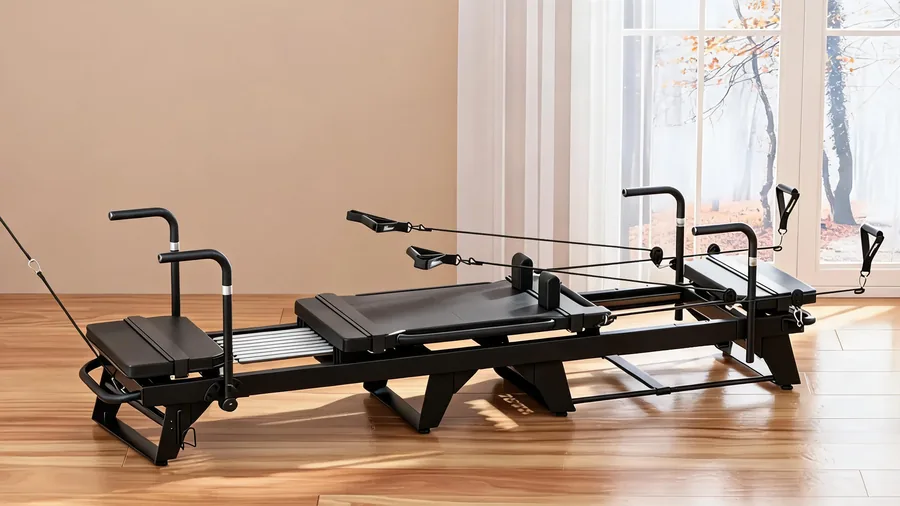
“What reformer does Club Pilates use?” is one of the most searched questions in the industry, usually asked by someone who took a class, liked the machine, and wants one for their own studio. The answer is less satisfying than the question deserves, and understanding why is genuinely useful if you are equipping a class-based studio.
Short answer: Club Pilates uses a proprietary, franchise-branded reformer, not a model sold to the public. You cannot walk into a retailer and buy the exact machine you used in class. What you can do is understand what that machine is designed for, and buy accordingly.
1. Why You Cannot Buy the Club Pilates Reformer
Club Pilates is a franchise, and franchises standardise. Their reformer is made and branded for the network, so every studio in the system runs the same equipment. That consistency is the point: same class, same feel, same training, wherever a member goes.
The manufacturer behind the machine has changed over the years and is not something the franchise publicises, so any specific “it’s made by brand X” claim you read online should be treated with suspicion. What is reliable is this: the machine is proprietary, produced for the franchise at volume, and not sold as a retail reformer.
For a studio owner, that is the useful takeaway. The machine is not magic. It is a commercial reformer specified for high-volume group classes, and that is something you can buy.
2. What Makes a Franchise Reformer Different
A machine built for a franchise group class has a specific job, and its design follows that job.
| Design priority | Why the franchise cares |
|---|---|
| Consistency across sites | Every location must feel identical |
| Fast class turnover | Quick setup between sessions, minimal adjustment |
| Durability at volume | Many clients a day, every day |
| Standardised parts | One spare-parts catalogue for the whole network |
| Simple operation | Group classes, not one-to-one precision work |
Notice what is not on the list: maximum adjustability, individual client fit, or rehab versatility. A franchise group machine is optimised for repetition and throughput of a standard class. That is a different design goal from a studio that runs private, rehab and mixed-level sessions.
3. What Studio Owners Can Learn From It
The Club Pilates model is instructive even if you never buy the machine.
Consistency sells. A member who moves cities and gets the same class is a retained member across the brand. For an independent studio, running identical machines across sites or rooms delivers the same benefit.
Turnover is revenue. Equipment that allows fast transitions between classes raises the number of sessions a room can host. Quick-adjust features matter commercially, not just for comfort.
Standardised parts keep you running. One parts catalogue across many machines means faster repairs and less downtime. This is a buying criterion, not an afterthought.
Simplicity scales. A machine with fewer setup variables is easier to train staff on and harder to get wrong. That is a trade-off against adjustability, and it is worth being deliberate about.
4. If You Want That “Class Machine” Feel
If what you liked was the group-class experience, you can get it without the franchise. What you are really looking for is a commercial reformer built for volume, with:
- A heavy, rigid frame that stays stable in fast group work
- A smooth, durable carriage that holds up to many users a day
- Standardised, quickly replaceable springs
- Replaceable upholstery panels
- A parts catalogue and warranty suited to daily use
- A spec you can repeat across every machine in the room
That combination is available from factory-direct commercial manufacturers, at a lower price than a premium branded machine, because you are not paying for a franchise system. Our commercial reformer buying guide and the studio reformer guide cover the spec in detail.
5. Independent Studio vs Franchise: Equipment Choices
Franchise and independent studios face different constraints, and the equipment decision differs.
A franchise has to buy the approved machine, because the whole value proposition is standardisation. There is little equipment decision to make.
An independent studio can buy the best machine for its own class mix and its own finances. That means it can often get a stronger machine for the money, or more machines for the same money, because it is not funding the franchise system. The trade-off is that you make more decisions and carry more of the sourcing and support work yourself.
For a class-based studio, the practical questions are how many machines you need and what class types you run. Our guide to how many reformers a studio needs and the group class guide cover the planning.
6. Choosing a Reformer for a Class-Based Studio
If you are buying for group reformer classes, weight your decision toward throughput and durability.
Prioritise a machine built for daily multi-client use, with fast spring changes and replaceable wear parts. A consistent spec across all machines matters more in a group setting than in a private studio, because clients rotate between machines. And buy for the class volume you plan to run, not the volume you have today, because equipment is expensive to upgrade twice.
If you are opening a studio and want to model it on the class-based format, the studio startup guide is a good next read. And if you want to compare a specific machine to what a franchise uses, talk to our team about what a commercial class-ready reformer spec actually includes.
Întrebări frecvente
What reformer does Club Pilates use?
Club Pilates uses a proprietary, franchise-branded reformer made for the network, not a model sold at retail. The specific manufacturer has changed over time and is not publicised. It is built for high-volume group classes with a consistent feel across locations.
What brand of reformer is used at Club Pilates?
It is a custom-branded machine produced for the franchise rather than a standard retail model from a named brand. Beware of confident claims naming a specific manufacturer, because that detail is not reliably published.
Can I buy the same reformer Club Pilates uses?
No. The machine is proprietary to the franchise and not sold to the public. You can, however, buy a commercial reformer built to similar standards for daily group use from a manufacturer.
Why do Club Pilates reformers look different?
They are designed around the franchise’s standard class format: fast transitions, consistent setup and durability at volume. That design brief produces a different machine from a studio reformer optimised for adjustability and rehab work.
Are Club Pilates reformers good quality?
They are built for commercial group use, which is a reasonable standard. Whether one machine is “better” than another depends on its components and build, which is why buyers should judge any reformer on specs rather than on a franchise association.
What reformer should an independent studio buy instead?
A commercial reformer built for daily multi-client use, with a rigid frame, smooth durable carriage, standardised replaceable springs, replaceable upholstery and a parts catalogue. That covers the group-class format without the franchise premium.
Is it less expensive to open an independent studio than a franchise?
Usually, especially on equipment, because an independent studio is not paying franchise fees or buying a mandated machine. It carries more of the setup and sourcing work itself, which is the trade-off.
How many reformers does a class-based studio need?
Enough to fill a class at the size you want to run, based on your revenue plan and room size. Group studios typically need more machines than a private studio. Plan for the class size you intend to grow into.