
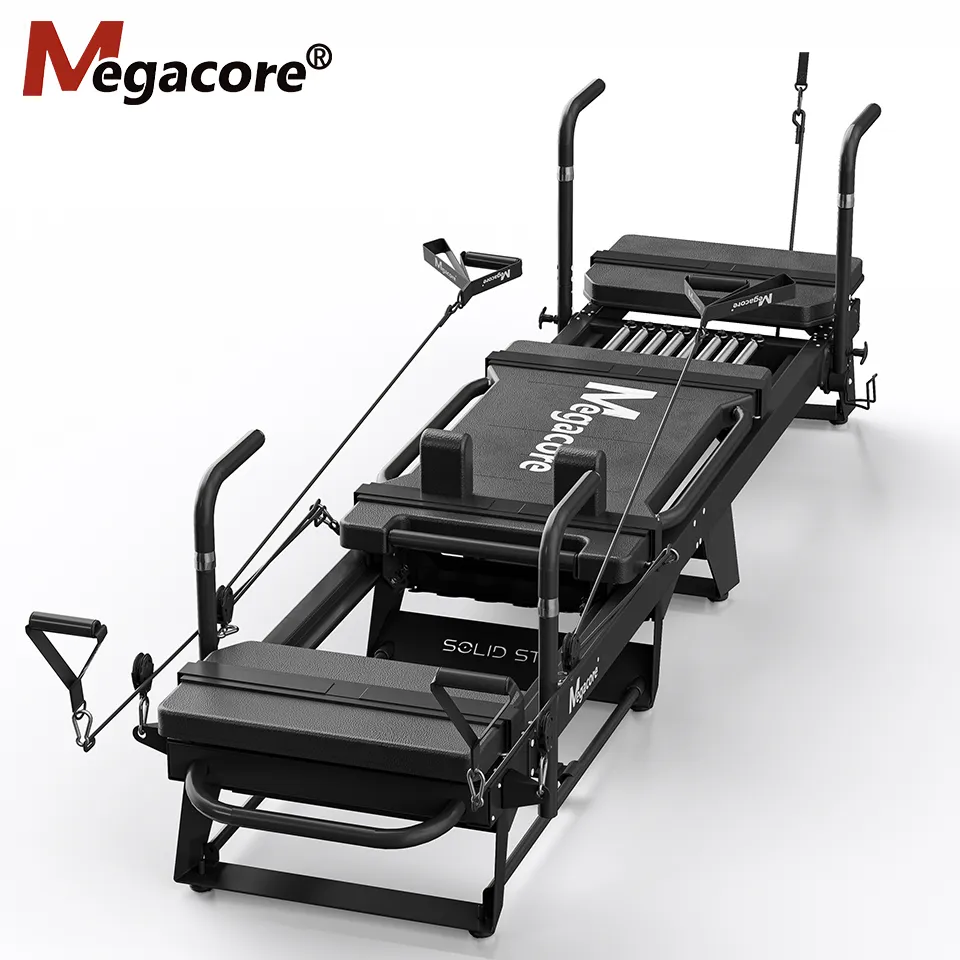
Guangzhou has emerged as one of the world’s leading manufacturing hubs for commercial Pilates equipment. The city’s industrial districts — particularly Panyu, Huadu, and Zengcheng — house dozens of factories producing reformers for brands and distributors across North America, Europe, Southeast Asia, and Australia.
This factory tour takes you inside a typical Guangzhou reformer production facility, following the manufacturing process from raw steel to finished product. Understanding how reformers are built helps studio owners evaluate supplier quality and make informed purchasing decisions.
Raw Material Reception and Inspection
The production process begins with incoming raw materials. Steel tubes arrive from domestic mills (typically Q235B or Q345B structural steel grades) with mill certificates documenting chemical composition and mechanical properties. Each batch is inspected for wall thickness consistency (target: 2.5 mm ±0.15 mm), surface finish, and straightness.
Spring wire — high-carbon alloy steel (65Mn or 60Si2Mn grades) — arrives in coils and is tested for tensile strength (target: 1,600–1,800 MPa), ductility, and surface quality. Foam blocks are checked for density (weighed and measured) and compression set (compressed to 50% for 22 hours, then measured for permanent deformation).
Steel Quality Inspection Procedures
Spring Wire Material Standards
Quality inspection begins before any manufacturing step. Materials that fail incoming inspection are rejected and returned to the supplier. This gate-check prevents substandard components from entering production — a key difference between quality-focused factories and low-cost operations.
Steel Frame Fabrication
Frame fabrication starts with tube cutting, performed on CNC tube-cutting machines with ±0.5 mm accuracy. Cut tubes are deburred and fed to the bending station. Commercial reformer frames require precision bends — particularly for the footbar support brackets and carriage rail mounts.
Welding is the most critical step in frame fabrication. Guangzhou factories use MIG (metal inert gas) welding with robotic arms for consistent penetration. Weld parameters are monitored: current (180–220 A), voltage (22–26 V), and travel speed (30–45 cm/min). After welding, each joint undergoes visual inspection and magnetic particle inspection (MPI) to detect surface cracks, porosity, and incomplete penetration.
Welding Techniques for Commercial Reformers
Frame Alignment and Quality Assurance
The frame then moves to the straightening jig, where any welding-induced distortion is corrected. A tolerance of ±1.5 mm across the frame length is standard. Frames that cannot be straightened to spec are scrapped — not sold as ‘seconds’ in quality-focused factories.
Surface Treatment and Painting
Surface preparation begins with shot blasting — steel shot is propelled at the frame to remove mill scale, rust, and surface contaminants. This step is essential for paint adhesion. Without proper shot blasting, paint peels within months.
After blasting, the frame receives a zinc-rich primer (40–60 microns dry film thickness) for corrosion resistance, followed by a powder top coat (60–80 microns). The powder coating is cured at 180–200°C for 10–15 minutes in a convection oven. Cured coating hardness is tested with a pencil hardness test (minimum 2H) and adhesion with a cross-hatch tape test.
Powder Coating vs Paint Finishes
Anti-Corrosion Treatment Processes
Colour matching is verified against the reference standard using a spectrophotometer. The allowable Delta E (colour difference) is ≤1.5 — imperceptible to the human eye.
Carriage and Bearing Assembly
The carriage platform — typically 15 mm bamboo or 18 mm marine-grade plywood with high-pressure laminate — is cut to size on a CNC router. Foam padding is bonded using solvent-free adhesive and covered with upholstery vinyl. The vinyl is stretched taut and stapled on the underside with pneumatic staplers — no wrinkles, no loose spots.
Bearing installation is performed in a clean area. Sealed roller bearings are pressed onto carriage mounting brackets with a manual press. Bearing rotation is tested individually — each bearing must spin freely without binding. Four to eight bearings per carriage are standard for commercial reformers.
Carriage Frame Construction
Bearing System Load Ratings
Maintenance Requirements for Bearings
The assembled carriage is fitted to the frame rails and glide-tested. A force gauge measures the pull required to move the carriage at a steady speed (target: 8–15 N). Inconsistent glide force indicates bearing alignment issues that must be corrected before the reformer proceeds.
Spring Manufacturing and Testing
Springs are coil-wound on automatic CNC spring coilers. Wire diameter, coil count, and free length are set per the spring specification card. After coiling, springs undergo shot peening — a process that bombards the spring surface with small steel shot to induce compressive residual stress, increasing fatigue life by 3–5 times.
Each spring is load-tested on a digital force gauge. The spring is compressed to a defined working length, and the force reading is recorded. Springs outside the ±5% tolerance band are rejected. Test data is logged with a batch number traceable to the raw material coil.
A random sample from each production batch (typically 5%) undergoes fatigue testing — 100,000 cycles of compression and release. Springs that survive without breakage or significant load loss pass the batch qualification. Quality inspection certificate GZHL2601000020601SP documents batch-level fatigue test results.
Final Assembly and Quality Control
Final assembly brings together the frame, carriage, spring set, ropes, pulleys, footbar, and shoulder rests. Each reformer is assembled by a single technician who signs a build card. The build card travels with the reformer through the final QC station.
Final QC includes: carriage glide test (consistent movement across full rail length), spring attachment verification (correct springs, correct colours, secure hooks), rope pulley function (smooth movement without binding), footbar adjustment (all positions engage and lock securely), noise check (no squeaks, rattles, or grinding), and cosmetic inspection (no scratches, dents, or finishing defects).
Quality Control Testing Protocols
Packaging and Shipping Preparation
Reformers that pass final QC receive a serial number and packaging. Each unit is wrapped in protective foam and packed in a corrugated cardboard box with foam inserts. A QC pass card and warranty registration card are included.
Summary
Guangzhou reformer manufacturing follows a structured production process with quality gates at every stage — from material inspection through welding, surface treatment, spring testing, and final assembly. Studio owners visiting factory facilities can observe these processes directly. Request to see the QC test records for your production batch, including material certificates, weld inspection reports, and spring load test data. How to Source Commercial Pilates Reforme Who Is the Best Pilates Reformer Manufac