
OEM, ODM, Private Label, White Label — What’s the Difference?
You have a Pilates brand idea. Your logo, your specifications, your product line. Working with an OEM Pilates reformers factory can turn that idea into reality. Maybe you run a studio and want to launch branded equipment. Maybe you are a fitness brand expanding into hardware. Either way, finding the right OEM Pilates reformers factory is the first and most important step. This guide walks through everything you need to know about partnering with an OEM Pilates reformers factory.
This guide walks through the entire process — differences between manufacturing models, step-by-step timeline, budgeting, IP protection, negotiation points, and the common mistakes to avoid.
Before contacting any OEM Pilates reformers factory, understand the four manufacturing models.
Understanding the Terminology
The industry uses four distinct terms. They are not interchangeable:
| Model | You Provide | Factory Provides | Minimale bestelhoeveelheid | Exclusivity |
|---|---|---|---|---|
| White Label | Your brand name & logo | Existing product, your label | 10-20 units | Nee |
| Private Label | Brand + color + minor specs | Existing platform, custom finish | 20-50 units | Negotiable |
| ODM | Concept / market requirements | Designs product from your brief | 50-100 units | Usually yes |
| Full OEM | Full specifications / drawings | Manufactures to your spec | 50-300 units | Yes (your IP) |
Most studio owners start with white label or private label, then move to full OEM as volume grows. Understanding where you fall on this spectrum helps you approach the right factories with realistic expectations.
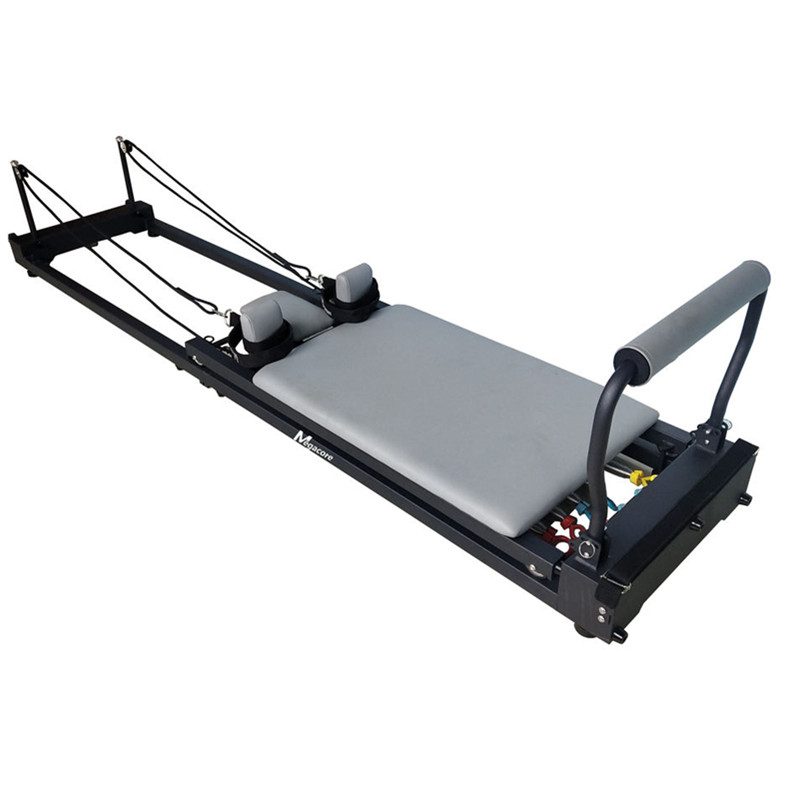
The OEM Process Step by Step
Phase 1: Requirements Briefing (Week 1-2)
Provide your requirements to the factory. Include every detail — factories work best with specific instructions, not vague concepts:
- Frame material: Steel (strongest, heavy), aluminum (light, corrosion-resistant), stainless steel (premium, expensive)
- Afmetingen: Overall length, width, carriage length, platform height
- Spring configuration: Number of springs, tension per spring in kg or lbs, color coding
- Color scheme: Frame powder coat (provide a RAL code), upholstery color and material type
- Branding: Logo placement — frame, carriage, headrest. Engraving, decal, or embossed upholstery
- Accessories: Box, jump board, leg straps, sitting box, pole — which to include
- Verpakking: Box design, foam layout, branding on packaging
- Target price: Be upfront so the factory can propose appropriate material grades
Phase 2: Sample Development (Week 2-6)
The factory produces 1-3 prototypes based on your brief. This takes 15-30 days. Expect 1-2 revision rounds — the first sample rarely matches perfectly on color, fit, or finish.
- First sample: Verify dimensions, frame alignment, spring tension, carriage glide
- Revision (if needed): Adjust color match, logo placement, fit and finish
- Final approval: Sign off in writing before production begins
Phase 3: Pre-Production Agreement (Week 4-5)
Before production starts, both parties agree on:
- QC standards and inspection protocol
- Payment terms (typically 30% deposit, 70% before shipment)
- Production timeline with milestone dates
- Shipping terms (Incoterm — see our shipping guide for details)
- Warranty terms (Megacore standard: 3 years frame, 1 year springs and upholstery)
Phase 4: Production (Week 5-10)
- Request progress photos at 50% and 100% completion
- Some factories offer video calls during production
- Third-party inspection (SGS, Bureau Veritas, TÜV) can be arranged at your cost
- Megacore provides pre-shipment inspection photos as standard — no extra charge
Phase 5: Shipping (Week 10-12)
After production and inspection, the order ships per your agreed Incoterm. Total timeline from initial briefing to delivery: approximately 8-12 weeks for a first order. Repeat orders are faster since samples and tooling are already done.
Budgeting Guide
Frame Material Cost Impact
Frame material is the biggest cost driver in an OEM project. Here’s how the three options compare:
- Steel: Baseline price. Heavy (80-120 kg), strong, cost-effective. Best for full-size commercial reformers.
- Aluminum: +$200-400 per unit vs steel. Lighter (40-70 kg), corrosion-resistant, premium feel. Best for foldable or portable models.
- Stainless steel: +$500-800 per unit. Luxury grade for high-end brands or medical-rehab markets.
Other Cost Factors
- Custom powder coating: +$20-50 per unit for non-standard RAL colors
- Custom upholstery: +$15-40 per unit (premium leatherette, custom stitching, logo embossing)
- Custom packaging: +$10-30 per unit (full-color print, foam inserts, retail-ready boxes)
- Sample development fee: $300-1,500 (often refundable with production order)
- Mold / tooling: $2,000-10,000 for custom frame components — only applies to full OEM projects with unique frame designs
MOQ varies by factory. When evaluating an OEM Pilates reformers factory, ask about their MOQ structure.
Minimum Order Quantities
- White label: 10 units. Lowest entry point.
- Private label (color + branding change): 20-30 units.
- ODM (custom design from concept): 50-100 units.
- Full OEM (your drawings, your specs): 50-300 units.
Megacore offers flexible MOQ starting from 10 units for white label — below the industry average of 50-100 units. This makes it viable for boutique studios testing their own branded equipment.
Intellectual Property Protection
For international trademark registration, refer to the World Intellectual Property Organization (WIPO).
A valid concern when manufacturing overseas. Here is how to protect your brand:
- Register your trademark in China and your home market. China is a first-to-file system — if you do not register first, someone else can.
- Sign an NDA or confidentiality agreement before sharing technical drawings with the factory.
- Choose a factory with a proven track record. Factories in business 10+ years with international clients are less likely to misuse your IP.
- Patent unique designs in China if you have novel features. This costs $5,000-15,000 through a Chinese patent attorney but is enforceable.
- Control your supply chain. Have the factory buy custom components from your designated supplier rather than sourcing generically.
Negotiation Tips
- Get pricing for multiple MOQ levels. Per-unit price at 100 units is often 15-25% lower than at 30 units.
- Ask about volume breaks — step-down pricing at 50, 100, 200, 500 units is standard.
- Separate tooling cost from unit cost. Tooling is one-time — negotiate it separately so you can compare unit prices apples-to-apples.
- Request client references. A legitimate factory will provide 2-3 existing OEM client contacts.
- Visit the factory if possible. Nothing replaces seeing the production line in person. Video calls are the second best option.
Common Mistakes to Avoid
- Not visiting the factory. Photos hide a lot. Even a video call beats nothing.
- Choosing the lowest price. The cheapest factory cuts corners on materials and QC. You pay for it in defective units.
- Not clarifying Incoterm. Miscommunication about shipping leads to unexpected costs and delays at the destination.
- Skipping pre-shipment inspection. $300-500 for a third-party inspection is cheap insurance against receiving a container of defective goods.
- Not budgeting for duties and taxes. These add 10-30% to total cost depending on destination country.
- Expecting perfection on the first sample. Colors and fit always benefit from at least one revision cycle.
- Not discussing warranty terms upfront. Who covers shipping for replacement parts? What is the response time for defect claims?
Check the WTO tariff database for the latest import duty rates on exercise equipment (HS 9506.91).
Megacore is an experienced OEM Pilates reformers factory with clients across North America, Europe, and the Middle East.
Why Megacore for OEM
Megacore has manufactured Pilates reformers for brands across North America, Europe, and the Middle East. With 24 years in metal fabrication, we offer:
- Custom frame materials: steel, aluminum, stainless steel
- Custom colors and RAL-matched powder coating
- Custom logo placement — engraved plates, decals, or embossed upholstery
- Custom packaging with your branding
- Samples available before committing to full production
- 3-year warranty on OEM products
- Quality certificate GZHL2601000020601SP
- MOQ starting at 10 units for white label projects
Ready to discuss your OEM project? Contact Megacore with your requirements for a custom quote.