
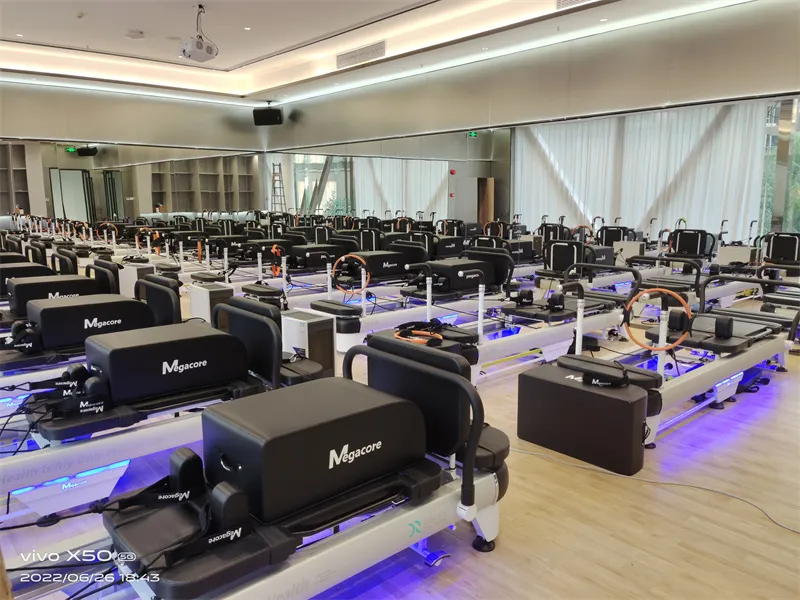
Space Challenges in Urban Pilates Studios
Real estate costs in prime urban locations present a significant challenge for Pilates studio owners. Premium commercial space in major metropolitan areas can cost $50-$150 per square foot annually, making every square foot of studio space a revenue-generating asset. For studio owners planning new locations or expanding existing ones, the choice between traditional floor-standing reformers and space-saving alternatives directly impacts both initial investment and ongoing operational costs.
Traditional floor-standing reformers require approximately 24-30 square feet per machine when accounting for the equipment footprint and necessary access space. A studio planning to operate 10 reformers needs 240-300 square feet of equipment floor space before considering instructor areas, client walkways, and storage. In high-rent districts, this square footage represents a significant recurring cost that must be justified by class revenue.
Wall-Mounted Reformer Systems: Design and Benefits
Wall-mounted Pilates reformers attach directly to reinforced wall framing, eliminating the floor-standing frame found in traditional reformers. The carriage, rails, and spring system are mounted on a vertical chassis that bolts to structural wall studs. When not in use, the carriage can be secured in a stored position, and the footbar folds flat against the wall. This design reduces the floor footprint by approximately 40% compared to equivalent floor-standing reformers.
Commercial wall-mounted reformers require specific wall construction to support the dynamic loads generated during use. Standard installation requires 2×6 or heavier wall studs at 16-inch centers, with additional blocking between studs at the mounting points. The mounting hardware must be rated for shear loads of at least 500 lbs, as the momentum of the carriage at full extension creates significant force vectors at the attachment points. Professional installation by a licensed contractor is mandatory for commercial insurance compliance.
For studios in leased spaces, wall-mounted systems offer the advantage of being removable at lease end without permanent damage to the space. The mounting plates can be patched and painted when the equipment is relocated, making wall-mounted reformers a flexible option for growing studios that may move to larger spaces as their client base expands.
Reformer Stand Systems: Portable and Flexible
Reformer stands offer an alternative approach to space optimization. These are purpose-built frames that elevate the reformer carriage and rail system to a standard working height while providing a significantly smaller footprint than full floor frames. Stand-mounted reformers typically occupy 12-16 square feet, compared to 20-25 square feet for a full floor-standing unit.
The primary advantage of stand systems is portability. A stand-mounted reformer can be moved on locking casters, allowing studio operators to reconfigure class spaces between sessions. A studio might arrange reformers in a traditional layout for morning classical classes, then reconfigure into a circle formation for afternoon group sessions. This flexibility enables studios to offer multiple class formats without dedicating separate rooms to each equipment configuration.
Reformer stands also facilitate hybrid studio layouts where reformers share space with other equipment types. A 500-square-foot studio might accommodate 6 stand-mounted reformers alongside mat space, a Cadillac, and a Wunda Chair, using the stackable storage capabilities of the stands to clear floor space when reformers are not in use.
Structural Considerations for Non-Floor-Standing Reformers
Both wall-mounted and stand-mounted reformers impose different structural requirements than floor-standing units. Floor-standing reformers distribute their weight (typically 200-400 lbs for commercial models) across four feet, creating point loads at each contact point. Wall-mounted units transfer dynamic loads into the wall structure, which must be engineered to handle these forces without transferring vibration through the building frame.
Multi-story buildings require particular attention when installing wall-mounted reformers on upper floors. The dynamic loading from reformer use can transmit through the building structure and create noise or vibration in units below or adjacent. Installing vibration-dampening mounting plates and consulting with a structural engineer before installation helps prevent issues with building management or neighboring tenants.
Stand-mounted reformers with casters should include locking mechanisms that engage when the equipment is in use. Unlocked casters allow the reformer to shift during exercise, creating both safety hazards and inconsistent resistance profiles. Commercial-grade locking casters with floor brakes provide the stability needed for safe operation while maintaining portability.
Space Planning Strategies for Small Studios
Studios operating in under 800 square feet require deliberate space planning to maximize equipment density without compromising client experience. A hybrid approach combining 4-6 wall-mounted reformers with 2-3 stand-mounted units can provide 6-9 reformer stations in approximately 200 square feet of equipment zone, compared to 4-5 floor-standing reformers in the same area.
Vertical storage solutions further optimize space usage. Spring sets, jump boards, and platform extenders can be stored on wall racks above or beside the reformers, keeping accessories accessible without floor storage. Adjustable shelving systems designed for reformer studios can store foam rollers, exercise bands, and small props within arm’s reach of each reformer station.
Ceiling-mounted hanging systems for straps and cables offer another space optimization opportunity. By suspending resistance elements from the ceiling rather than floor-level attachments, studios can clear floor space while maintaining exercise variety. These systems require structural ceiling reinforcement but can add significant exercise options without expanding the equipment footprint.
Installation and Maintenance Considerations
Wall-mounted and stand-mounted reformers require different maintenance schedules than floor-standing units. The mounting hardware should be inspected quarterly for signs of loosening, corrosion, or structural fatigue. All bolts should be torqued to manufacturer specifications using a calibrated torque wrench, as undertightened bolts can loosen under dynamic loading and overtightened bolts can create stress risers in the mounting points.
Factory-direct manufacturers typically include installation specifications with their wall-mounted and stand-mounted reformers. These specifications include mounting template dimensions, bolt grade requirements, and torque specifications. Compliance with these specifications is typically required for warranty coverage on the equipment. The quality testing certification GZHL2601000020601SP applies to all reformer models, including wall-mounted and stand-mounted configurations.
The 3-year warranty on factory-direct commercial reformers covers frame and structural components, including the mounting brackets for wall-mounted units. However, the warranty explicitly excludes damage resulting from improper installation or inadequate wall structure. This makes professional installation particularly important for wall-mounted configurations.
Conclusion: Choosing the Right Configuration
The decision between wall-mounted, stand-mounted, and floor-standing reformers depends on the specific constraints of each studio space. Wall-mounted systems offer maximum space efficiency for permanent installations in studios with appropriate wall construction. Stand-mounted reformers provide flexibility for multi-purpose spaces and studios that may relocate. Floor-standing reformers remain the standard for high-volume commercial studios where maximum stability and durability are prioritized. Factory-direct manufacturers offer all three configurations with consistent quality standards verified through GZHL2601000020601SP certification, enabling studio owners to choose the optimal solution for their specific space requirements. Preparing Your Space for a Pilates Refor Pilates Reformer Dimensions & Space The Best Pilates Reformers for Commercia