
Pilates reformer dimensions: The Layout Mistake That Cost a Studio $8,000 in Lost Capacity

A boutique studio in Barcelona signed a lease on a beautiful 90m² (970 sq ft) space with high ceilings and natural light. They installed 12 reformers in neat rows. On opening day, they discovered that the side reformers were too close to the walls — clients could not safely mount or dismount. They removed 2 reformers and rearranged the rest, but the new layout only fit 9. The lost capacity meant $7,800 in monthly revenue they could have earned.
This is not an unusual story. Studio layout mistakes are the most common — and most expensive — error new owners make. A reformer that cannot be reached by a client is not an asset; it is a liability that cost $2,000+ and takes up 25 sq ft.
This article covers not just the dimensions of the machine itself, but the full spatial requirements: clearance for the instructor to walk around, space for clients to transition between exercises, and the laws of movement that determine whether your studio layout works on a busy Tuesday morning.
Reformer Dimensions: The Numbers You Actually Need
Manufacturer specs vary, but commercial reformers fall within these ranges:
| Measurement | Standard Commercial | Compact Commercial | Home-Use |
|---|---|---|---|
| Length (frame) | 96–110 in (244–280 cm) | 84–92 in (213–234 cm) | 72–88 in (183–224 cm) |
| Width (frame) | 24–28 in (61–71 cm) | 22–24 in (56–61 cm) | 18–23 in (46–58 cm) |
| Height (floor to carriage) | 16–22 in (41–56 cm) | 16–20 in (41–51 cm) | 10–16 in (25–41 cm) |
| น้ำหนัก | 120–180 lbs (55–82 kg) | 100–140 lbs (45–64 kg) | 50–90 lbs (23–41 kg) |
| Carriage travel length | 42–52 in (107–132 cm) | 36–42 in (91–107 cm) | 30–38 in (76–97 cm) |
The most important number is not the frame length — it is the total spatial envelope, including the client lying on the carriage with arms extended overhead. An average client with arms up adds 6–10 inches (15–25 cm) to the space requirement beyond the frame.
Minimum Space Per Reformer: The Clearance Rules
Three clearance zones determine whether a reformer is usable:
Zone 1: Side clearance (critical). A client must be able to step onto the reformer from either side. Minimum 36 inches (91 cm) of open floor space on the instructor side. Minimum 18 inches (46 cm) on the wall side. Less than that, and the reformer cannot be safely used.
Zone 2: End clearance. The footbar end needs 24 inches (61 cm) for the instructor to stand and cue. The headrest end needs 12–18 inches (30–46 cm). Reformers placed with the footbar directly facing a wall are a common layout mistake — the instructor has no room to work.
Zone 3: Overhead clearance. Minimum 96 inches (244 cm) from floor to ceiling for safe arm exercises on the long box. Low ceilings (under 90 inches) force clients to curl their spines differently, altering exercise biomechanics. Studios in converted basements or mezzanines should check ceiling height before signing the lease.
Calculating Maximum Capacity for Your Space
Here is the quick formula to determine how many reformers your room can hold:
(Room length in inches − 36) ÷ (Reformer length + 36) = machines per row
(Room width in inches − 72) ÷ (Reformer width + 54) = number of rows
The 36-inch subtraction accounts for instructor clearance at each end. The 54-inch addition between rows accounts for the side clearance on both reformers plus walking space for clients passing between machines.
Real-world example: A 300-inch × 240-inch room (25 ft × 20 ft / 500 sq ft):
• Rows: (300 − 36) ÷ (110 + 36) = 264 ÷ 146 = 1.8, so 1 row of reformers
• Per row: (240 − 72) ÷ (28 + 54) = 168 ÷ 82 = 2 machines per row
• Maximum capacity: 2 reformers in 500 sq ft
This seems low because it accounts for usable commercial space. Most studios overestimate by 30–50% on their first layout. A 1,000 ตารางฟุต room realistically fits 5–6 reformers with proper clearance, not the 8–10 that seem to fit on paper. See our how many reformers your studio needs guide for detailed calculations.
Layout Configurations: What Works and What Does Not
Parallel rows (most common for group classes). Reformers arranged in parallel rows facing the same direction. The instructor walks between rows. Optimal for 6–12 reformers. Requires minimum 120 inches (10 ft) between rows for instructor access.
Concentric/semicircle. Reformers arranged in a curve around the instructor station. Popular in boutique private-session studios. Allows the instructor to observe multiple clients without moving. Less space-efficient — a 6-reformer circle requires approximately 600 sq ft versus 400 sq ft for parallel rows.
Perpendicular (L-shaped). Reformers along two walls at 90°. Maximizes floor space in irregular rooms. Works best for private sessions. A “dead zone” forms in the corner that cannot hold a reformer. Use that corner for storage or a small desk.
Alley configuration (do not do this). Reformers facing each other with a narrow walkway between. Clients make eye contact during exercises, awkward when lying down. Instructors must squeeze between to cue. Common in budget studios trying to maximize equipment count. Sacrifices experience quality.
The Traffic Flow Problem Most Layouts Ignore
Every minute a client spends navigating to their machine is a minute of lost class time. In a 50-minute class with 10 clients, a 15-second fumble each adds up to 2.5 minutes of dead time — 5% of total class duration.
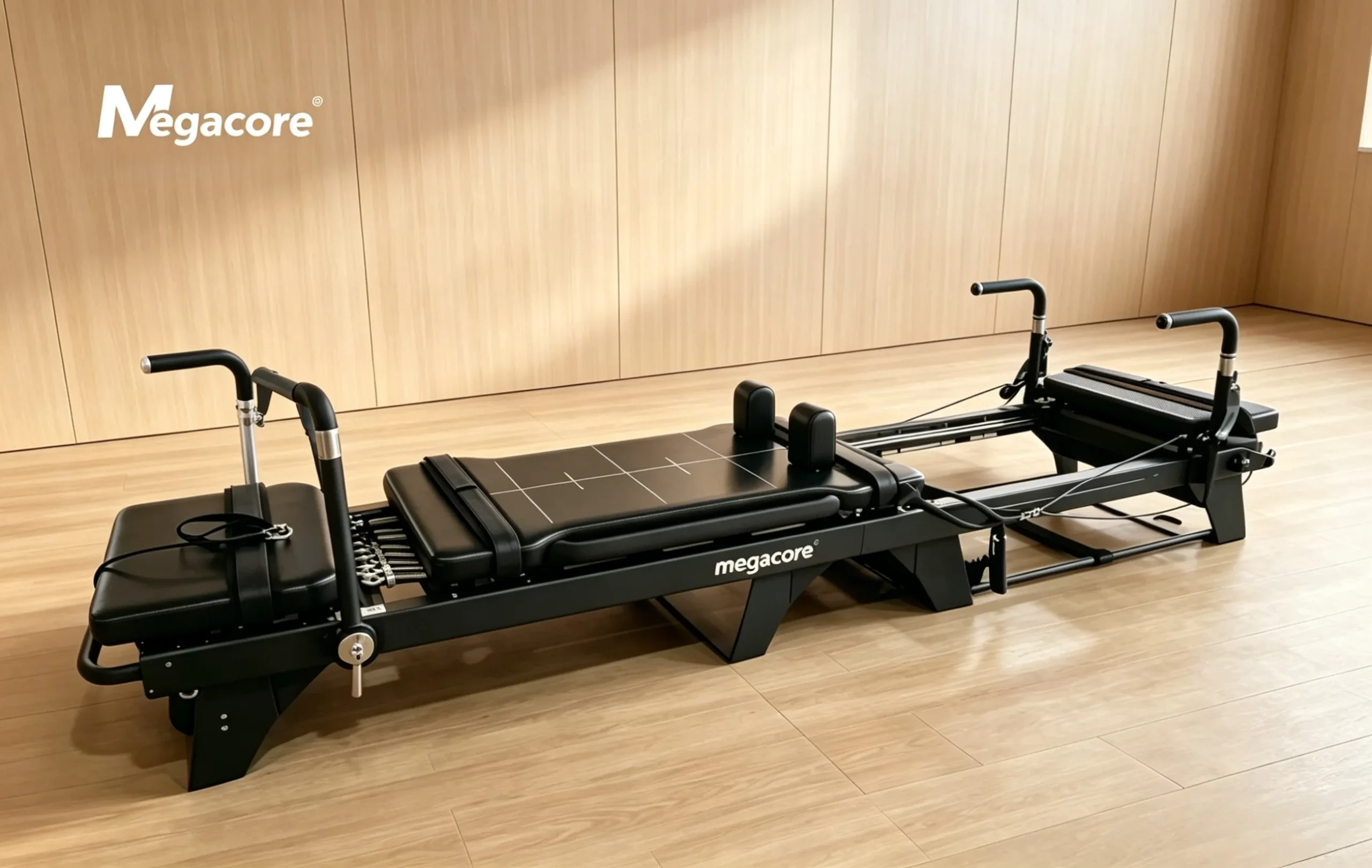
Good traffic flow means:
• A clear path from the door to every reformer without crossing another client’s path
• Room at the footbar end for the instructor to demonstrate (maximizing revenue per reformer) while everyone watches without craning their neck
• Wall space for foam rollers, pads, and equipment storage without equipment cluttering the walking path
• Reformers arranged so the instructor can see every client’s face from the front of the room
The most common violation: reformers placed too close together, forcing clients to walk behind the instructor’s teaching position to reach their machine. Rearranging the reformer positions by 12 inches (30 cm) can solve the entire traffic problem.
Ceiling Height: The Overlooked Dimension
Studio owners measure floor space obsessively and ceiling height hardly at all. Yet ceiling height directly affects which exercises can be taught:
• 120 inches (10 ft) — ideal. Full range of motion for long box, standing, and aerial work.
• 108–120 inches (9–10 ft) — good. Long box exercises may need modification for tall clients.
• 96–108 inches (8–9 ft) — functional. Standing Pilates may be limited. Most tall clients can still use the reformer safely.
• Below 96 inches (8 ft) — problematic. Reformer work is possible but springboard and wall units are not.
For basement studios or converted spaces: measure from the finished floor to the lowest overhead obstruction (ductwork, lights, sprinkler heads), not to the roof deck. A light fixture hanging 84 inches from the floor makes the entire room unsuitable for safe reformer use regardless of ceiling construction.
Flooring Considerations
Commercial reformers weigh 120–180 lbs and generate lateral force during exercises. The floor must handle both the static load and the dynamic stress. Key requirements:
• Load capacity: minimum 100 lbs per sq ft (the reformer is 180 lbs concentrated on 4–6 contact points of about 4 sq in each)
• Surface: firm. Carpet is acceptable if low-pile and dense. Thick berber or plush carpet causes the reformer to rock during carriage movement. Carpet is unacceptable under the reformer itself — install a hard surface panel (¼” plywood or vinyl) under each machine.
• Noise absorption: use quality rubber or vinyl flooring between reformers. The 3–4mm Eva foam tiles that cheap yoga studios use will not absorb carriage noise. Install 6–8mm commercial rubber flooring for a professional sound environment.
• Subfloor: ground-level concrete is ideal. Wood-frame upper floors transmit reformer stepping and jumping noise to the floor below. Install a floating floor with acoustic underlayment for multi-story spaces.
Small Space Solutions: Making Reformers Fit Where They Should Not
Not every studio has 1,500 sq ft. Here are strategies for tight spaces:
Wall-mounted reformers. The reformer is mounted to a wall rail system and folds up when not in use. Each unit takes only 12 inches of depth when stored. Wall-mounted reformers are becoming popular in multi-purpose spaces (rental studios, hotel fitness centers, physical therapy clinics).
Space-efficient reformers. Compact commercial reformers (the Megacore C26 model, for example) offer full commercial construction in 84-inch length. The shorter footbar-to-headrest distance is acceptable for clients under 6’2” (188 cm). Taller clients may need the full-length version.
Dual-purpose reformers. Some reformers convert to a flat platform for mat work, eliminating the need for separate space allocation. A 12-reformer studio that converts 4 reformers to platforms during mat classes gains the equivalent of 4 mat stations without additional floor space.
คำถามที่พบบ่อย
How much space do I need for a home Pilates reformer?
Minimum 7 ft × 5 ft (35 sq ft). Add 2 ft on the sides and 3 ft at the footbar end for safe use. A spare bedroom or converted garage typically has enough space.
What is the optimal ceiling height for a Pilates studio?
9 feet (108 inches) is the minimum. 10 feet is ideal. Studios with clients over 6 feet tall or teaching springboard work should check for 10+ foot ceilings. See our complete dimensions guide เพื่อทราบรายละเอียดเพิ่มเติม.
Can I put a reformer on an upper floor of a building?
Yes, with proper flooring. Install a floating floor with acoustic underlayment rated for gym use. The floor load rating should be at least 80 lbs per sq ft for standard residential construction.
How much clearance do I need between reformers in a class?
Minimum 48 inches (122 cm) from reformer edge to reformer edge for group classes. Private session studios can use 36 inches between machines.
What is the smallest room that can fit a reformer?
10 ft × 8 ft (80 sq ft) for a single reformer with safe clearance. Anything smaller means the instructor cannot access the client from both sides, which limits exercise options and safety.
พร้อมที่จะสั่งซื้อเครื่องพิลาทิส รีฟอร์มเมอร์แล้วหรือยัง?
ติดต่อทีมงานของเราเพื่อรับราคาจากโรงงานโดยตรง ตัวอย่างสินค้า และบริการตามความต้องการของคุณ ให้คำปรึกษาฟรี — ไม่มีข้อผูกมัดใดๆ.
ได้รับการรับรองตามมาตรฐาน ISO 9001 และ CE • มีประสบการณ์การส่งออกมากกว่า 20 ปี • ปริมาณสั่งซื้อขั้นต่ำ (MOQ) เริ่มต้นจาก 1 หน่วย
อีเมล: [email protected] • WhatsApp: +86 189 0238 9454