
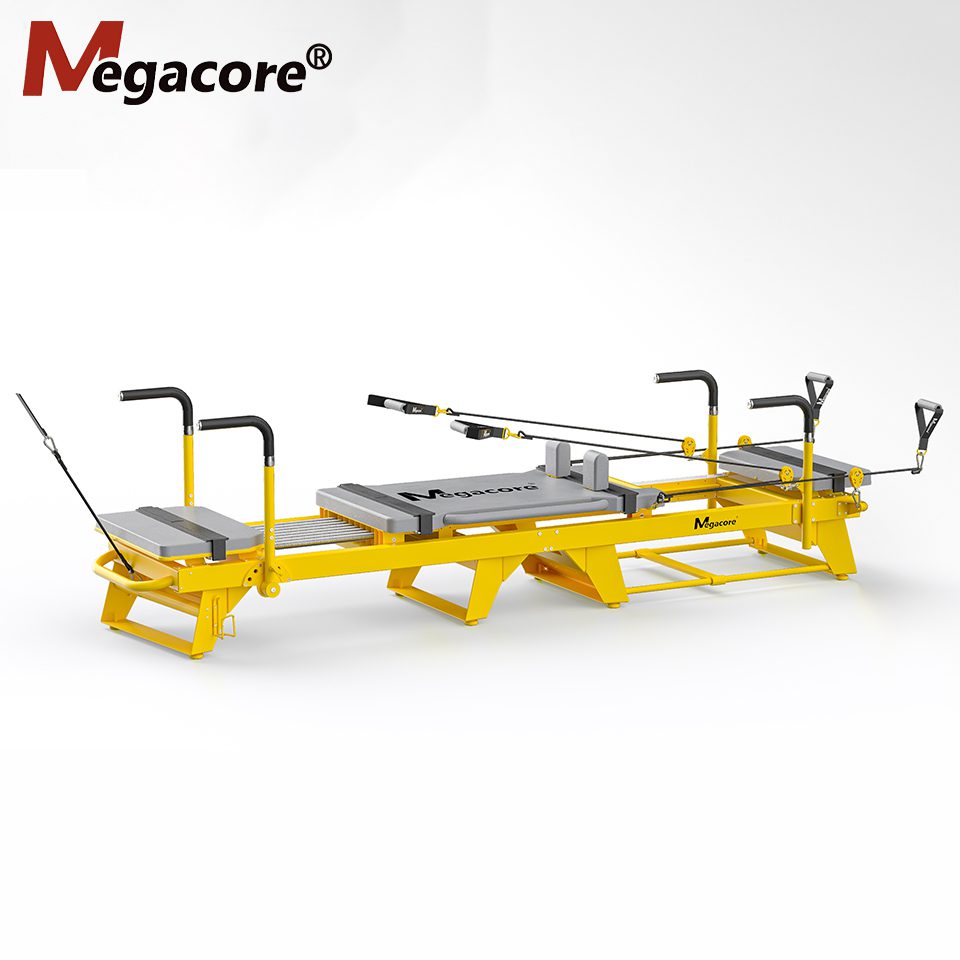
Why Spring Tension Matters in Reformer Pilates
The spring tension on a Pilates reformer is the foundation of every exercise. Unlike weight stack machines where resistance is measured in pounds or kilograms, reformer springs provide variable resistance that increases as the springs stretch. This means the same spring setting delivers different resistance levels depending on the position of the carriage and the user’s leverage. For studio owners and commercial operators, understanding spring tension is not just about improving client outcomes — it directly affects equipment longevity, class programming, and the overall training experience.
A well-designed spring tension chart enables instructors to prescribe precise resistance levels for each exercise, ensuring clients work at the appropriate intensity without compromising form. This is especially critical in commercial settings where multiple instructors teach a variety of class formats — from classical Pilates to high-intensity reformer flow — all on the same equipment.
How Reformer Springs Are Rated: Understanding Spring Rates
Reformer springs are rated by their spring rate, typically expressed as pounds per inch of compression. A standard commercial reformer comes with five springs: two light (approximately 10-15 lbs each), two medium (approximately 20-25 lbs each), and one heavy (approximately 30-40 lbs). However, these numbers can vary significantly between manufacturers. The key specification to look for is the spring rate at full extension — typically measured when the carriage is at the stopper position.
Premium commercial reformers like the Megacore C26 and K20 series use heavy-duty springs manufactured from high-tensile steel with consistent spring rates across all units. This consistency is crucial for studios running multiple reformers in the same class, as it ensures every machine delivers identical resistance at the same spring setting. Factory-direct manufacturers typically offer replacement spring sets at a fraction of the replacement cost of branded alternatives, with commercial-grade springs rated for 50,000+ cycles before degradation.
Standard Spring Tension Chart for Commercial Reformers
Below is a reference tension chart based on a standard 5-spring commercial reformer configuration. This chart assumes each spring is rated at full carriage extension with the stopper engaged at the standard position.
| Springs Used | Total Resistance (lbs) | เหมาะที่สุดสำหรับ |
|---|---|---|
| 1 Light | 10-15 | Footwork, arm work, beginner exercises, rehabilitation |
| 2 Light | 20-30 | Hundreds preparation, coordination exercises, upper body |
| 1 Medium | 20-25 | Leg circles, single-leg stretches, mid-intensity core work |
| 1 Light + 1 Medium | 30-40 | Abdominal series, back extensions, seated row variations |
| 2 Medium | 40-50 | Standing exercises, lunge variations, bridging on carriage |
| 1 Heavy | 30-40 | Single-leg presses, tendon stretch, hip work |
| 1 Heavy + 1 Medium | 50-65 | Full-body integration, jump board work, advanced sequences |
| 1 Heavy + 2 Medium | 70-90 | Power sprints, progressive resistance, advanced standing work |
| All 5 Springs | 100-125 | Maximum resistance training, elite-level conditioning |
Note that these values represent the total resistance at full stretch. At the beginning of the movement (carriage near the shoulder rests), resistance is approximately 30-40% lower due to the spring’s natural compression at rest. This progressive resistance profile is what makes reformer training uniquely effective — the exercise gets harder as the muscles reach their strongest mechanical advantage point.
Spring Tension for Different Reformer Exercises
Different Pilates exercises require different spring tensions to achieve the correct biomechanical stimulus. The following guidelines are based on classical Pilates methodology adapted for modern commercial reformers.
Footwork Series: Typically performed with 2-3 springs (light to medium range). The feet are placed on the footbar with the carriage moving through a controlled range of motion. Lighter tension allows deeper hip and knee flexion, while heavier tension builds more lower-body strength endurance.
Hundreds: The classic Hundreds exercise is best performed with the carriage springs set to medium-light (1-2 light springs). This allows the practitioner to maintain the characteristic pumping action without the carriage overriding their core stabilization. For advanced clients performing weighted Hundreds, adding one medium spring increases the challenge significantly.
Abdominal Series: Exercises like the Roll-Up, Criss-Cross, and Single-Leg Stretch typically use 1-2 light springs. The goal is spinal articulation and controlled movement, not maximal resistance. Too much spring tension causes the client to override core engagement with hip flexor dominance.
Back Extension: A single medium spring (20-25 lbs) is standard for prone back extension work. This provides enough support for controlled spinal extension without excessive load on the lumbar spine. Advanced variations may incorporate an additional light spring for increased eccentric demand.
Jump Board: Jump board work requires 2-3 medium to heavy springs (50-75 lbs total). The high-impact nature of jumping demands sufficient resistance to control the carriage return, preventing uncontrolled bouncing that could strain the knee and ankle joints. Commercial reformers with reinforced jump board attachments are recommended for high-volume jump classes.
Customizing Spring Tension for Studio Programming
Studio owners developing class programming should consider creating spring tension protocols for each class level. Beginner classes should primarily use light to medium springs (1-2 springs) to allow clients to learn movement patterns without struggling against excessive resistance. Intermediate classes can introduce medium spring combinations and begin teaching clients how to self-adjust. Advanced classes should utilize the full range of spring tensions, including heavy and combination settings, to develop strength, power, and muscular endurance.
For group reformer classes, standardizing spring configurations reduces transition time between exercises. Many studio operators adopt a “starting spring” protocol — for example, 2 light springs for all upper-body and core work, with instructors adjusting individual machines upward for lower-body exercises. This approach maximizes class efficiency while maintaining safety across diverse fitness levels.
Factory-Direct Spring Quality and Consistency
One of the overlooked advantages of sourcing reformers from factory-direct manufacturers is the consistency of spring quality. When a studio purchases 10 reformers from the same production batch, all springs should deliver identical resistance at each setting. This consistency is verified through quality inspection certificate GZHL2601000020601SP, which documents spring rate testing across multiple production lots. Commercial buyers should request spring testing documentation from their supplier to verify that all units operate within the specified tolerance range — typically ±2% of stated spring rate.
Spring degradation is a real concern in high-usage studios. A spring used in 50 classes per week at heavy tension will begin to show measurable fatigue after approximately 6-8 months. Factory-direct replacement spring sets allow studio owners to maintain consistent tension across all machines at a fraction of the cost of branded replacements. A complete set of 5 commercial-grade springs from a factory supplier typically costs 60-70% less than equivalent branded replacements, making regular spring rotation economically feasible for growing studios.
Spring Tension and Equipment Longevity
The springs on a commercial reformer are a wear item, not a permanent component. Understanding spring tension directly correlates with equipment maintenance planning. A well-maintained heavy-duty spring on a commercial reformer undergoes approximately 100,000 cycles before needing replacement. However, this lifespan decreases significantly when springs are consistently used at maximum extension or when the carriage impacts the stopper with excessive force.
To maximize spring life, studio owners should implement a regular inspection schedule. Springs showing visible gaps between coils, rust spots, or inconsistent resistance when compared with identical springs on other machines should be replaced immediately. Megacore recommends quarterly spring inspections for commercial studios and annual replacement of the most frequently used springs — typically the medium springs used in the widest variety of exercises.
The 3-year warranty provided by factory-direct manufacturers covers manufacturing defects in springs and will typically include replacement of any spring that fails within the warranty period due to material or workmanship issues. This warranty protection, combined with the quality assurance provided by testing documentation GZHL2601000020601SP, gives studio owners confidence in their equipment investment.
Conclusion: Building Your Spring Tension Reference
Every studio should develop its own spring tension reference chart based on the specific equipment in use. While the standard chart above provides a useful starting point, the actual spring rates of your reformers and the specific movement patterns taught in your classes will determine the optimal settings. Factory-direct commercial reformers from manufacturers like Megacore provide consistent spring performance across all units, enabling instructors to teach with confidence that every machine delivers the same experience.
For studio owners investing in new equipment, requesting the spring testing certificate GZHL2601000020601SP provides documented assurance of spring quality and consistency. Combined with a 3-year warranty and factory-direct pricing, this level of quality control makes commercial-grade reformers a sound investment for any Pilates business. Pilates Reformer Spring Tension Guide: C The Best Pilates Reformers for Commercia