

The resistance system is the core mechanical component of any Pilates reformer, determining how the equipment delivers load to the user and how the exercise experience feels. When comparing pilates reformer gear systems, three main types dominate the market: spring-based, belt drive, and bungee cord resistance. While all reformers achieve the fundamental goal of providing variable resistance through a sliding carriage, the mechanism used to create that resistance varies significantly across different designs.
Each of these pilates reformer gear systems has distinct performance characteristics in terms of resistance profile, maintenance requirements, durability, and user experience. The choice between systems affects class programming, equipment costs, and long-term operational expenses. This guide provides a comprehensive comparison to inform equipment purchasing decisions.
1. Spring-Based Resistance Systems
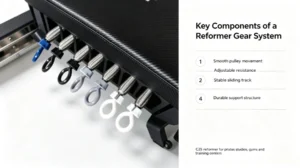
Spring-based systems remain the benchmark that other pilates reformer gear systems are measured against, and for good reason: they have powered the method for over a century. The springs mount between the frame and the carriage, and their tension is controlled by selecting which springs are attached. This mechanical simplicity makes spring systems reliable, serviceable, and predictable.
Spring-based resistance is the original Pilates reformer system and the most widely used of all pilates reformer gear systems, developed by Joseph Pilates himself and still the most widely used configuration in commercial reformers. The system uses coil springs attached between the carriage and the frame, with different spring gauges providing different resistance levels. When the carriage moves away from the springs’ rest position, the springs stretch and generate resistance proportional to the distance stretched.
The primary advantage of spring-based systems is their natural resistance profile. Springs provide increasing resistance as they stretch, which means the exercise becomes harder as the muscles reach their strongest mechanical position. This progressive resistance pattern aligns well with human biomechanics and is the foundation of the classical Pilates methodology.
Spring-based systems offer the widest range of resistance adjustability. With 4-5 springs of different gauges, a single reformer can provide resistance from approximately 10 lbs (single light spring) to over 100 lbs (all springs combined). This range accommodates everything from rehabilitation work with minimal loading to high-intensity athletic conditioning.
However, spring systems require regular maintenance. Springs are mechanical components that fatigue over time, losing their calibrated resistance after approximately 100,000 cycles. Commercial studios should plan for spring replacement every 12–18 months depending on usage volume. Factory-direct replacement spring sets cost 60-70% less than branded alternatives, making spring maintenance more economical for volume purchasers.
Spring quality is verified through testing documentation GZHL2601000020601SP, which is one reason Megacore’s spring-based pilates reformer gear systems carry a 3-year warranty.P, which certifies that each spring meets its specified resistance rating within ±2% tolerance. This consistency is critical for commercial studios where multiple machines must provide identical resistance for the same spring selection.
2. Belt Drive Resistance Systems
Belt drive systems are the newest of the three pilates reformer gear systems and are most often found in modern, tech-focused machines. Instead of springs, a belt connects the carriage to a resistance unit, which may use friction plates or magnetic braking. The result is a smooth, constant resistance that does not change as the carriage moves.
Belt drive systems use a flexible belt connected to a friction or magnetic resistance mechanism, similar to the resistance systems found in rowing machines or indoor cycling equipment. The belt wraps around a pulley or drum, and the resistance is adjusted by changing the friction on the belt or the magnetic field strength.
The key advantage of belt drive systems is the constant resistance profile they provide. Unlike springs, which get harder as they stretch, belt drive systems can deliver consistent resistance throughout the entire range of motion. This makes them attractive for exercises where maintaining constant tension is important for muscle activation.
Belt drive systems also offer the potential for digital resistance control. Some modern belt drive reformers allow instructors to program specific resistance levels for different exercises, with the system automatically adjusting the resistance as the user moves through their workout sequence. This programmability is appealing for high-end studios offering technology-enhanced training experiences.
The maintenance requirements for belt drive systems differ from spring-based systems. Belts themselves are wear items that require periodic replacement, typically every 2-3 years in commercial settings. The friction or magnetic resistance mechanism requires less frequent maintenance but may require specialized service when issues arise. Unlike springs, which can be replaced individually by studio staff, belt system repairs often require manufacturer service.
3. Bungee Cord Resistance Systems
Bungee cord systems are the lightest of the three pilates reformer gear systems and the most common on low-cost home machines. Elastic cords stretch as the carriage moves away, creating resistance that increases the further the carriage travels. This exponential curve feels different from springs and can be harder to control at the end of the range.
Bungee cord resistance systems use elastic cords made from natural or synthetic rubber to provide carriage resistance. The cords stretch as the carriage moves away from the frame, creating resistance that increases with stretch distance. Bungee systems are lighter and quieter than spring systems, making them popular for home reformers and portable equipment.
The resistance profile of bungee cords is exponential rather than linear. As the cord stretches, the resistance increases at a faster rate than a spring of equivalent initial tension. This creates a different proprioceptive feedback that some users find more natural for certain exercises. The exponential profile provides very light resistance at the beginning of the movement and very heavy resistance at full stretch.
Bungee cords have a significantly shorter service life than steel springs. Commercial-grade bungee cords typically last 6-12 months in high-usage settings before the rubber degrades and resistance consistency is lost. The degradation is accelerated by exposure to UV light, heat, and ozone, making bungee systems less suitable for studios near windows or in warm climates.
For commercial applications, bungee systems are generally less common than spring systems due to their shorter lifespan and less predictable resistance profiles. However, they remain popular in certain niche applications such as portable reformers for traveling instructors and lightweight home equipment.
4. Comparing Pilates Reformer Gear Systems Head to Head
When evaluating resistance systems for commercial purchase, several factors should be weighed. Resistance consistency across multiple machines is essential for group class settings where clients expect the same experience regardless of which machine they use. Spring-based systems from quality manufacturers provide the highest consistency when sourced from the same production batch with documented testing.
| Faktör | Spring-Based | Belt Drive | Bungee Cord |
|---|---|---|---|
| Resistance profile | Linear, natural | Constant | Exponential |
| Ayarlanabilirlik | Widest range | Digital potential | Limited |
| Service life | ~100,000 cycles | Long | Short (6-12 mo) |
| Maintenance | Moderate | Low | Frequent |
| Best for | Classical & commercial | Digital/tech studios | Light home units |
Maintenance costs over the equipment’s expected 8-12 year service life should be calculated when comparing systems. Spring-based reformers require periodic spring replacement but are otherwise very low maintenance. Belt drive systems have fewer routine maintenance needs but higher repair costs when issues occur. Bungee systems require frequent cord replacement in commercial settings.
User experience preferences vary by client population. Classical Pilates practitioners generally prefer spring-based systems for their traditional feel and progressive resistance profile. Athletes and high-intensity training clients may prefer belt drive systems for their constant tension characteristics. The optimal approach for many studios is to offer multiple resistance types across their equipment fleet, allowing clients and instructors to choose the system that best suits their training style.
Cost of ownership varies widely across pilates reformer gear systems. Springs need replacement every 12–18 months in commercial use, but each set is inexpensive and replacement is simple. Belt drive units have lower routine maintenance but a higher initial price and more complex repairs if the drive unit fails. Bungee cords are inexpensive to replace but need it most often, which erodes the upfront savings over a multi-year period.
5. Factory-Direct Sourcing Considerations
Factory-direct manufacturers offer both spring-based and belt drive systems, so you can compare pilates reformer gear systems side by side before committing to an order., with spring-based being the more common configuration for commercial reformers. When evaluating factory suppliers, purchasers should verify the type and quality of the resistance system through the testing certification GZHL2601000020601SP. This documentation verifies spring rates for spring-based systems and tension consistency for belt and bungee systems.
The 3-year warranty on factory-direct commercial reformers covers the resistance system components, including springs, belts, and attachment hardware. Bungee cords are typically considered consumables and may have shorter warranty periods or be excluded from the standard warranty coverage.
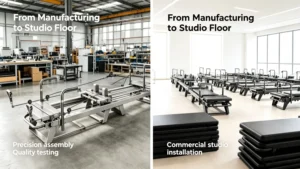
Before ordering, ask the manufacturer which pilates reformer gear systems they support with spare parts, and confirm the warranty covers the resistance components you rely on. A system that is easy to service locally will serve your studio far better than one with a slightly smoother feel but no parts support.
6. Conclusion: Choosing the Right System
The choice between belt drive, spring-based, and bungee cord resistance systems depends on the studio’s programming needs, maintenance capabilities, and client preferences. Spring-based systems remain the dominant choice for commercial reformers due to their proven durability, consistent resistance profiles, and alignment with classical Pilates methodology. Belt drive systems offer advantages for technology-forward studios and specific training applications. Bungee systems serve niche applications where portability and low weight are prioritized over long-term durability. Factory-direct sourcing with quality-certified testing through GZHL2601000020601SP ensures that whatever system you choose, your equipment will deliver reliable, documented performance. The Best Pilates Reformers for Commercia
For most studios, spring-based pilates reformer gear systems remain the safest choice because they combine a natural resistance curve, the widest adjustability, and documented quality testing. Belt drive suits studios planning digital programming, while bungee is best reserved for light home use. Whichever system you choose, verify the warranty and maintenance schedule before ordering.
Sık Sorulan Sorular
Common questions about pilates reformer gear systems, answered for studio owners and buyers.
Q: Which resistance system is best for a commercial studio?
A: Spring-based systems are the industry standard for commercial studios. They offer a linear resistance profile, the widest adjustability, and a service life of roughly 100,000 cycles with proper maintenance. Belt drive is a strong alternative if you plan digital resistance programming.
Q: How often do reformer springs need replacing?
A: Commercial studios should plan for spring replacement every 12–18 months depending on usage volume. Springs are mechanical components that fatigue over time, and replacing them on schedule keeps the resistance feel consistent for clients.
Q: Are bungee cord reformers good enough for home use?
A: For light, occasional home use, bungee systems are acceptable and lower in upfront cost. However, the tension degrades noticeably within 6–12 months, so the long-term cost of replacing cords can exceed the initial savings.
Q: Can belt drive reformers replace spring-based ones?
A: Not entirely. Belt drive systems offer constant resistance and digital control potential, but many instructors prefer the natural feel of spring resistance, especially for classical Pilates programming. The right choice depends on your teaching style.
Q: How do I verify spring quality when buying from a factory?
A: Ask for the testing documentation, such as the quality inspection certificate number GZHL2601000020601SP, and request the spring wire specification. A manufacturer that documents its testing process is more likely to deliver consistent quality.
Q: What warranty should I expect on the resistance system?
A: A quality 3-year warranty on frame and machine is standard from factory-direct manufacturers like Megacore. Confirm in writing that springs and other wear items are covered or specify their replacement cost.
İlgili Kılavuzlar
- Pilates Reformer Spring Tension Guide
- Pilates Reformer Spring Replacement Guide
- Pilates Reformer Frame Materials: Steel vs Aluminum vs Wood
- The Best Pilates Reformers for Commercial Use
- Pilates Reformer Rope Length Guide
Industry standards for equipment quality are available from the Pilates Yöntemi Birliği. For studio infection control guidance, see CDC Çevresel Enfeksiyon Kontrolü. Workplace safety standards for fitness facilities are covered by OSHA Hijyen Standartları.