

Studio owners and Pilates instructors frequently debate whether to invest in reformers or focus on mat programs. The answer is rarely one versus the other — successful studios use both to serve different client needs and revenue streams. This comparison examines the business case for Pilates reformer vs mat Pilates across revenue, space, staffing, and client retention to help you decide the right equipment mix for your facility.
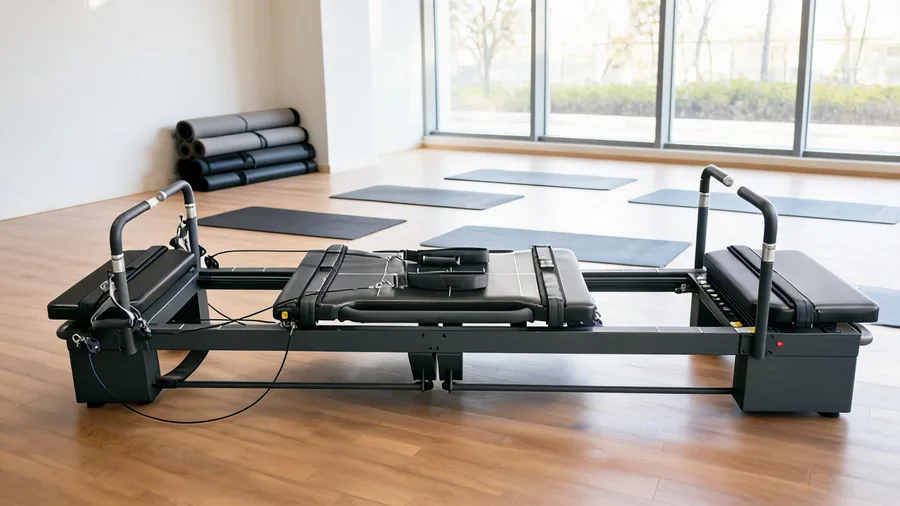
A balanced approach to Pilates reformer vs mat Pilates investment considers your target demographic, available space, local competition, and instructor availability. Some studios succeed with reformer-heavy models while others thrive on high-volume mat classes. Understanding the economics behind each choice helps you allocate resources where they generate the best return without overextending your initial financial plan.
1. Revenue Comparison: Reformer vs Mat Classes
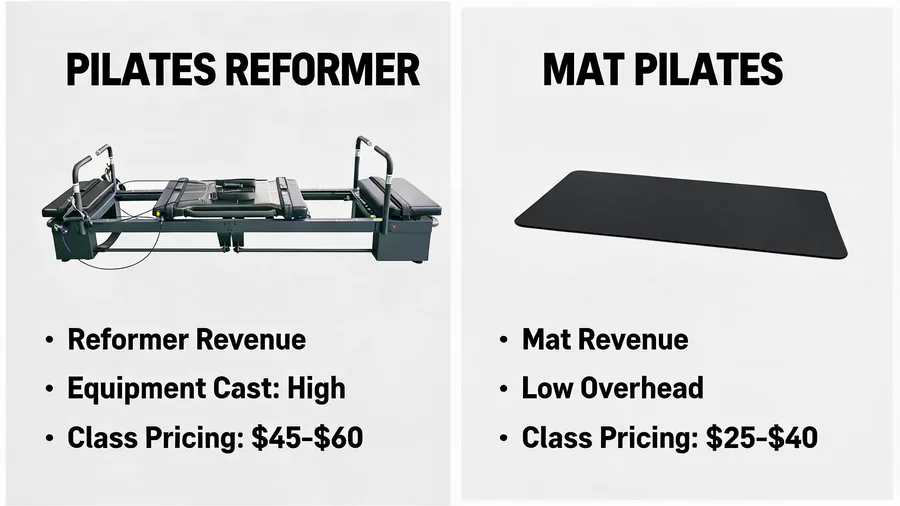
Reformer classes command significantly higher session fees than mat classes due to equipment costs, smaller class sizes, and perceived premium value. Private reformer sessions typically range from 60 to 120 per session depending on location and instructor experience, while mat classes usually run between 15 and 35 per person. This pricing disparity is the primary driver behind the Pilates reformer vs mat Pilates business decision for most studio owners evaluating their service offerings.
Group reformer classes with 4-6 clients generate 240 to 720 per session at typical pricing. In contrast, mat classes accommodating 10-15 clients produce 150 to 525 per session. While reformer sessions show higher per-session revenue potential, the equipment and space investment is also substantially higher. Mat classes require minimal equipment investment beyond mats and small props, making them an accessible entry point for new studios with limited capital.
Monthly membership revenue tells a similar story. Reformer-based memberships typically price 50 to 100 percent higher than mat-only memberships, reflecting the equipment value and smaller class sizes. Studios offering unlimited reformer memberships often price them at 200 to 400 monthly, compared to 80 to 150 for unlimited mat memberships. These numbers directly impact your studio revenue projections and financial planning priorities.
Revenue comparison between reformer and mat Pilates classes for commercial studios.
| Metric | Reformer Classes | Mat Classes |
|---|---|---|
| Private session fee | $60–$120 | $15–$35 |
| Group class size | 4–6 clients | 10–15 clients |
| Group session revenue | $240–$720 | $150–$525 |
| Monthly membership | $200–$400 | $80–$150 |
| Equipment cost per station | $2,000–$7,000 | $50–$200 |
2. Space and Equipment Requirements
Space planning differs significantly between reformer-focused and mat-focused studios. Understanding Pilates reformer vs mat Pilates space requirements helps you allocate floor area efficiently. A single reformer station requires approximately 45 to 55 square feet including clearance zones for instruction and client mounting. A mat class area, by contrast, needs only 20 to 25 square feet per participant including instructor access space. This fundamental difference in space utilization is a key factor in the Pilates reformer vs mat Pilates equipment strategy decision for studio owners evaluating their floor plans and capacity planning needs.
For a 1,000-square-foot studio, the maximum reformer capacity is approximately 16 to 18 reformers based on standard spacing guidelines. The same space can accommodate 40 to 45 mat participants with comfortable spacing between positions. This means mat classes can generate comparable or higher total revenue during peak hours despite lower per-session pricing, simply by serving more clients per class. However, the higher staffing requirements for mat classes reduce some of this revenue advantage, making the net profit comparison closer than gross revenue numbers suggest.
However, reformers offer the advantage of smaller class sizes with higher per-client attention. A studio running back-to-back reformer sessions from morning through evening can achieve strong daily revenue with fewer total clients, reducing wear on facilities and allowing more personalized instruction that clients are willing to pay premium rates to receive.
3. Revenue Per Square Meter Analysis
Revenue per square meter provides a useful metric for comparing the financial efficiency of Pilates reformer vs mat Pilates class allocations. A typical reformer station generating 300 per week in session revenue across 50 square feet yields approximately 6 per square foot weekly. A mat class generating 450 per week across 500 square feet produces roughly 0.90 per square foot — lower density but with minimal equipment investment overhead to subtract from gross revenue figures.
The true advantage of reformers appears when calculating profit per square foot after accounting for equipment depreciation. A reformer purchased for 4,000 with a 5-year depreciation schedule costs 800 annually or about 15 per week. Mat equipment costing 100 per student with 2-year depreciation adds roughly 1 per week. After equipment costs, reformer stations typically deliver 2 to 3 times higher profit per square foot than mat areas, justifying the higher initial investment for studios with sufficient capital.
4. Client Acquisition and Retention Dynamics
Reformer programs excel at client retention compared to mat-only offerings, which is a critical factor in the Pilates reformer vs mat Pilates business decision. Industry data from studio management platforms shows reformer clients maintain membership an average of 14 to 18 months, while mat-only clients average 6 to 9 months before cancellation. This retention gap is one of the most compelling reasons to include reformers in your studio mix when evaluating Pilates reformer vs mat Pilates investment options for long-term business stability and recurring revenue generation.
The retention advantage comes from several factors. Reformer clients feel a stronger connection to the equipment and the studio environment, making them less likely to switch to competitors. The measurable progress on a reformer — increased spring resistance, longer sessions, more complex movement patterns — creates visible improvement that motivates continued attendance. Mat clients, while easier to acquire initially, show higher churn rates because they can replicate mat-based workouts with minimal equipment anywhere they choose to practice.
5. Instructor Requirements and Staffing Costs
Qualified reformer instructors command higher wages than mat instructors due to the additional training and certification required. A comprehensive reformer instructor certification program requires 400 to 600 hours of training plus supervised teaching hours, while mat instructor certifications typically need 100 to 200 hours. This training gap directly affects your staffing costs and instructor availability when expanding your studio operations and service offerings.
Reformer instructors typically earn 35 to 60 per hour teaching, compared to 20 to 35 per hour for mat-only instructors. For a studio running 40 weekly reformer sessions and 20 mat sessions, the annual instructor payroll difference can exceed 40,000. However, the higher revenue per reformer session typically offsets this cost, with reformer instructor cost representing 30 to 35 percent of session revenue compared to 40 to 45 percent for mat classes in most commercial studio environments.
6. Equipment Investment and Studio Scalability
The initial equipment investment is the most significant barrier to adding reformers in any Pilates reformer vs mat Pilates equipment strategy. A single commercial-grade reformer costs 2,000 to 7,000 depending on features and build quality, while mat Pilates requires only basic mats, bands, and small props. This capital requirement means studios must carefully consider their growth trajectory before committing to a reformer-heavy model versus a mat-focused approach that scales more easily with lower per-unit costs.
Commercial-grade reformers built for daily heavy use in studio environments represent a significant long-term asset. With proper maintenance and care, commercial reformers last 10 to 15 years in professional studio settings, providing excellent return on investment over their operational lifespan. This long service life means the initial investment in a reformer fleet becomes increasingly cost-effective over time, with per-session equipment costs dropping substantially after the first few years of studio operations.
7. Finding the Right Class Mix
Industry data from the Pilates Yöntemi Birliği shows the most financially successful studios operate at a 60:40 to 70:30 ratio of reformer to mat capacity. This balance allows studios to use mat classes as an accessible entry point for new clients while maximizing revenue through premium-priced reformer sessions. Mat classes serve as a funnel — new clients try your studio at a lower price point, build trust in your instruction, and graduate to reformer programs as their practice deepens and commitment grows stronger over time.
Monthly workshops, introductory packages, and new client specials that include both mat and reformer classes tend to convert better than programs offering only one modality. Clients who experience both formats develop a deeper appreciation for the studio and are more likely to purchase high-value membership packages. The synergy between reformer and mat programs creates a complete client journey that supports long-term retention and steady revenue growth across all service levels and pricing tiers.
For studios with limited initial capital, a phased approach works well: start with 4-6 reformers and a dedicated mat studio space, then expand reformer capacity as revenue grows and client demand increases. This strategy minimizes upfront risk while building toward the optimal equipment mix for your specific market and client demographic preferences.
8. Frequently Asked Questions About Reformer vs Mat Pilates
Can a studio be profitable with only mat classes?
Yes, high-volume mat studios can be profitable, particularly in urban areas with strong demand. However, per-client revenue is limited, and client retention tends to be lower than studios offering reformer programs. Mat-only studios typically need higher client volume to match the revenue of mixed-equipment studios with reformer programs.
How many reformers should a new studio start with?
Most successful boutique studios start with 4 to 6 reformers. This allows small group classes while keeping initial equipment investment manageable. As revenue grows, expanding to 8-12 reformers is common within the first 1-2 years of studio operations and client base development.
Do reformer clients really stay longer than mat clients?
Industry data from the Pilates Yöntemi Birliği consistently shows reformer clients maintain membership 50 to 100 percent longer than mat-only clients. The equipment investment creates a stronger commitment, and the measurable progress visible in reformer work encourages continued attendance and higher retention rates across all client segments and membership tiers.
What is the ROI timeline for a commercial reformer?
At typical pricing of 60-80 per private session or 25-35 per group class, a single reformer reaches payback within 6 to 18 months depending on utilization rate and session pricing. After the payback period, each reformer generates pure profit for the remaining 8 to 14 years of its operational service life with proper maintenance.
Should I offer reformer or mat teacher training certifications?
Both have value. Mat teacher training is more affordable and attracts a wider pool of candidates. Reformer certification creates higher-value instructors who can teach premium classes. Many successful studios offer both certification pathways to serve different career tracks within their instructor community.
9. Making Your Studio Decision
The choice between focusing on Pilates reformer vs mat Pilates is not binary. Successful studios use mat classes to acquire clients efficiently and reformer classes to maximize revenue from committed members. A balanced approach that includes both modalities creates the strongest business model with diversified income streams and multiple growth pathways for different client segments and market conditions.
Commercial-grade reformers that match your space and financial requirements provide the foundation for premium pricing and strong client retention. Investing in quality equipment from a reliable manufacturer ensures your reformer fleet performs consistently for years, supporting the high-volume class schedules that drive studio profitability. Factory-direct purchasing from experienced manufacturers eliminates middleman markups while giving you access to customized specifications and direct technical support throughout the life of your equipment investment.
The key takeaway for studio owners evaluating Pilates reformer vs mat Pilates is that both modalities serve important roles in a balanced studio business model. Mat classes drive client acquisition and fill studio capacity during off-peak hours. Reformer classes maximize revenue per square foot and build the client loyalty that sustains long-term business growth. Studios that invest in both create resilient businesses that adapt to market changes while serving the full spectrum of client needs across different experience levels and spending preferences.