
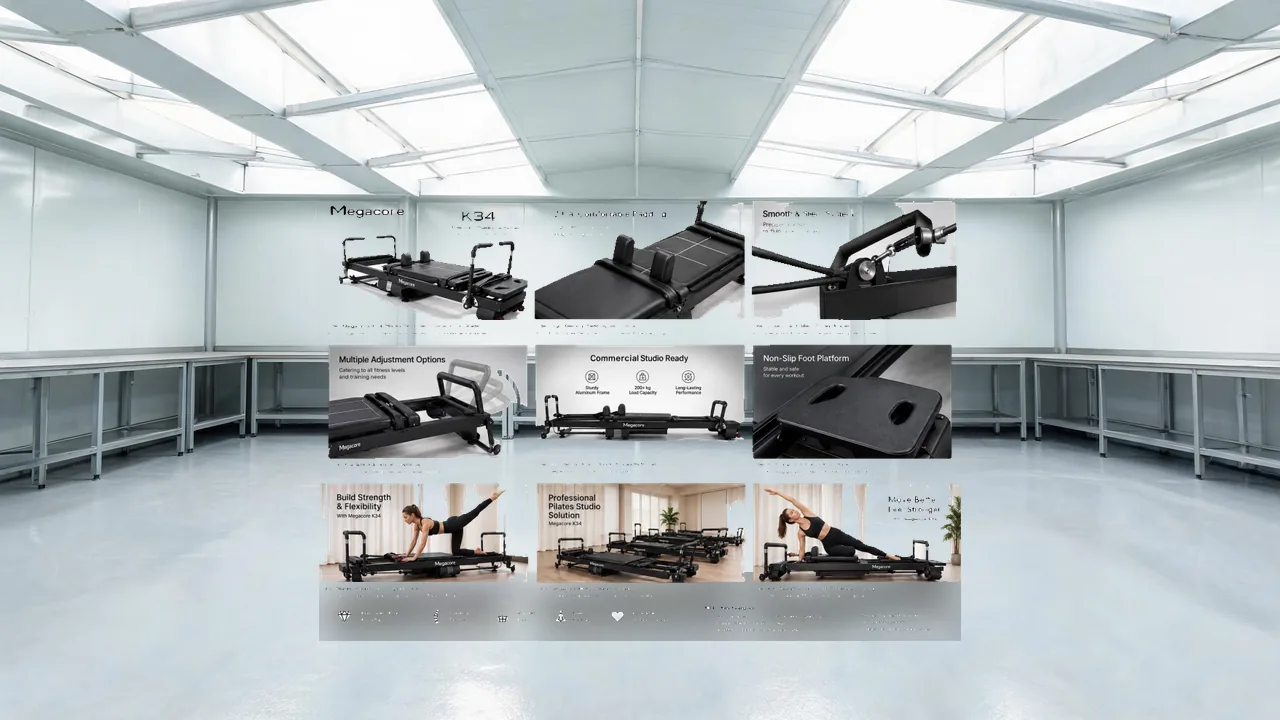
Most people who contact us about starting their own reformer line have already done the reading. They know the terminology, they’ve compared quotations, they’ve been told about MOQ.
Then they hit the part nobody explains: what to decide first, and what those decisions cost you six months later.
This is written from the manufacturing side, by a factory that builds reformers to order for other people’s brands. Instead of a fourteen-step checklist, here are the four decisions that determine whether the line survives its second order, plus the paperwork that keeps a factory and a brand from misunderstanding each other.
The four decisions, in order
- How many SKUs you launch with
- Which frame platform you build on
- What you change, and what you leave alone
- How you define “correct” before the first unit ships
Everything else — packaging, spare parts, payment terms, landed cost — follows from those four. Get them wrong and no amount of good photography saves the launch.
Decision 1: Launch with fewer models than you want to
The most common mistake we see from new brands is a catalogue. Six reformers, a chair, a barrel, three colours, all at once.
It looks like a real brand. It also means six sets of tooling, six upholstery runs, six sample approvals, and six ways to be out of stock on the day your first ad performs well.
Three products is enough for a launch, and the split that works most often is:
- One entry model. Your price anchor. It should be genuinely good at one thing, not adequate at everything.
- One core commercial model. The one studios actually buy. This is where your margin and your reputation live, and it should get most of your customization budget.
- One premium model. Exists to make the core model look sensible, and to catch the buyers who want the best thing in the room.
If you have budget for a fourth product, spend it on spare parts and packaging instead. Both are cheaper than a fourth SKU and both affect retention more.
Decision 2: The frame platform decides everything downstream
Wood, aluminum, or foldable. This one choice locks in your price band, your shipping cost, your replacement-parts business, and how easily you can change anything later.
Holz reads warm and traditional, and it photographs well. It also varies: grain, moisture content, and joinery quality differ between batches, and a brand-new factory will not always tell you which of those it controls. If you go wood, demand the moisture content spec in writing, and ask what happens to a frame that ships to Arizona in July.
Aluminum holds tolerances, weighs less, and behaves the same in batch one and batch twenty. It costs more per unit at small volumes and it’s the platform most private-label brands should start on, because consistency is the thing that protects a young brand. Our aluminum platform is documented here if you want the technical baseline: Aluminium-Pilates-Reformer.
Foldable solves a real problem — home buyers, hotel rooms, small studios — and creates a new one. Every hinge is a wear point and a warranty claim waiting to happen. Foldable sells well and returns more often. Know that before you build a line on it.
One practical note: Edelstahl is a different conversation from aluminum. It’s heavier, it costs more, and it’s the right answer when your market is commercial gyms or humid coastal climates rather than boutique studios. Our steel frames come off our own line in Guangzhou. We still push most first-time brands toward aluminum — a steel line makes sense once you know which model sells.
Decision 3: Customize the outside, standardize the inside
The instinct is to customize everything, because customization feels like what you’re paying for. It’s also the fastest way to turn a two-month lead time into five months and to introduce a failure mode nobody has tested.
What’s worth changing:
- Upholstery colour and material. High perceived-brand impact, low engineering risk. Require a physical swatch approval, not a photo — screens lie about dark greys and warm whites.
- Frame finish. Powder coat colour is cheap to change and easy to get wrong. Ask for a coated sample panel, not a colour code, and check it under daylight and under gym lighting.
- Logo. The single most misunderstood item in private label. Ask specifically: embroidered, printed, debossed, or a badge? On the headrest, the frame, or the footbar plate? What’s the minimum logo size the method can hold, and what happens to a logo with fine lines or small text? Get the answer as a sample, not as an email.
- Small functional tweaks that don’t touch structure — footbar height options, handle shape, spring configuration within the rated range.
What to leave standard unless you have an engineer on your side: frame geometry, spring anchor positions, rope and pulley routing, wheel and track design. These are load-path decisions. Changing them without testing is how brands end up with a reformer that “feels wrong” and no idea why.
The line we hold: customize what the buyer sees, standardize what carries the load. Unser custom reformer builds page lists what we’ll change and what we won’t, and we’d rather lose an order than ship a structural change we haven’t validated.
Decision 4: Define “correct” before anything ships
This is the step that separates brands who reorder smoothly from brands who spend their second order arguing.
You need two documents, and neither takes long to write.
The spec sheet. One page, filled in by you, confirmed in writing by the factory. Ours covers: model code, frame material and finish, upholstery code, overall dimensions, weight, max user weight, spring set and ratings, logo method and placement, accessory list, packaging method, carton dimensions, units per carton, HS code, and the exact unit price at each quantity tier.
The approved sample. Signed, dated, photographed from six angles, and kept by both sides. From that day, the sample — not the quotation, not the brochure, not the WhatsApp conversation — is the definition of the product. Every subsequent batch gets compared against it.
If a factory resists putting specs in writing, that’s your answer about the factory.
What a sample proves, and what it doesn’t
A sample proves the product can exist. It does not prove the factory can repeat it two hundred times.
So test the sample like a customer would, not like a buyer. Put it in a studio for two weeks if you can. Check spring tension after a hundred reps, look for upholstery creep at the corners, listen for the noise that appears only when someone heavier than you uses it.
Then ask the questions a sample can’t answer:
- Which parts of this unit were made in-house and which were bought in?
- What’s your inspection standard per batch, and at what AQL?
- How do you record which batch a given unit came from?
- If I reorder in eight months, what’s likely to have changed?
Unser Produktionsprozess is published step by step, and our Qualitätskontrolle page shows where inspection happens, because those are the questions every serious buyer eventually asks and most factories answer vaguely.
The thing that actually kills private-label brands
Not quality. Inconsistency.
Batch one is beautiful. Batch three has upholstery a shade darker, springs that feel 10% firmer, and a logo that sits two millimetres lower. Individually, nobody complains. Collectively, your customers start to think your brand is sloppy.
Three controls prevent most of it:
- Fabric and foam lot tracking. Ask which lot your approval sample came from, and require that future batches match that lot or that you approve a new swatch. Colour variance between lots is normal in textiles; silence about it is not.
- Spring calibration. Springs are the part most likely to drift. Require a stated tolerance on spring rate, and a measured check per batch, not a visual one.
- A retained sample per batch. The factory keeps one unit from each production run. When a customer complains eighteen months later, you can compare instead of speculate.
None of this is exotic. It’s just rarely offered unless asked for.
Spare parts, before the first order
Decide now what you’ll stock, because your customers will need it in year two and air-freighting forty springs is a bad business.
The minimum kit for a reformer line: springs in each rating you sell, ropes and straps, pulleys, wheels and track inserts, footbar and shoulder-rest pads, upholstery panels, and the small hardware that strips its thread first.
Ask the factory two questions: what’s the minimum order per part, and will they hold my specification for at least three years? Ours is 20 pieces per part. A brand that can’t supply a spring in year three has a warranty problem it can’t solve.
Landed cost, not factory price
The quotation is the smallest part of what you’ll spend. Work the full number:
Landed cost per unit = factory price + freight per unit + duty + insurance + inland delivery + a reserve for damage and returns
Two line items people forget. Duty varies by HS code and destination, so confirm the code rather than assuming. And damage in transit runs higher than most first-time importers budget for, especially on upholstered items — which is why packaging deserves to be specified, not left to the factory’s default carton.
Run the math at your real volume, not at the tier you hope to reach. A price that only works at 100 units is not a price, it’s a plan.
Sizing the first order
The first order has three jobs: prove the product sells, prove the factory repeats, and leave you enough spare parts to support what you sold.
That usually argues for a modest first run rather than a container-filling one. Start with MOQ 1 if you’re validating a market, scale to a mixed pallet or LCL once one model proves itself, and only then think in containers. The money you save per unit at volume is real, but it’s smaller than the cost of sitting on inventory that turned out to be the wrong model.
Expanding after the core model works
Once one reformer is selling and reordering, the line extends naturally — tower combos, chairs, cadillac and trapeze tables, ladder barrels, spine correctors, then accessories. Same frame platform, same upholstery, same logo method, so the catalogue looks like one brand instead of five suppliers.
Add in order of what your existing customers ask for. Not in order of what looks good in a catalogue.
Questions worth asking any factory
- What’s made in-house and what’s outsourced?
- What’s your inspection standard, and at what AQL?
- Can I see the frame before upholstery goes on?
- Which lot did my sample come from, and how do you match future batches?
- What’s your spring rate tolerance and how is it measured?
- What’s the real lead time at my volume, and what delays it most often?
- Can you hold my specification for three years?
- What are the spare-part minimums?
- Who owns the logo and tooling if we stop working together?
- What does your packaging survive — and can I see a drop test?
If the answers come back as paragraphs instead of numbers, keep asking.
FAQ
What’s the difference between OEM and private label Pilates equipment?
Private label means a standard product with your branding — logo, upholstery, finish. OEM means the product is built or modified to your specification, which can include dimensions, frame material, and component choices. Most brands start private label and move toward OEM as they learn their market.
What’s the minimum order for a private label reformer?
It depends on the factory and on how much you’re changing. We build from one unit, which is unusual — most factories set MOQs in the tens or hundreds. Low MOQ costs more per unit; it buys you the ability to test a market before committing capital.
How long does a private label reformer program take?
A sample takes about 15 days on our line, plus shipping. Production runs after approval, and how long it takes depends on the order quantity — we quote that per order in writing rather than publish a number that would be wrong half the time.
Can I put my logo on the reformer?
Yes. Decide the method first — embroidery, print, deboss, or badge — because the method determines the minimum size, the placement, and how fine your artwork can be. Approve a physical sample, not a digital mockup.
Do I need to buy spare parts with the first order?
Not required, but strongly advised. Springs, ropes, pulleys and pads are what your customers need in year two, and small-quantity air freight on those parts is expensive.
Megacore builds Pilates reformers to order in Guangzhou — aluminum and stainless steel platforms, MOQ 1, and custom builds for brands and distributors. If you’re scoping a line, our manufacturer overview is the short version, and our FAQ covers the questions buyers ask first.