
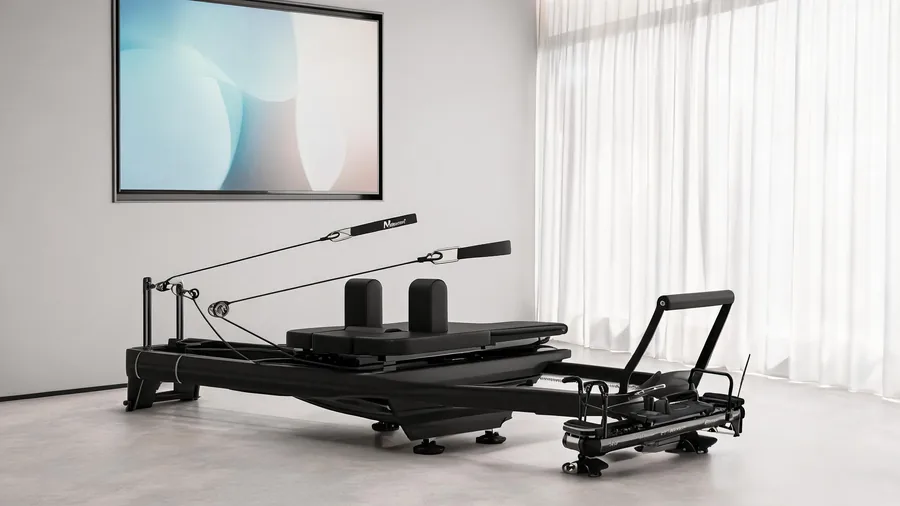
The reformer market uses three tiers of language, and it uses them loosely: home, studio-grade and commercial. Buyers end up comparing a “studio reformer” from one brand against a “commercial reformer” from another as if the labels meant the same thing. They do not.
The consequence shows up eighteen months in, when the machine that was sold as studio-ready is losing calibration, the carriage is gritty, and the upholstery is failing in a room that runs six classes a day. This guide explains what the tiers really mean, what actually changes between them, and how to buy the right one for the traffic you have.
1. The Three Tiers, Defined
There is no universal standard, but the tiers map to intended duty, which is the only thing that matters.
Home. Built for one or two users, a few sessions a week. Lighter frames, home-grade springs, thinner upholstery, proprietary parts. Fine for a spare room; not built to survive a studio.
Studio-grade. A broad middle. Built for regular use in a small studio or a semi-private setup, typically lighter than a full commercial machine and sold at a lower price. Quality within this tier varies enormously, which is why the label is unreliable on its own.
Commercial. Built for continuous daily use by many clients. Heavier, more rigid frames, standardised replaceable wear parts, sealed bearings, commercial upholstery, and component-level warranty support. This is what a busy studio needs.
The useful question is never “what tier is it labelled?” but “how many hours a day and how many clients is this built to handle?”
2. What Durability Actually Means
Durability is not one number. It is a set of components, each with its own wear rate.
| Componente | Hogar | Commercial |
|---|---|---|
| Marco | Lighter gauge, more flex | Heavier, rigid, finished for humidity and cleaning |
| Muelles | Home-grade, lose calibration fast | Standardised, replaceable, calibrated |
| Rodamientos | Open or basic | Sealed or shielded |
| Tapicería | Thin vinyl, fixed panels | Commercial vinyl, replaceable panels |
| Foot bar / locks | Occasional-use hardware | Built for hundreds of adjustments a week |
In a high-traffic studio, the parts that fail first are predictably springs, upholstery seams, carriage bearings and adjustment locks. A commercial machine is designed so each of those is standardised and replaceable. A home machine treats them as permanent, which is why a home machine in a studio dies quickly. Our heavy-duty reformer guide goes deeper on the components.
3. Performance Differences Clients Feel
Durability is not just a maintenance issue. It changes the training experience, and clients notice even if they cannot explain why.
Carriage glide. A commercial carriage moves smoothly under load and stays that way. A lighter machine develops play, noise and grab, which affects how movements feel and how confidently clients can control them.
Spring consistency. If springs drift, the resistance your instructor specifies is not what the client gets. That matters most for rehab and technique work, where precision is the point. Our spring tension guide explains how to keep settings consistent.
Stability under load. Heavy, rigid frames feel secure during dynamic and standing work. Flexible frames flex, and clients feel the difference.
4. Warranty and Maintenance Compared
The warranty is the clearest signal of how a manufacturer expects the machine to be used.
A true commercial reformer carries component-level terms, with frames covered longest and springs covered generously. A home machine often has a shorter, vaguer warranty that excludes the parts that fail. When you compare brands, compare the terms, not the headline. Our warranty guide covers what to check.
Maintenance also scales with tier. A commercial machine is designed to be serviced: springs swapped in sets, upholstery panels replaced, bearings renewed. A home machine is often a closed unit, and the first serious failure ends its life. Our spring replacement guide y cleaning guide show what a commercial maintenance routine looks like.
5. The High-Traffic Test
If you run six to ten classes a day across several machines, you are in commercial territory whether or not your machines are. Ask these questions, and score the machine honestly.
- Is the frame built for continuous use, with minimal flex under load?
- Are springs standardised and replaceable in matching sets?
- Are bearings sealed against dust and sweat?
- Are upholstery panels replaceable without replacing the carriage?
- Are the lock and adjustment mechanisms rated for constant use?
- Does the manufacturer stock spare parts, and how fast can they ship?
A machine that cannot answer all six is a studio-grade machine at best, no matter how it is marketed. In a high-traffic room, that gap is where your downtime comes from.
6. Cost Over Five Years
The purchase price is the least interesting number in this decision. What matters is what the machine costs to keep running, and how long it stays in rotation.
An inexpensive studio-grade machine that needs a spring set annually and new upholstery in year two can cost more over five years than a commercial machine that just keeps going. And every day a machine is out of service is lost class revenue on top of the part cost. Our commercial reformer cost breakdown covers the ranges and the drivers.
For a low-traffic setup, the maths can flip, and a studio-grade machine may be the sensible buy. That is why the tier should follow the traffic, not the price tag alone.
7. How to Tell Which Tier a Machine Really Is
Since the labels are unreliable, judge the machine itself.
- Weigh it, or ask the weight. Commercial machines are heavy for a reason.
- Ask for the spring spec and whether sets are standardised and replaceable.
- Ask what the bearings are, and whether they are sealed.
- Ask whether upholstery panels are replaceable on their own.
- Ask for the component-level warranty and a spare-parts list.
- Ask how many hours a day it is rated for.
A supplier who cannot answer these is either selling a home machine in studio clothing, or has not thought about commercial buyers at all.
8. What to Buy for Different Settings
Busy studio or multi-site: commercial, without compromise. It is the lowest total cost over its life and the only one that stays in rotation.
Small or new studio: commercial if you can fund it, because growth exposes light machines fast. If cost forces a compromise, choose the heaviest built commercial machine you can afford rather than the lightest labelled “studio”.
Clinic or rehab room: commercial, with a focus on carriage smoothness, spring precision and adjustability. See our page on reformers for physical therapy.
Hotel or apartment gym: commercial for durability with light supervision, and consider connected features where there is no instructor. See commercial vs residential.
Home or personal use: home or studio-grade is genuinely fine, because the duty is low. Do not over-buy.
If you are not sure which tier fits your traffic, talk to our team. Tell us your class volume and machine count and we will tell you which build you actually need, including when a lighter machine is the right call.
Preguntas frecuentes
What is the difference between a studio-grade and a commercial reformer?
A studio-grade reformer is built for regular but lighter use. A commercial reformer is built for continuous daily use by many clients, with a heavier frame, standardised replaceable springs, sealed bearings, commercial upholstery and component-level warranty support.
Can I use a home reformer in a studio?
You can, but it will not last. Home reformers use lighter frames and home-grade springs and have proprietary parts that fail under daily multi-client use. For any regular studio use, a commercial machine is the only sensible choice.
What’s the most durable reformer for high-traffic use?
A commercial reformer with a heavy rigid frame, standardised replaceable springs, sealed bearings, replaceable upholstery panels and stocked spare parts. Duty rating and serviceability matter more than the brand name.
How many classes a day before I need a commercial reformer?
Once you are running several classes a day across the same machines, you are in commercial territory. As a rule, if the machine is used by multiple clients most days, buy commercial.
Do commercial reformers cost more to maintain?
They cost more per service but less over the machine’s life, because parts are standardised and replaceable and the machine stays in rotation. A less expensive machine that fails often costs more in downtime than in parts.
How long does a commercial reformer last?
A well-maintained commercial reformer can run for many years in a busy studio, with springs and upholstery replaced periodically. Lifespan depends on build quality and maintenance more than on the label.
How do I compare warranty across reformer brands?
Compare component-level terms, not the headline number. Check the frame, spring, upholstery and bearing cover separately, and ask what parts cost once the warranty ends.
Is studio-grade good enough for a small studio?
It can be, if traffic is genuinely low. But studios grow, and light machines expose themselves fast. If you expect to expand, buying commercial from the start usually costs less over time.