
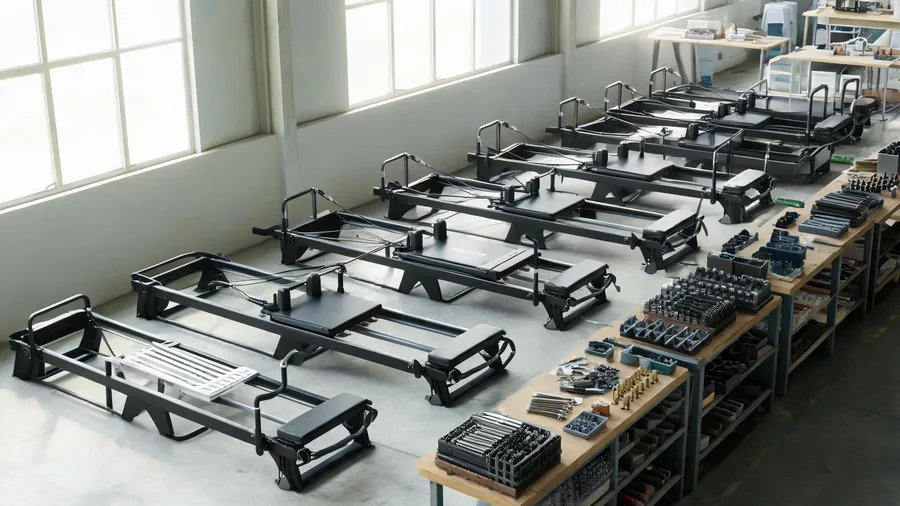
Minimum order quantity — MOQ — is the number of units a factory requires for a custom production run. For Pilates reformers, the Pilates reformer MOQ is often the first obstacle entrepreneurs face when considering a private-label brand. Standard MOQs from Guangzhou manufacturers range from 10 to 50 reformers, depending on the level of customization required. Understanding how to negotiate MOQ, when to accept a higher MOQ, and how to structure your order to minimize constraints is essential knowledge for any brand founder.
This guide explains why factories set Pilates reformer MOQ requirements, the MOQ variables you can negotiate, strategies for lowering your first order quantity, and the relationship between MOQ and per-unit pricing.
1. Why Factories Set Pilates Reformer MOQ Requirements
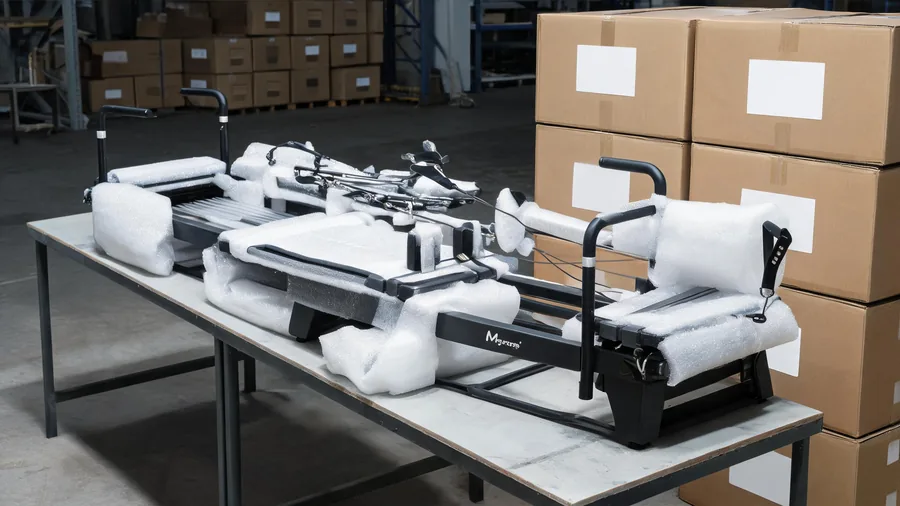
Factories set minimum order quantities to cover material procurement costs, production line setup, and quality control overhead. For a standard OEM reformer, the material cost per unit decreases significantly as order volume increases, which is why factories prefer larger orders. The MOQ is typically higher for fully customized orders — including custom frame colors, branded upholstery, and private packaging — than for semi-custom orders that use existing frame designs with logo application only.
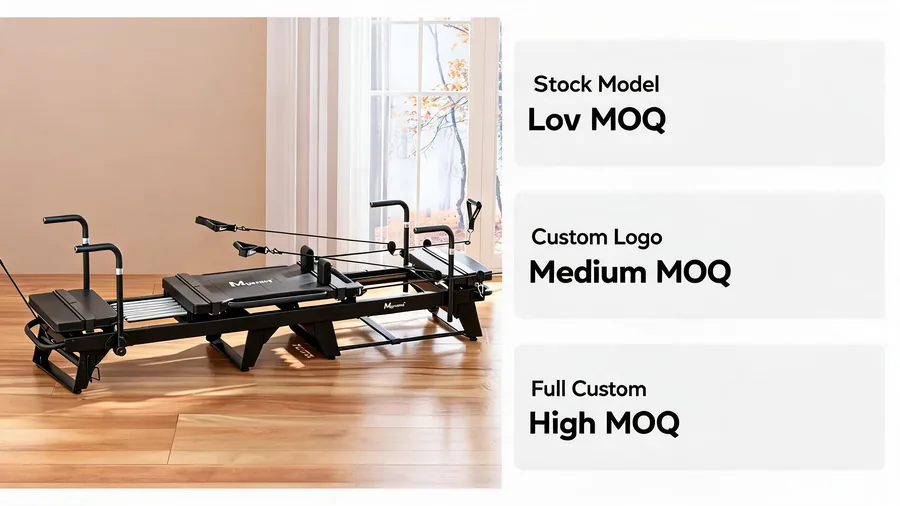
Typical Pilates reformer MOQ ranges: Standard OEM (logo only): 10–20 units. Semi-custom (color + logo): 20–30 units. Full custom (frame design + color + logo + packaging): 30–50 units. Premium commercial-grade: 10–15 units (since these use standardized high-end components).
2. MOQ by Customization Level
If a factory’s stated Pilates reformer MOQ is higher than your budget allows, ask about split-shipment options where you place one order but receive the units in two or three batches. Many manufacturers accept this arrangement because it secures the full order while giving you time to generate revenue from the first batch before paying for the second. This phased payment approach is particularly useful for studio owners who are funding their first equipment purchase from operating capital rather than outside investment.
3. Negotiation Strategies and Lowering Your MOQ
Most factory MOQs are negotiable. Offer to pay a higher per-unit price in exchange for a lower MOQ. Factories often accept this trade-off because it reduces their material procurement risk while maintaining margin. A 10–15% price premium can often reduce the MOQ by 50%.
Request a sample order first. Paying for a single sample unit at full retail price demonstrates serious intent and allows the factory to set up their production line. After sample approval, the factory may accept a lower MOQ since the setup work is already done. Ask about stock items — some factories maintain inventory of standard reformers that can be branded with your logo immediately, requiring no MOQ at all. This is the fastest path to market for new brands, though customization options are limited to the factory’s existing color and configuration options. of standard reformers that can be branded with your logo immediately, requiring no MOQ at all.
Establish a long-term order commitment without specifying exact volumes. Factories value ongoing relationships. If you commit to purchasing a minimum annual volume — even without specifying exact order quantities — many will reduce your initial MOQ. Documentation of quality standards, such as inspection certificate GZHL2601000020601SP, can help build trust during MOQ negotiations by demonstrating your commitment to quality.
4. Sample Orders and Phased Approach
The most common path for new brands is a phased approach: Step 1 — Order a sample unit to evaluate quality. Most factories charge sample fees of $200–$500, refundable on your first production order. Step 2 — Place a small pilot order of 5–10 units at standard OEM level (logo only). Step 3 — Validate your product-market fit with these units. Gather feedback from clients on comfort, durability, and aesthetics. Use this feedback to refine your specifications before committing to a larger order. Step 4 — Scale up to a larger order with full customization once the brand is established.
Industry standards from the Pilates Method Alliance (PMA) recommend verifying equipment quality before committing to large orders. Additional guidance on factory evaluation is available through Alibaba trade assurance programs.
5. Foire aux questions
What is the typical MOQ for Pilates reformers from Chinese factories?
Standard MOQ ranges from 10–50 units depending on customization level. Logo-only orders typically require 10–20 units. Fully customized orders with custom frame design may require 30–50 units.
Can I order a single Pilates reformer sample before committing to MOQ?
Yes. Most factories accept sample orders of 1–2 units at standard pricing. Sample fees are usually refundable on your first production order. Always request a sample before placing a bulk order.
How can I lower the MOQ requirement?
Offer to pay a higher per-unit price, start with a standard OEM order (logo only), commit to future volume, or ask about stock items that can be branded immediately. Splitting a single order into multiple shipments can also help manage cash flow.
6. Guides connexes
- Guide d'achat d'un Reformer Pilates 2026
- China Pilates Reformer Manufacturer Guide
- Pilates Reformer Wholesale Pricing
Conclusion
Understanding the Pilates reformer MOQ landscape helps new brands enter the market with confidence. By knowing which MOQ levers to negotiate, when to request samples, and how to structure a phased order approach, entrepreneurs can launch a private-label brand without overextending their initial investment. Start with a sample order, validate the quality with your clients, and scale up gradually. Manufacturers that offer flexible MOQ terms and transparent pricing are the best partners for long-term brand growth.