Choosing between Pilates reformer air freight sea freight shipping methods affects your delivery timeline and total cost. This guide compares air freight vs sea freight for shipping commercial Pilates reformers from Chinese manufacturers to studios worldwide.
1. Pilates Reformer Air Freight Sea Freight Overview
International buyers of 필라테스 reformers face a critical logistics decision, following 필라테스 메소드 얼라이언스 guidelines: air freight or sea freight. The choice affects delivery timeline, total landed cost, and the condition in which equipment arrives. This guide lays out the practical differences between the two shipping methods, including cost comparisons, transit times, packaging requirements, and customs considerations specific to fitness equipment.

2. Pilates Reformer Air Freight Sea Freight: Sea Freight
Sea freight is the default shipping method for commercial reformer orders, and for good reason. The cost advantage is substantial — shipping a 20-foot container of reformers (15–18 units) from Shenzhen to Los Angeles costs approximately $3,000–$5,000, or $170–$330 per reformer. To Sydney or Melbourne, the same container runs $2,500–$4,500. To Rotterdam or Hamburg, expect $4,000–$7,000 depending on the ocean carrier and season.
Container shipping also provides better protection for the equipment. The reformers are packed in foam and cardboard within a sealed container, protected from weather, handling, and pilferage throughout the voyage. The container can be loaded on a flatbed truck at the destination port and delivered directly to your studio, minimizing intermediate handling that risks damage.
The main disadvantage is transit time. Sea freight from China’s major ports to North America’s West Coast takes 14–18 days; to Europe 25–32 days; to Australia 15–20 days. Add 3–5 days for inland transport from the port to your studio. The total door-to-door timeline is typically 30–45 days from the date the container leaves the factory.
For studios planning Pilates reformer air freight sea freight shipping, container loading configuration affects total cost. Stacking 15-18 reformers per 20-foot container maximizes space. Palletized loading for air freight allows 4-6 units per pallet depending on reformer dimensions.
3. Pilates Reformer Air Freight Sea Freight: Air Freight
Air freight is the choice for urgent orders — when a new studio opening is approaching and the container will not arrive in time, or when a reformer breaks down and a replacement spring set or upholstery component is needed immediately. Air freight from Shenzhen or Guangzhou to most international destinations takes 3–7 days door-to-door, dramatically compressing the logistics timeline.
The cost premium is significant. Shipping a single reformer by air typically costs $600–$1,200 depending on volumetric weight and destination — roughly 4–6 times the per-unit cost of sea freight. A partial pallet of components such as spring sets or carriage pads is more reasonable at $50–$150 for a 10 kg package, making air freight the practical choice for spare parts and accessories.
Air freight also has size limitations. The maximum pallet height on most cargo aircraft is 160 cm, which means a fully assembled reformer (typically 50–60 cm tall) ships easily, but the length (230–250 cm) requires the reformer to be shipped in a disassembled state or on a special oversized cargo rate. Most air shipments of reformers involve partially disassembling the frame — removing the rails and attaching them separately — which adds reassembly time at the destination.
4. Pilates Reformer Air Freight Sea Freight Comparison
The decision threshold usually falls at 3–5 units. Below that quantity, air freight may be competitive after factoring in the inland trucking and customs clearance costs associated with sea freight. Above 5 units, sea freight becomes increasingly cost-effective. For full container loads (15+ units), sea freight is the only economically sensible choice.
A hybrid approach works for many buyers: send the main order by sea freight while air-freighting a few sample units or a partial set of equipment to arrive 3–4 weeks earlier. This allows the studio to begin installation, layout planning, and staff training with the early units while the main container is still in transit. The air-freighted samples also serve as a benchmark for comparing against the container shipment when it arrives.
5. Packaging for Pilates Reformer Air Freight Sea Freight
Proper packaging is critical for Pilates reformer air freight sea freight shipping.
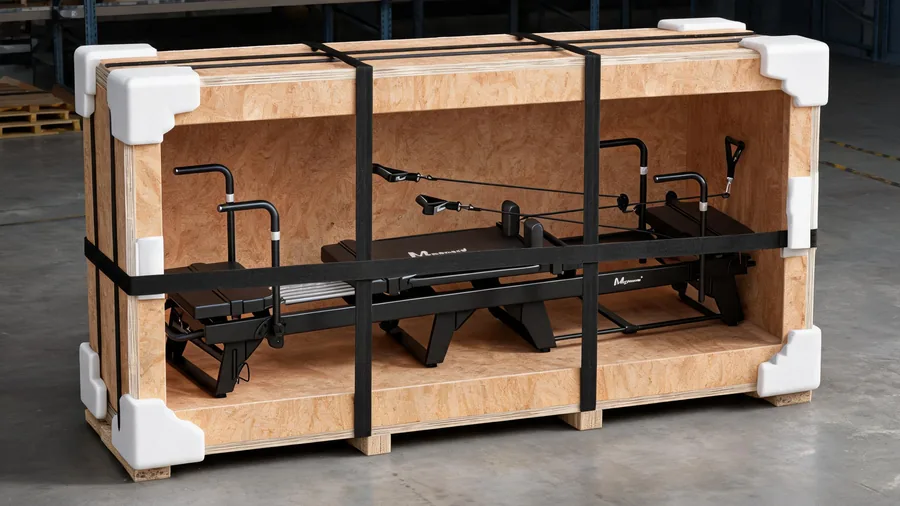
Sea freight packaging must withstand stacking, container movement, and potential humidity during the ocean voyage. Reformers should be wrapped in polyethylene foam (at least 5 cm thickness on all sides), then in corrugated cardboard, and finally in a heavy-duty polyethylene bag to protect against moisture. Each unit should be secured within the container with cargo straps or dunnage bags to prevent shifting during rough seas.
Air freight packaging is lighter. A single layer of 3 cm foam and corrugated cardboard is sufficient because the handling environment is much less demanding. The total shipping weight for air freight is calculated on volumetric weight — (length × width × height in cm) / 6000 — and the carrier bills whichever is greater between actual weight and volumetric weight. Reducing packaging volume by even 10–15 percent on an air shipment can produce meaningful cost savings.
6. Customs for Pilates Reformer Air Freight Sea Freight
Sea freight shipments clear customs at the destination port, which means the container may sit at the port for 2–5 days while documentation is processed. Engaging a customs broker before the shipment arrives is essential — they handle classification, duty calculation, and any required inspections. The standard documentation package includes: commercial invoice, packing list, bill of lading, and the certificate of origin (if needed for preferential duty rates under your country’s trade agreement with China).
Air freight shipments typically clear customs at the destination airport within 24 hours, especially if the shipment is under $2,500 in value. Larger consignments may be routed to a formal customs inspection that takes 2–3 days. The documentation requirements are the same as for sea freight, but the sped-up timeline means having all documents ready before the flight departs is critical to avoid demurrage charges at the airport cargo facility.
7. Insurance for Pilates Reformer Air Freight Sea Freight
Cargo insurance is strongly recommended for both shipping methods. For sea freight, the risk of container damage during storms, saltwater ingress, or rough handling at transshipment ports is real though low (approximately 1–2 percent of containers have some level of damage). Insurance premiums are typically 0.3–0.5 percent of the cargo value for sea freight and 0.5–0.8 percent for air freight, reflecting the higher per-unit value and faster transit.
Most manufacturers offer to arrange insurance as part of their CIF (Cost, Insurance, Freight) quotation, but the coverage terms should be verified — standard “all-risk” marine cargo insurance covers physical loss or damage but not delays or consequential losses such as studio opening postponement. For high-value orders, consider a separate “delay-in-startup” policy or verify that your studio’s business interruption insurance covers equipment delivery delays.
8. Logistics Timeline for Pilates Reformer Air Freight Sea Freight
Whether you choose air or sea freight, build a logistics timeline that includes buffer for the variables outside your control. A realistic sea freight timeline from order to delivery is: 15 days production, 5 days inland transport to port, 18–25 days ocean transit, 5 days customs clearance, and 3 days inland delivery — total 46–53 days. Air freight timelines are: 10 days production (expedited for air freight orders), 2 days to airport, 3–5 days air transit and customs, and 2 days final delivery — total 17–19 days.
Megacore Pilates provides logistics coordination for both shipping methods, including documentation preparation, carrier booking, and customs clearance support. Our logistics team can prepare comparative quotes for air and sea freight for any destination and advise on the most cost-effective approach for your order size and timeline requirements. How to Source Commercial Pilates Reforme
Pilates reformer air freight sea freight: Frequently Asked Questions
이 필라테스 기구가 초보자용 제품들과는 어떤 점이 다른가요?
차이는 소재와 제작 방식에 있습니다. 상업용 장비는 전체 금속 프레임, 밀폐형 베어링, 그리고 정밀 조정된 스프링을 사용합니다. 반면 보급형 모델은 더 가벼운 소재를 사용하기 때문에 성능이 더 빨리 저하됩니다. 고품질 리포머는 5~10년 이상 사용할 수 있는 반면, 보급형 리포머는 대개 1~2년 만에 교체가 필요합니다.
이 장비가 제 구체적인 요구 사항에 적합한지 어떻게 알 수 있나요?
Consider your primary use case: studio vs home, client demographics, class volume, and studio finances. Studio owners should prioritize durability and maintenance access. Home users should prioritize space efficiency and ease of use. Match the equipment specifications to your specific requirements rather than buying general-purpose.
신뢰할 수 있는 제조업체로부터 어떤 보증과 지원을 기대할 수 있나요?
상업용 장비에는 최소 2년의 구조적 보증과 1년의 부품 보증이 제공되어야 합니다. 메가코어(Megacore)와 같은 공장 직영 제조업체는 종종 보증 기간 연장 및 직접적인 기술 지원을 제공합니다. 구매하기 전에 반드시 서면으로 된 보증 서류를 요청하십시오.
Pilates reformer air freight sea freight: Conclusion
적합한 장비를 선택하는 것은 필라테스 수련이나 사업 운영에 큰 차이를 만들어 줍니다. 스튜디오를 새로 개설하든, 기존 기구를 업그레이드하든, 아니면 집에서 수련할 환경을 갖추든 간에, 자신의 구체적인 필요에 맞는 고품질 장비에 투자하는 것이 장기적인 만족도와 성과를 위한 토대가 됩니다.
Plan Your Pilates Reformer Air Freight Sea Freight Shipping
Understanding Pilates reformer air freight sea freight differences helps studio owners make cost-effective shipping decisions for their orders.
Contact us to discuss Pilates reformer air freight sea freight options for your order. Our logistics team helps with shipping from China to your studio.
Using this Pilates reformer air freight sea freight guide helps studio owners choose the right shipping method. Compare Pilates reformer air freight sea freight rates before placing your next order. Pilates reformer air freight sea freight choices affect your studio delivery timeline.