
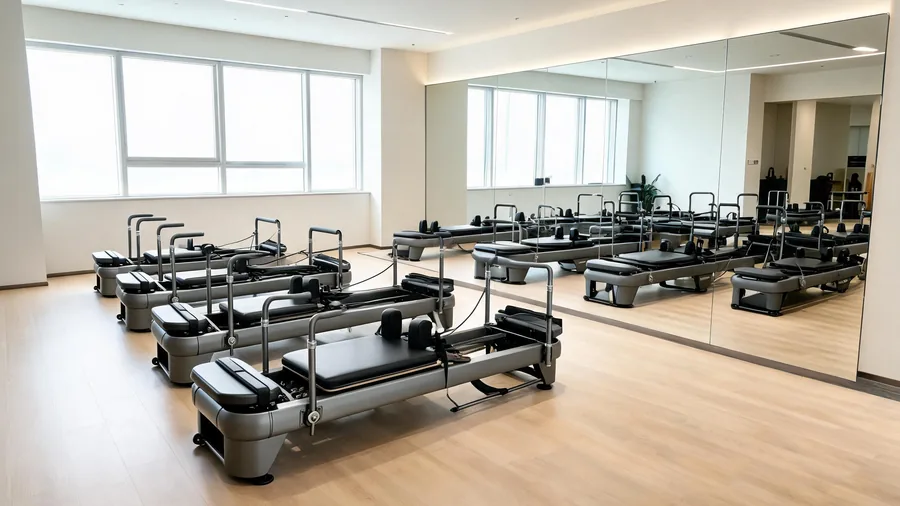
If you are buying a commercial Pilates reformer this year, the 140th Canton Fair is one of the few places in the world where you can meet dozens of suppliers in a single week. It is also a place where buyers make expensive mistakes, because a trade show floor is built for first impressions, not for the questions that decide whether a machine survives five years of daily classes.
This guide is for studio owners, distributors and gym operators heading to Guangzhou. It covers what the fair is genuinely good for, what it hides, and the one step that separates a confident supplier decision from a hopeful one.
1. Canton Fair 2026: Dates, Phases and Where Fitness Equipment Sits
The 140th Canton Fair runs from 15 October to 4 November 2026 at the Canton Fair Complex in Pazhou, Guangzhou, in three phases:
- Phase 1 (15–19 Oct): advanced manufacturing, machinery, hardware, electronics, vehicles.
- Phase 2 (23–27 Oct): home and lifestyle goods, furniture, ceramics, gifts.
- Phase 3 (31 Oct – 4 Nov): textiles, food, medical, and sports, leisure and recreation products.
Pilates and fitness equipment sits in Phase 3, so that is your window. You can skip the rest. The fair runs 09:30 to 18:00 each day, and there is a break between phases for exhibitors to rebuild their booths. Confirm the current schedule on the official Canton Fair site before you book flights, because dates tighten every year.
2. What a Fair Booth Is Actually Good For
Used well, the fair is a fast filter. In two or three days you can meet more reformer suppliers than you would in six months of email, put side by side the models you were already circling online, and get a first read on price bands, minimum order quantities and lead times.
It is also the quickest way to understand how the market is positioned. After ten booths you can tell who is a real manufacturer, who is a trading company fronting someone else’s factory, and who is showing a catalogue they cannot yet produce at volume.
3. What a Booth Cannot Tell You
Here is where buyers get burned. A booth demo is choreographed. The carriage glides because it is new and lightly used. The springs feel even because nobody has worked them hard. The upholstery looks crisp because it has seen a few hundred sits, not a few hundred thousand.
None of that tells you:
- how the carriage behaves under a heavy client at speed, hour after hour;
- whether the springs hold calibration after a month of group classes;
- how the frame behaves when someone drops onto it;
- what breaks first, and how fast parts arrive when it does.
Those are the things that decide your total cost of ownership. They live in the factory and in the field, not on the show floor.
4. Questions to Ask Anyone Quoting You a Reformer
Ask the same set at every booth and write the answers down. The suppliers who answer clearly, with specifics, are the ones worth a second meeting.
| Ask | Why it matters |
|---|---|
| Which parts are standardised and replaceable? | Proprietary parts turn a machine into a paperweight once the model is retired. |
| What is the spring specification, and how often should it be replaced in commercial use? | Springs are the most-replaced part on any reformer. Vague answers are a warning. |
| Frame material and wall thickness? | Two “aluminium” frames can differ hugely in stiffness and life. |
| What bearings and glide system does the carriage use? | Sealed bearings survive dust and sweat. Open ones get noisy fast. |
| What does the warranty cover, part by part, in writing? | A single headline number hides what is excluded. |
| What quality documents come with an order? | Ask for a quality inspection certificate with a traceable reference, not a promise. |
| Minimum order, lead time, and can we visit the factory? | The last question sorts manufacturers from resellers in one sentence. |
5. Guangzhou Is the Reformers’ Factory Floor, Not Just a Trade Show City
One reason the fair is worth the trip is what sits around it. Guangdong is where a large share of the world’s Pilates equipment is made, and many of the factories you meet in Pazhou are within a couple of hours of the hall. That turns a fair visit into something a trade show alone can never be: a factory trip.
If you are serious about a supplier, the fair should be the start of the trip, not the end. Meet them at the booth, then go see where the machine is welded, coated, upholstered and assembled. The gap between a polished booth and a tidy production line is a useful thing to see with your own eyes.
6. The Step Most Buyers Skip: Test the Machine Yourself
The single best use of your Guangzhou trip is to put your hands on the machine outside a booth setting, at working speed, on a floor that is not covered in carpet tiles.
Megacore keeps a showroom in Tianhe, Guangzhou, a short ride from the fair venue, where the full commercial range can be tested back to back rather than compared from photos. You can run the carriage under load, check the spring feel, sit on real upholstery, and ask the spec questions from section 4 directly. If you want to go further, our factory in Jiangmen, Guangdong is a morning’s drive away. Details are on the showroom page.
7. Red Flags When a Supplier Quotes You at the Fair
- No factory access. If a “manufacturer” cannot host you at a production site, be careful what you are actually buying.
- Prices far below the field. Something is thinner, lighter or missing. Find out what before the container ships.
- No parts catalogue. If springs, wheels and upholstery are not listed with prices, plan for surprise downtime.
- Pressure to sign on the spot. Fair pricing is rarely the real floor, and a deposit is hard to unwind.
- Specs that change when you ask twice. Consistency is the whole point of a commercial supplier.
8. From Fair Visit to Supplier Decision
A fair is a shortlist machine, not a closing tool. The useful pattern is: meet everyone, shortlist two or three, visit at least one factory, order a sample or a small first batch, and inspect it against the spec you wrote down. Only then commit to volume.
Buyers who do that arrive home with a supplier they understand. Buyers who sign at the booth arrive home hoping. The difference shows up in year three, when one machine is still in rotation and the other is a spare-parts problem.
9. FAQ
Which Canton Fair phase has Pilates and fitness equipment?
Phase 3, which in 2026 runs from 31 October to 4 November. Sports, leisure and recreation products are grouped there, so that is the phase to plan around.
Is the Canton Fair good for finding a Pilates reformer manufacturer?
Yes, as a first filter. You can meet many suppliers quickly and compare ranges and price bands. It is a weak place to judge build quality, which is why a factory or showroom visit should follow.
Can I test a reformer at the Canton Fair?
You can usually sit on and move a demo unit, but booths are crowded and the machines are new. That is not a real test. Testing the same machine in a showroom at working speed tells you far more.
Should I buy a reformer directly at the fair?
Rarely on the spot. Use the fair to shortlist, then visit the factory, check specs and parts in writing, and order a sample or small batch before committing to volume.
How do I know a supplier is a real factory, not a trading company?
Ask to visit the production site, ask who owns the tooling and the QC process, and compare the answers across suppliers. A manufacturer can show you the line. A reseller usually cannot.
What documents should come with a commercial reformer order?
At minimum a fixed spec sheet, a component and parts list, and a quality inspection report with a traceable reference. Confirm what your destination market requires and who holds the relevant paperwork.
When should I plan my Guangzhou factory visit?
Build it around Phase 3 for fitness equipment, and leave at least one extra day beyond the fair for a factory or showroom visit. Trying to squeeze both into a fair day never works.
10. Planning a Reformer Trip Around the Fair
If a commercial reformer is on your list for 2026, treat the Canton Fair as the beginning of your due diligence rather than the whole of it. Meet suppliers in Pazhou, then come and put the machines to work in person.
Talk to our team to arrange a showroom visit in Guangzhou or a factory tour in Jiangmen while you are in China. Tell us your class volumes and the models you want to compare, and we will have them ready when you arrive.
For standards and professional context on the method itself, see the Pilates metodes alianse.