
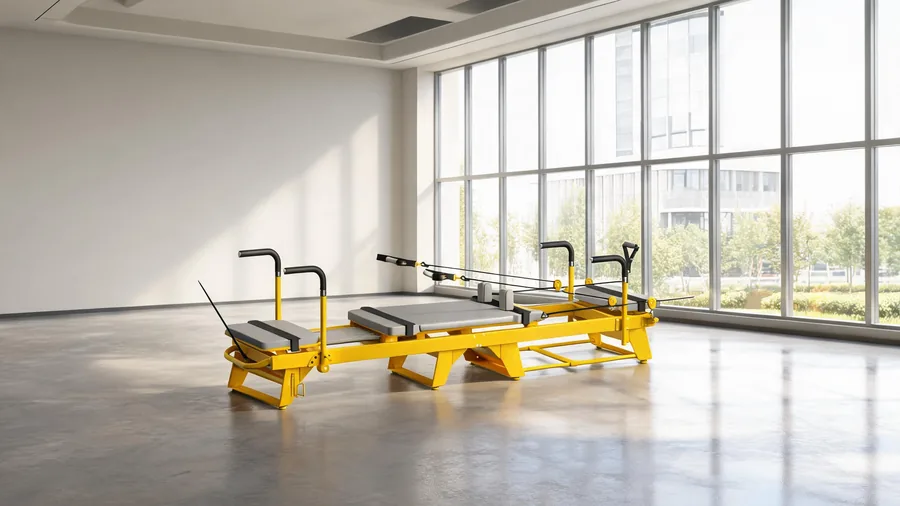
Pilates reformers for commercial use have to survive 8 to 15 classes a day, fit clients of every size, and still run smooth and quiet years later. That is a higher bar than home equipment, and it decides what the machine really costs you over its life. This guide covers what commercial grade actually means, what to specify before you buy, and what to expect to pay.
Quick answer: A reformer is commercial grade when four things are true: a welded steel or heavy aluminium frame, a spring system rated for 8 to 12 classes per day, a sealed roller-bearing carriage rather than plain bushings, and a warranty issued by the manufacturer rather than a reseller. Expect roughly USD 500 to 900 per unit at factory-direct pricing. Over ten years a commercial unit usually costs less per class than a consumer unit, because it survives the replacement cycle instead of adding to it.
What makes a reformer “commercial grade”?
Not the price and not the brand. It comes down to four engineering choices: frame material, spring duty rating, carriage bearing quality, and who backs the warranty. A studio machine is built to be used by 20 to 40 different bodies a week for years, which is a different brief from a home reformer.
Commercial reformer frames compared
| Welded stainless steel | Aluminium alloy | Wood | |
|---|---|---|---|
| Daily class capacity | 8 to 12 classes/day | 4 to 8 classes/day | 2 to 4 classes/day |
| Weight and stability | Heaviest, most stable under load | Lightest and easiest to move or reconfigure | Light, but shifts under heavy spring loads |
| Maintenance | Weld seams are the only wear point; nothing to re-torque | Check fasteners periodically | Humidity and sweat degrade the finish; needs refinishing |
| Best for | High-turnover studios, gyms, hotels | Boutique studios, mixed-use rooms, home studios | Classical or heritage styling |
| Megacore model | K16 | K20 | Not offered |
Megacore commercial reformer specifications
| K16 | K20 | K30 | |
|---|---|---|---|
| Positioning | All-round commercial workhorse | Lightweight / boutique studio | Strength-focused programming |
| Frame | Stainless steel, welded | Aluminium alloy | Steel, Megacore design |
| Overall size | 327 × 86.6 × 89.4 cm | 294 × 90 × 95 cm | 314 cm platform length |
| Vervoer | 122.6 × 66.8 cm | 112 × 66 cm | 120 × 66.8 cm |
| Seat height | 45 cm | — | 43 cm |
| Verengels | 8 springs: 4 lb × 2 + 8 lb × 3 + 22 lb × 2 + heavy × 1 | 6 springs, 4 to 44 kg range | 8 springs, up to 102 kg combined |
| Adjustment | Pin-and-hole locking (foot bar and arms) | 4-position arm rests | 4-position arm rests, 4-angle rear foot bar |
| Gewicht | 150 kg net (160 kg gross) | 180 kg gross (packed) | 180 kg gross (packed) |
| Garantie | 3 years, direct from manufacturer | 3 years, direct from manufacturer | 3 years, direct from manufacturer |
Buying at volume? See factory-direct commercial reformers and our wholesale and volume pricing guide.
What Defines a Commercial-Grade Pilates Reformer?
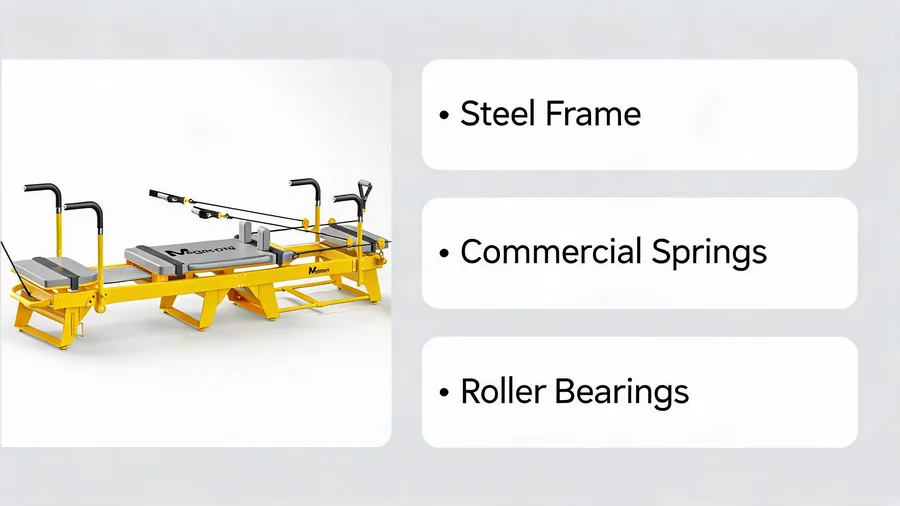
A pilates reformers for commercial use differs from a home model in three critical areas: frame construction, spring longevity, and carriage system durability. Commercial units are built for 8–10 hours of daily use, whereas home models handle 1–2 hours. The difference is not just marketing—it is in the materials, tolerances, and quality control that go into every component. When evaluating pilates reformers for commercial use, start by examining the frame — it is the foundation of everything else. A commercial frame should be made of Q235 structural steel or aircraft-grade aluminum. Commercial frames use Q235 structural steel or aircraft aluminum weighing 70–90 kg, supporting 250–350 kg weight capacity. Home-grade frames use thinner steel tubing or wood, weighing 25–40 kg with weight limits of 120–200 kg. Heavier frames absorb vibration better during high-intensity exercises, reducing noise and creating a more professional client experience.
Frame Materials: Steel vs Aluminum vs Wood
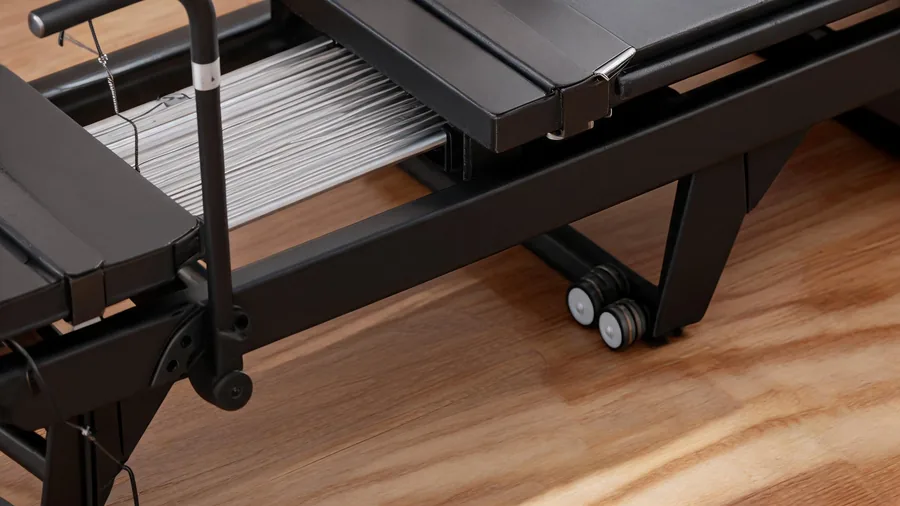
The frame material of pilates reformers for commercial use directly determines durability, weight, and maintenance requirements. Steel frames (Q235 structural steel, 70–90 kg) offer the highest weight capacity at 250–350 kg and last 10–15+ years. Aluminum frames (aircraft-grade, 40–55 kg) are lighter and easier to move but have lower weight limits. Wood frames look beautiful but absorb moisture over time and can develop structural weaknesses in humid studio environments. For most commercial studios, steel is the optimal choice — it provides the stability and longevity that daily high-volume use demands, and the extra weight actually improves stability during high-intensity exercises like jump-board work.
Spring Systems: The Heart of Commercial Resistance
Pilates reformers for commercial use require spring systems that maintain consistent tension across thousands of cycles. Commercial springs are calibrated to exact resistance levels, color-coded for easy identification, and designed for replacement after 2–3 years of daily use. Consumer springs lose tension unevenly after 6–12 months, creating inconsistent resistance across different reformers in your studio. This inconsistency directly affects class quality—clients notice when one reformer feels different from another. Commercial spring systems use heavier gauge wire and precision winding, ensuring every spring delivers the same resistance as the day it was installed. Megacore reformers use replaceable, color-coded spring systems that make maintenance straightforward and keep your equipment performing consistently.
Carriage System: Roller Bearings vs Basic Bushings
The carriage system is where the smooth, silent glide of a commercial reformer is engineered. High-quality pilates reformers for commercial use feature sealed ball bearings running on precision-machined tracks. These bearings are designed for millions of cycles and require only annual lubrication. Consumer reformers use basic bushings on simpler tracks that develop uneven wear patterns after 6–12 months of daily use. Uneven bearing wear makes the carriage feel jerky, affects exercise quality, and cannot be repaired without replacing the entire assembly. Commercial bearings can be serviced and replaced individually. This single difference—maintainable bearings versus disposable bushings—is one of the most important factors in the total cost of ownership over a reformer’s lifespan.
Key Features to Look for in a Commercial Reformer
Beyond the basic specifications for pilates reformers for commercial use, consider the carriage design. Commercial reformers should have a carriage that glides smoothly along the full length of the frame with zero resistance at the bearing points. The platform should be padded with high-density foam that maintains its shape after thousands of uses. Adjustable foot bars, headrests, and shoulder rests accommodate clients of different heights and proportions, which is essential for a studio serving diverse populations. Removable carriage systems allow for deep stretching exercises that clients expect in a professional setting.
When shopping for pilates reformers for commercial use, prioritize these features: frame warranty of 3+ years, daily class capacity of 10–15+, weight capacity of 250 kg minimum, replaceable spring system, sealed ball bearing carriage, adjustable headrest and shoulder rests, removable carriage for deep stretching, and frame compatibility with studio accessories like jump boards and box barrels. These features distinguish commercial equipment from consumer machines and determine how long your investment will serve your studio. Taking the time to compare these specifications before purchasing saves thousands in replacement costs down the road. Studios that choose reformers with these specifications report significantly lower maintenance costs, higher client satisfaction, and better equipment longevity.
Cost Analysis: Commercial vs Consumer Over 10 Years
To put this in perspective: a studio upgrading 12 reformers to commercial-grade at factory-direct prices of $2,200 per unit spends $26,400 upfront. With those reformers generating $60–$90 per class and running 8 classes daily, the equipment pays for itself within approximately 55 days of operation. After that, every class is pure profit minus minimal maintenance. This is why studios that invest in commercial equipment consistently outperform those that buy consumer-grade and replace every 3–4 years—the revenue-per-class math heavily favors commercial-grade durability and reliability.
The numbers tell the story. Consumer-grade reformers cost $800–$1,500 per unit but need replacement every 3–5 years with annual maintenance costs of $200–$400 per unit. Pilates reformers for commercial use cost $1,800–$3,500 per unit upfront but last 10–15+ years with annual maintenance of just $50–$80 per unit. Over a 10-year period for a 10-reformer studio, consumer equipment costs $3,300–$5,100 per year while commercial equipment costs $1,930–$3,620 per year. The breakeven point occurs in year 3–4, after which commercial-grade equipment saves your studio money every single year while delivering a better client experience throughout.
Why Studios Choose Megacore for Commercial Use
Megacore has supplied pilates reformers for commercial use to studios in 40+ countries, from boutique 6-reformer studios in Tokyo to 30-reformer flagship locations in New York. Our clients consistently report three advantages: factory-direct pricing that reduces costs by 30–50% compared to retail distributors, quality inspection reports available for every batch (report GZHL2601000020601SP), and after-sales support with dedicated account managers who respond within hours via WeChat or WhatsApp.
Megacore has become a trusted name for pilates reformers for commercial use worldwide. Our reformers use Q235 structural steel frames tested to 300 kg weight capacity, color-coded replaceable spring systems with consistent tension, sealed ball bearing carriages for whisper-quiet operation, and a 3-year warranty on both frame and components. Every reformer undergoes quality inspection before shipping, and we provide replacement parts for the life of the equipment. Factory-direct pricing saves studios 30–50% compared to local distributors, and our production team can customize frame colors, logo placement, and spring configurations to match your studio brand.
Warranty and After-Sales Support
A commercial reformer is a long-term investment, and the warranty reflects the manufacturer’s confidence in their product. Pilates reformers for commercial use should carry a minimum 3-year warranty on the frame and components. Megacore provides a full 3-year warranty covering both frame and springs, with replacement parts available for the life of the equipment. Our support team provides video-based technical assistance, making it easy for studio staff to perform routine maintenance and minor repairs without waiting for a technician visit. This level of support is essential for studios that cannot afford equipment downtime.
Frequently Asked Questions About Pilates Reformers for Commercial Use
Common questions about pilates reformers for commercial use:
What is the best reformer for commercial studio use? The best commercial reformers feature Q235 steel frames, sealed bearing carriages, replaceable calibrated spring systems, weight capacity of 250 kg minimum, and a warranty of at least 3 years. Megacore reformers meet or exceed all these specifications.
How many classes per day can a commercial reformer handle? Commercial-grade reformers are designed for 10–15+ classes per day. Consumer models handle 2–4 classes before showing signs of wear. This is the single most important specification for studio owners.
How long do commercial Pilates reformers last? 10–15+ years with proper maintenance. Springs need replacement every 2–3 years depending on class volume. Megacore offers a 3-year warranty on both frame and components.
What is the weight capacity of commercial reformers? 250–350 kg (550–770 lbs). Megacore steel frame reformers are tested to 300 kg with safety margins, suitable for all client body types and advanced athletic training.
Are Megacore reformers good for commercial studios? Yes. Megacore reformers are used by studios worldwide for their durable steel frames, smooth carriage systems, consistent spring tension, and factory-direct pricing that reduces equipment costs by 30–50% compared to retail brands.
Can I customize commercial reformers for my studio? Yes. Megacore offers custom frame colors, logo engraving, branded packaging, and custom spring configurations with a minimum order of 10 units for full customization.
How do I maintain commercial reformers in my studio? Voor pilates reformers for commercial use, daily cleaning with a damp microfiber cloth, weekly track inspection and lubrication, and spring tension checks every 3 months. Commercial reformers require less frequent maintenance than consumer models, but the tasks are more specialized. Megacore provides a maintenance guide with every purchase.
Scientific Research and Industry Standards
Pilates reformers for commercial use are held to higher safety and performance standards than consumer equipment. ASTM F2116-18 covers Pilates equipment safety specifications including weight capacity, spring testing, and structural integrity. The Pilates Method Alliance recommends commercial-grade steel frames and certified spring systems for professional studio use. Research shows spring-based variable resistance provides effective load progression for both rehabilitation and conditioning. Industry data from fitness facility management studies indicates commercial-grade equipment reduces per-class equipment cost by 55% over 10 years compared to consumer alternatives that need frequent replacement. Studios using commercial-grade reformers report 40% less equipment downtime compared to those using consumer-grade machines.
Ready to Choose Your Commercial Reformers?
Get a personalized quote for pilates reformers for commercial use tailored to your studio. Tell us your studio size, class schedule, and equipment preferences, and we will recommend the optimal pilates reformers for commercial use models and quantities tailored to your budget and timeline.
Conclusie
De juiste keuze maken pilates reformers for commercial use determines your studio’s equipment costs, client experience, and maintenance workload for the next decade. Commercial-grade reformers with steel frames, sealed bearings, and calibrated spring systems deliver the durability, consistency, and professional feel that clients expect. While the upfront cost is higher, the long-term savings and revenue benefits make commercial equipment the only logical choice for growing studios. Contact Megacore to discuss your commercial reformer needs—our team provides pricing, specifications, and customized solutions for studios of every size.
Gerelateerde handleidingen
Pilates Reformer Buying Guide 2026: Complete Checklist
Pilates Reformer Weight Capacity Guide
Commercial Pilates Reformer: Complete Buyer’s Guide