
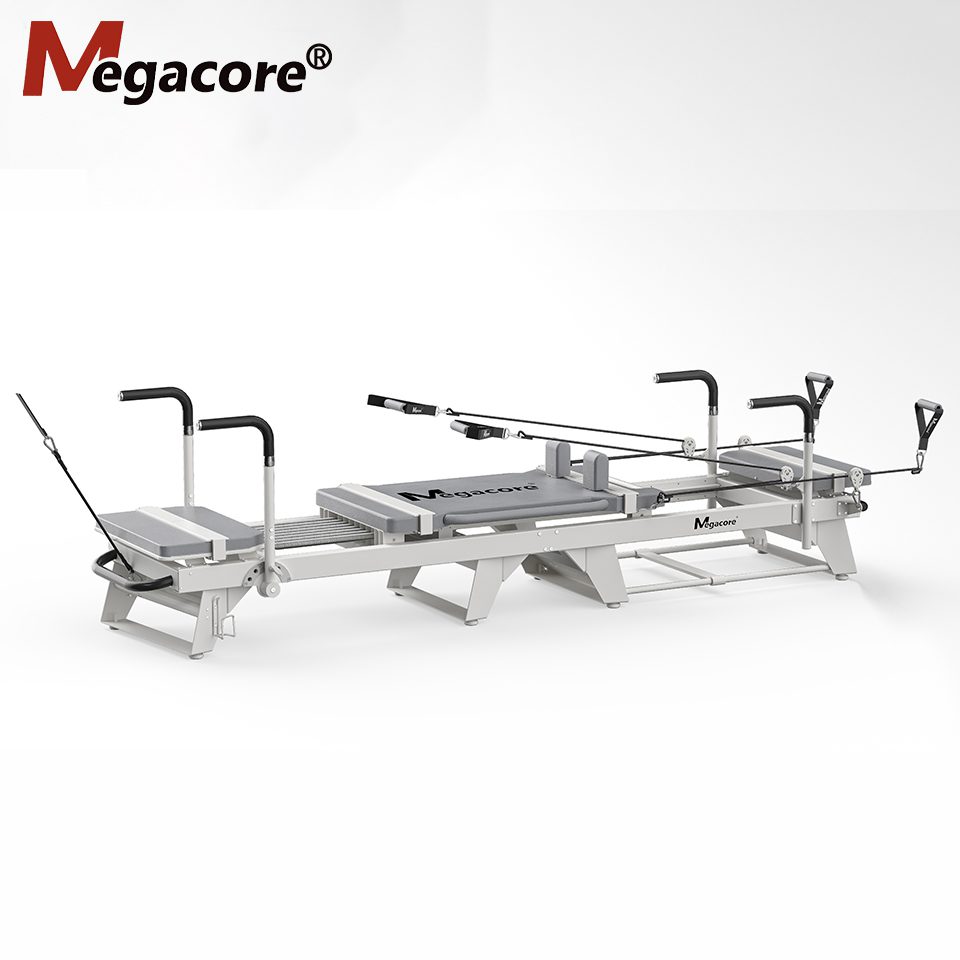
A growing number of Pilates studios are upgrading their equipment from standard home-grade reformers to commercial-grade machines. The decision involves comparing upfront cost against long-term benefits in durability, client experience, and return on investment.
This analysis examines the cost-benefit equation for studio owners considering an upgrade to commercial-grade reformers, using real-world pricing and performance data from Guangzhou-based manufacturers.
Defining Commercial-Grade vs. Standard Reformers
The line between commercial-grade and standard (home-grade) reformers is defined by materials, construction methods, and performance specifications.
Commercial-grade reformers use steel frames with minimum 2.5 mm wall thickness, sealed roller bearings or precision polymer slides, shot-peened alloy springs tested to 100,000+ cycles, fire-retardant upholstery with marine-grade vinyl, and adjustable footbars with metal locking mechanisms. Standard (home-grade) reformers use aluminium or thin-wall steel frames (1.5–2.0 mm), open ball bearings or basic polymer slides, standard springs without fatigue testing, basic upholstery with standard vinyl, and fixed or limited-adjustment footbars with plastic locking components.
The price difference reflects these material and manufacturing divergences. A standard reformer costs ¥2,500–4,500 factory-direct; a commercial-grade reformer costs ¥4,500–8,000. The premium is ¥2,000–3,500 per unit.
The Upgrade Cost: A 10-Reformer Studio
For a studio with 10 reformers, upgrading from standard to commercial-grade equipment represents an additional equipment cost of ¥20,000–35,000 (10 × ¥2,000–3,500). Shipping and installation adds ¥3,000–5,000 more. Total upgrade investment: ¥23,000–40,000.
While this sum is significant, it must be evaluated against the service life difference. A standard reformer in a commercial setting (15–25 sessions per week) lasts 3–5 years before showing structural issues. A commercial-grade reformer under the same conditions lasts 12–18 years. The per-year equipment cost for commercial-grade is actually lower: ¥375–667/year vs. ¥500–1,500/year for standard.
Benefits That Offset the Premium
Client Retention and Satisfaction:
Commercial-grade reformers deliver a smoother, quieter, more consistent experience. Clients notice the difference. Studios that upgrade report 15–25% improvement in class retention rates within six months.
Reduced Maintenance Downtime:
Standard reformers in commercial rotation require spring replacements every 6–9 months, bearing maintenance every 12–18 months, and often structural repairs by year 3. Commercial reformers operate with routine spring replacements only — a 20-minute job per machine. Annual maintenance cost: ¥400–800 for standard vs. ¥150–300 for commercial-grade.
Insurance and Liability:
Commercial-grade reformers with documented load testing and quality inspection certificates (such as GZHL2601000020601SP) satisfy insurance requirements that standard machines may not. Insurance premiums for studios using commercial-grade equipment are typically 8–12% lower.
Resale Value:
After 5 years, a commercial-grade reformer retains 40–50% of original value; a standard reformer retains 15–25%. This gap further narrows the total cost of ownership difference.
Brand Perception:
Studios using commercial-grade equipment command ¥30–50 more per class session than equivalent studios with standard equipment. Over a year with 20 classes per week, this generates ¥31,000–52,000 in additional revenue — exceeding the upgrade cost within 12 months.When Upgrading Makes Sense
The upgrade to commercial-grade reformers is most justified when: the studio runs 20+ classes per week per reformer, target clientele includes premium clients paying ¥300+ per session, the studio plans to operate for 5+ years, and the studio offers high-intensity or jump board classes.
For low-volume studios (under 10 classes per week) or home use, standard reformers remain a practical choice.
Financing the Upgrade
Guangzhou manufacturers typically offer bulk purchase discounts of 5–12% for orders of 10+ units. Payment terms are usually 30% deposit, 70% before shipment. Some factories offer net-30 terms for established businesses.
Equipment leasing programmes are available through fitness equipment finance companies. Monthly payments for a ¥400,000 reformer fleet over 36 months are approximately ¥12,000–14,000 — easily covered by the revenue increase from premium pricing and improved retention.
Summary
Upgrading from standard to commercial-grade reformers requires an upfront investment of ¥23,000–40,000 for a 10-reformer studio. The benefits — longer service life, lower maintenance, higher client retention, premium pricing capability, and better resale value — create a compelling total-cost-of-ownership case. For studios committed to long-term operation, commercial-grade reformers are the financially sound choice. The Best Pilates Reformers for Commercia What Makes the Best Pilates Reformer for The Best Pilates Reformers for Commercia What Makes the Best Pilates Reformer for