
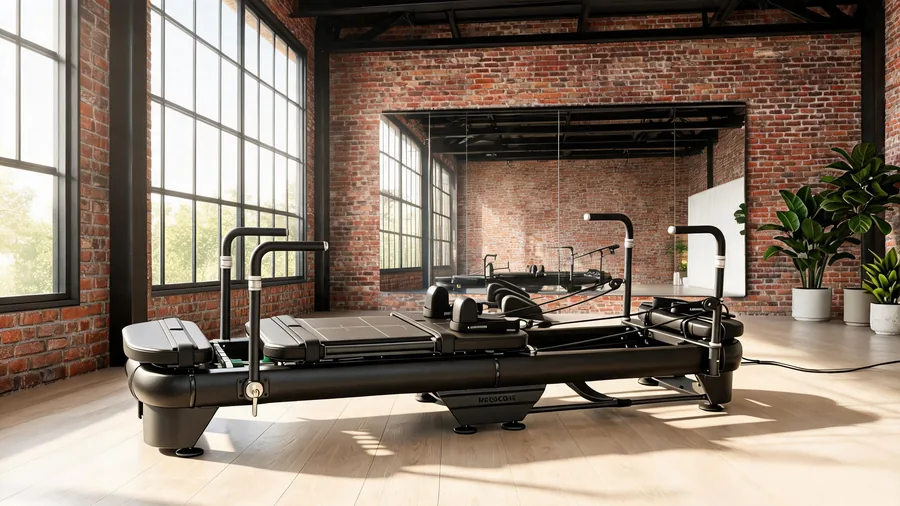
Heavy duty Pilates reformers are the backbone of a commercial studio. Walk into a room running back-to-back classes six days a week and every component is tested to its limit: the frame, the springs, the carriage bearings, the upholstery. A reformer that feels sturdy on day one can wobble or fail within months if it was never built for that load. This guide breaks down what separates a heavy duty reformer from one that is only wearing the label.
1. Steel Specifications for Heavy Duty Pilates Reformers
Heavy duty pilates reformers are defined by their steel frame specifications. The minimum standard for commercial heavy duty pilates reformers is 2.5 mm wall thickness in the main frame tubing. Premium heavy duty pilates reformers may use 3.0 mm steel in high-stress areas such as the spring bar mounting bracket and carriage stop supports. Entry-level frames use 1.2 mm to 1.5 mm steel, which flexes under repeated load and develops hairline cracks within 12-18 months of daily studio use.
The steel grade matters as much as the thickness. Most heavy duty pilates reformers use Q235 or Q345 structural steel, which provides the yield strength needed for daily commercial use. The frame should be powder-coated with a minimum 60-micron thickness to prevent corrosion in humid studio environments, which is a common cause of frame degradation in lower-grade equipment. Heavy duty pilates reformers typically use Q235 or higher structural steel with a minimum tensile strength of 370 MPa. The welding method should be CO2 shielded arc welding, not spot welding. Each weld on a heavy duty reformer should be inspected for penetration depth and surface finish as part of the quality control protocol.
Frame geometry also affects durability. Heavy duty pilates reformers feature reinforced corner gussets, cross-braced carriage stops, and oversized mounting brackets for the spring bar. These structural details prevent deformation over years of high-volume use and maintain precise alignment between the carriage rails and the frame.
2. Load-Bearing Capacity of Heavy Duty Pilates Reformers
The load rating of heavy duty pilates reformers is a critical specification. Industry standard for commercial equipment is a static load rating of 250 kg (550 lbs) and a dynamic load rating of 150 kg (330 lbs). The difference accounts for the impact forces generated during jump board exercises and fast-paced transitions in group class settings.
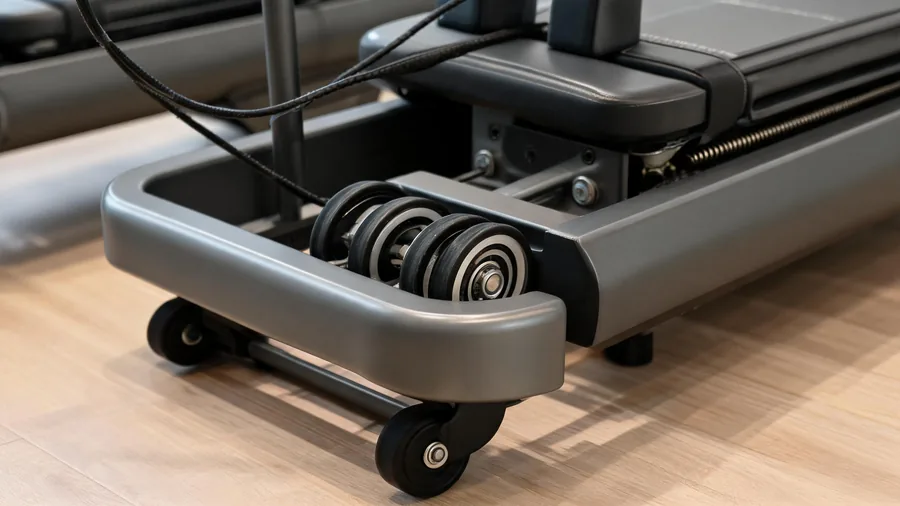
The carriage is the most stressed component. Heavy duty pilates reformers use carriages with 4-6 sealed bearings mounted on hardened steel rails. The rail diameter should be at least 25 mm for commercial applications. Rail alignment tolerances should be within 0.5 mm over the full travel length to ensure smooth glide and even spring distribution.
Carriage stops on heavy duty pilates reformers are steel plate construction, not plastic or aluminum. The stop mechanism should engage with a metal-on-metal contact point rated for 500,000+ cycles, according to ACE Fitness industry guidelines. This prevents the carriage from sliding off the rails during high-intensity movements and protects the end user from injury. Heavy duty pilates reformers also include reinforced carriage bumpers made from industrial-grade urethane that absorb impact without cracking. These bumpers should be replaceable without disassembling the frame, allowing for quick maintenance during normal operating hours.
3. Spring Calibration in Heavy Duty Pilates Reformers
The spring system is where heavy duty pilates reformers differ most from consumer-grade equipment. Commercial springs should be made from 304 stainless steel or equivalent corrosion-resistant alloy. The wire diameter for a standard tension spring on heavy duty pilates reformers should be 1.8 mm to 2.2 mm, producing consistent resistance at every extension point in the range of motion.
Spring calibration is verified at the factory using digital tension testers. Each spring on heavy duty pilates reformers should test within 5% of its rated resistance. Color coding should follow a consistent standard across the manufacturer’s product line: red for light tension, blue for medium, green for heavy, and black for extra heavy resistance levels.
Spring life expectancy on heavy duty pilates reformers is 80,000 to 100,000 cycles before tension degradation exceeds 10%. Studios running 10 classes per day should expect to replace springs every 18-24 months. Spring attachment points should be reinforced with welded eyelets rather than stamped hooks, which can deform under continuous load. Studio maintenance schedules for heavy duty pilates reformers should include monthly spring inspection, quarterly tension testing with a spring scale, and annual replacement of all springs regardless of visual condition to maintain consistent resistance across every reformer in the studio.
4. Bearing Systems in Heavy Duty Pilates Reformers
The bearing system determines glide quality and maintenance frequency in heavy duty pilates reformers. Two main types exist: roller bearings and sealed cartridge bearings. Roller bearings are found on legacy equipment and require periodic lubrication and adjustment. Sealed cartridge bearings, used in modern heavy duty pilates reformers, are maintenance-free for the life of the bearing pack.
Sealed cartridge bearings on heavy duty pilates reformers are rated for 500,000 linear meters of travel before replacement. This translates to approximately 5-7 years of daily studio use. The bearing housing should be precision-machined aluminum or stainless steel, not plastic, to maintain alignment under load.
Rail surface finish is equally important. Heavy duty pilates reformers use chrome-plated or hardened stainless steel rails with a surface hardness of HRC 60 or greater. The rail-to-bearing clearance should be 0.05 mm to 0.10 mm for optimal glide smoothness without lateral play. The lubrication used in heavy duty pilates reformers should be food-grade silicone or PTFE-based, not petroleum-based grease that can degrade the rubber seals on cartridge bearings. Properly maintained heavy duty pilates reformers maintain their glide quality for the full lifespan of the bearing system.
5. Upholstery and Components in Heavy Duty Pilates Reformers
The upholstery on heavy duty pilates reformers must withstand daily cleaning and continuous client use. Commercial upholstery should be marine-grade vinyl with a minimum thickness of 1.2 mm, reinforced with polyester scrim backing. This material resists sweat degradation, cleaning chemicals, and UV fading better than standard vinyl or PU leather.
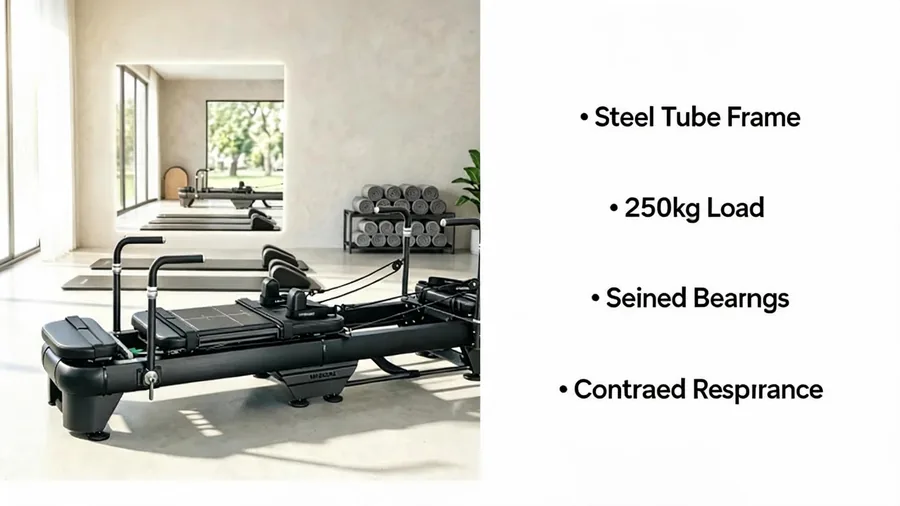
Foam density is another spec that differentiates heavy duty pilates reformers from home equipment. The carriage pad should use high-resilience foam with a density of at least 35 kg/m³. Shoulder rests and head pads need closed-cell foam that does not absorb moisture. Foam compression set should be less than 10% after 100,000 cycles of simulated use.
Rope and strap systems on heavy duty pilates reformers should use 8 mm diameter braided nylon or polyester webbing with a breaking strength of 500 kg minimum. Rope cleats should be metal construction with positive locking mechanisms. Pulleys should be nylon or Delrin with sealed bearings operating at a coefficient of friction below 0.1. Replacement parts for heavy duty pilates reformers should be available from the manufacturer for at least 10 years after the original purchase. This includes upholstery sets, spring packs, bearing assemblies, and strap systems. Factory-direct manufacturers like Megacore maintain parts inventory for all current and previous models to support ongoing studio operations.
Perguntas frequentes
Como posso saber se um reformer é realmente de nível profissional antes de o comprar?
Preste atenção a três aspetos: a espessura do aço do quadro (peça a ficha técnica), o tipo de rolamentos (os rolamentos de cartucho selados são um sinal positivo) e o material da mola (o aço inoxidável 304 é o padrão para uso comercial). Verifique também a garantia — uma garantia do quadro com duração inferior a três anos é um forte indicador de que o fabricante não espera que a máquina tenha uma longa duração num ambiente comercial.
É possível utilizar um reformer de uso doméstico num pequeno estúdio onde se ministram apenas algumas aulas por dia?
É possível a curto prazo, mas não é aconselhável. Mesmo quatro aulas por dia a intensidade moderada irão acelerar o desgaste de um quadro e rolamentos de nível doméstico. A maioria dos proprietários de estúdios que começam com máquinas de nível doméstico acabam por substituí-las no prazo de 12 a 18 meses — e o custo total excede o que teriam pago à cabeça por equipamento comercial.
Quanto tempo deve durar um reformer de pilates para uso intensivo num estúdio?
Com uma manutenção adequada, um reformador comercial de alta resistência deverá ter uma vida útil de 8 a 15 anos. As molas terão de ser substituídas a cada 2 a 3 anos, dependendo do volume de aulas, e o estofo a cada 4 a 5 anos. A estrutura, o carro e o sistema de rolamentos deverão durar toda a vida útil da máquina.
Are factory-direct reformers from China as good as established Western brands?
Many are, and often better value. Reputable Chinese manufacturers use the same Q235 steel, 304 stainless springs, and sealed bearings found in premium Western brands — but sell at 40 to 60 percent lower prices because they eliminate distributor and retail markups. The key is choosing a manufacturer with verifiable quality control, published specifications, and a solid warranty policy. It is also worth visiting the factory or requesting a video walkthrough of the production line before committing to a large order.
Heavy Duty Pilates Reformers: Conclusion
The difference between a reformer that lasts a decade and one that fails in a year comes down to engineering choices made long before the machine reaches your studio. Frame steel thickness, bearing quality, spring material, upholstery density — every component tells the story of whether the manufacturer designed the machine for occasional home use or for the demands of a professional Pilates studio.
When you invest in a heavy duty pilates reformer, you are buying peace of mind: fewer repairs, happier clients, higher class capacity, and a machine that holds its value for years. Megacore builds each reformer with precisely these priorities — overbuilt frames, commercial-grade components, and factory-direct pricing that puts quality within reach of every studio owner. Review the complete product line and download specification sheets to see the difference for yourself.
Invest in Heavy Duty Pilates Reformers for Your Studio
Choosing the right equipment is critical for studio success. Contact us to learn more about heavy duty pilates reformers and factory-direct pricing for your commercial studio. Our team can help you select the ideal configuration for your space and client needs.
Guias relacionados
- Os melhores Reformers de Pilates para uso comercial
- Guia de materiais da estrutura de reformadores Pilates
- Como escolher um fabricante de equipamento Pilates
Referência do setor · Referência do setor ·
Frames, spring ratings and per-unit pricing for the commercial reformer lineup are listed by model.