
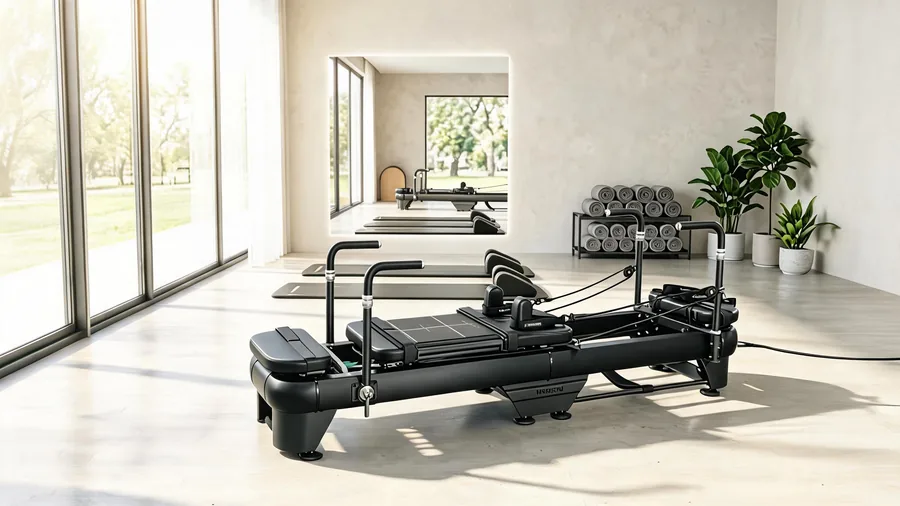
The difference between commercial-grade and residential-grade Pilates reformers is not marketing — it is engineering. A commercial vs residential Pilates reformer comparison reveals fundamental differences in frame construction, bearing systems, spring durability, upholstery quality, and warranty coverage. Commercial reformers are designed for 15 to 25 sessions per day, 6 to 7 days per week, year after year. Residential reformers are designed for 1 to 2 sessions per day, 3 to 5 days per week.
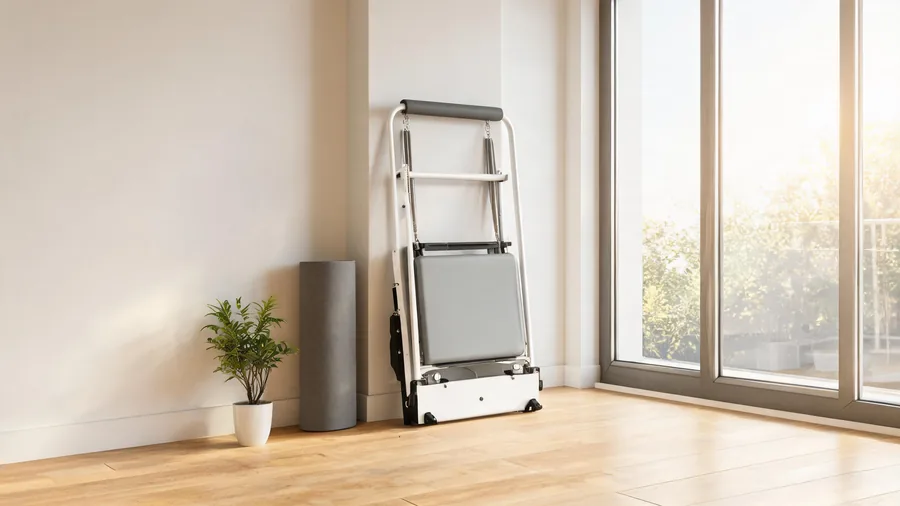
Understanding the commercial vs residential Pilates reformer differences is essential for studio owners evaluating equipment for a new space. The upfront cost difference — typically $1,800 to $4,000 per commercial reformer versus $800 to $2,000 for residential — is justified by the commercial machine’s longer service life and lower per-session cost over 5 to 10 years of continuous operation in demanding studio environments.
1. Frame Construction: The Core Commercial vs Residential Pilates Reformer Difference
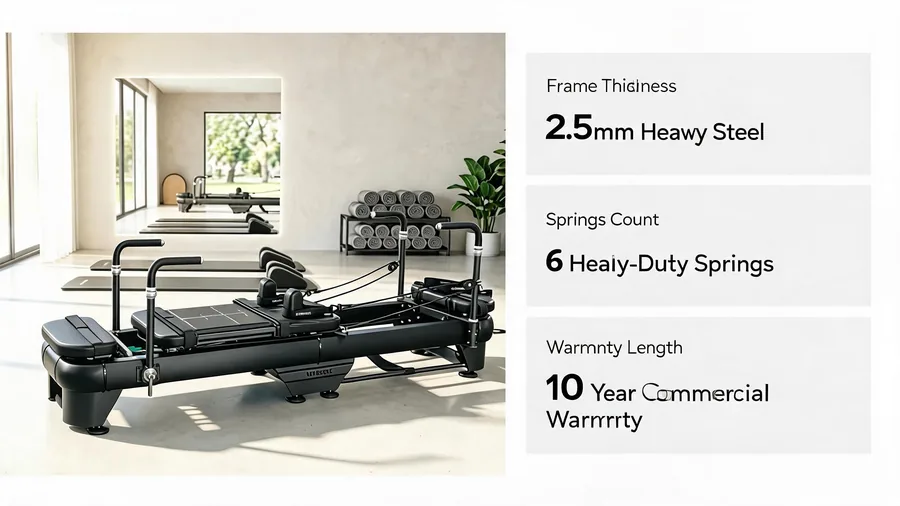
The most significant difference in any commercial vs residential Pilates reformer comparison is frame construction. Commercial-grade reformers use heavier-gauge steel (2.0 to 3.0 mm wall thickness) designed for 10 or more years of daily use. The frame undergoes robotic TIG welding for consistent joint quality and is powder coated at 60+ microns for chip resistance. Residential reformers use lighter materials (1.2 to 1.8 mm wall thickness) adequate for weekly home use but prone to fatigue and frame flex under daily studio conditions.
When a residential frame fails in a commercial setting, the entire reformer typically must be replaced. Frame replacement is rarely cost-effective on lower-priced units because the labor and shipping costs approach the value of the machine itself. This makes frame quality the single most important consideration for studio owners comparing reformers across different price points and usage categories for their facility.
Commercial reformers use structural steel (Q235 grade or equivalent) with reinforced cross-bracing at stress points including footbar mounts, rail attachment points, and spring post brackets. Residential reformers often use mild steel tubing without reinforcement, which develops frame play and squeaking within 6 to 12 months if used in a studio environment exceeding the manufacturer’s intended usage guidelines and duty cycle specifications.
2. Bearing Systems and Carriage Quality
The bearing system is where the performance difference between commercial and residential reformers is most noticeable during use. Commercial reformers use sealed cartridge bearings on precision-ground stainless steel rails. These bearings are rated for 500,000+ meters of carriage travel — equivalent to 10 or more years in a busy studio. Residential reformers use open wheel bearings on aluminum or standard steel rails that collect dust and debris, developing roughness within 6 to 12 months of commercial-level use.
Sealed bearings eliminate the need for periodic lubrication and bearing replacement. Open bearings in residential reformers require regular cleaning and lubrication, and they allow dust and hair to enter the bearing race, causing uneven wear that clients feel as roughness during exercises. The carriage glide quality directly affects client perception of your equipment quality, making smooth bearing performance a critical factor in client retention.
Rail material also differs significantly. Commercial reformers use stainless steel rails (22 to 25 mm diameter) that resist corrosion from cleaning chemicals and humidity. Residential reformers typically use aluminum or zinc-coated steel rails that can develop corrosion spots over time, particularly in humid studio environments where climate control is limited and moisture levels fluctuate throughout the year.
3. Spring Durability and Resistance Systems
In any commercial vs residential Pilates reformer comparison, spring quality separates commercial reformers from residential units in terms of both performance and ongoing maintenance costs. Commercial reformers use high-carbon steel springs rated for 50,000+ cycles with consistent tension throughout their lifespan. Each spring is individually tested and matched within a tolerance range to ensure uniform resistance across all reformers in a studio. Residential reformers use lower-grade springs rated for 10,000 to 20,000 cycles that lose tension and require replacement more frequently.
Spring replacement frequency has a direct impact on studio operating costs. A studio with 10 reformers using commercial-grade springs will replace springs every 18 to 24 months at a cost of approximately $15 to $25 per spring. The same studio using residential-grade springs would need replacement every 6 to 12 months, with springs losing tension gradually, causing inconsistent resistance that clients and instructors notice during exercises.
Commercial reformers also offer better spring attachment systems. Quick-change spring hooks that allow springs to be swapped without tools reduce setup time between classes. Color-coded spring systems help instructors quickly identify and adjust resistance levels. Residential reformers typically use fixed spring attachments that require tools to replace and lack color coding, slowing down class transitions and instructor workflow in studio settings.
4. Weight Capacity and Stability
Weight capacity is one of the clearest differentiators in the commercial vs residential Pilates reformer comparison. Commercial reformers support 150 to 225 kg (330 to 500 lb) compared to 100 to 135 kg (220 to 300 lb) for residential models. Commercial reformers have wider bases and larger stabilizing feet that prevent tipping during dynamic exercises. Residential reformers are intentionally lighter for portability, but this lightness makes them less stable for vigorous studio use with clients of varying sizes.
Frame geometry also contributes to stability. Commercial reformers have lower centers of gravity with wider stance dimensions. The carriage rails are mounted to a reinforced subframe that distributes weight evenly across the base. Residential reformers often use a narrower frame design that saves material costs but creates a higher center of gravity that can lead to rocking or tipping during exercises performed near the edge of the carriage.
For studio owners, weight capacity and stability directly affect client safety and insurance liability. Commercial reformers with documented weight capacity testing provide peace of mind that your equipment can accommodate all clients safely. Residential reformers used in a commercial setting create potential liability exposure if a client exceeds the equipment’s rated capacity during an exercise session or training activity in your studio.
5. Specs Comparison Table
6. Warranty and Total Cost of Ownership
O commercial vs residential Pilates reformer warranty comparison in this commercial vs residential Pilates reformer evaluation reveals differences in manufacturer confidence. Commercial reformers carry comprehensive warranties covering frame, springs, bearings, and upholstery for 3 or more years. Residential reformers typically offer 1 to 2 year warranties with limitations on usage (stated in warranty terms as “home use only”). Using a residential reformer in a commercial setting voids the warranty, leaving the studio owner responsible for all repair and replacement costs.
Total cost of ownership calculations favor commercial reformers for studio applications despite the higher upfront price. A commercial reformer at $2,500 with a 10-year lifespan costs $250 per year. A residential reformer at $1,200 with a 3-year lifespan in commercial use costs $400 per year plus higher maintenance costs for spring and bearing replacements that occur more frequently with lower-grade components.
The Pilates Method Alliance provides guidelines on commercial equipment standards that help studio owners verify manufacturers’ claims about commercial-grade construction. When comparing options, request specification documentation, warranty terms in writing, and independent quality inspection reports that verify the equipment meets commercial-grade standards before making your final purchasing decision for your studio investment.
Compare Commercial Reformers for Your Studio
Contact our team for commercial-grade reformer specifications, pricing, and sample requests. Factory-direct pricing from $1,800 per unit.
E-mail: [email protected] • WhatsApp: +86 189 0238 9454
Guias relacionados
- Commercial Pilates Reformers Guide
- O melhor Reformer de Pilates para utilização em estúdio
- Reformer Weight Capacity Guide
- Reformer Frame Materials Guide
- Guia de Compra de Reformers de Pilates 2026
7. Perguntas frequentes
What is the difference between commercial and residential Pilates reformers?
Commercial reformers use thicker steel frames (2.0-3.0mm), sealed cartridge bearings, stainless steel rails, springs rated for 50,000+ cycles, and carry 3+ year warranties. Residential reformers use lighter materials and are designed for home use only, with 1-2 year warranties.
Can I use a residential reformer in my studio?
Technically yes, but it is not recommended. Residential reformers are designed for 1-2 sessions per day. Using them commercially voids the warranty, accelerates wear, and creates liability concerns due to lower weight capacities and reduced frame stability.
How much more does a commercial reformer cost vs residential?
Commercial reformers typically cost $1,800 to $4,000 compared to $800 to $2,000 for residential models. However, the per-year cost of ownership is lower for commercial reformers because they last 8-15 years versus 3-5 years for residential units in commercial use.
What frame thickness do I need for a studio reformer?
Minimum 2.0 mm steel wall thickness for commercial use. Reformers with 1.5 mm or thinner frames are residential-grade and will develop frame flex and play within months of daily studio use. Look for Q235 structural steel with robotic TIG welding for best results.
Do commercial reformers have better resale value?
Yes. Commercial-grade reformers retain 40 to 60 percent of their value after 5 years and can be sold to other studios or home users. Residential reformers have minimal resale value because their shorter lifespan means the next owner inherits soon-to-fail components.
What is the lifespan of a commercial vs residential reformer?
Commercial reformers last 8 to 15 years in daily studio use with proper maintenance. Residential reformers last 3 to 5 years under the same conditions before frame fatigue, bearing wear, and spring failure require replacement of the entire unit.