

Le secteur du fitness connaît un rapprochement croissant entre l'entraînement fonctionnel et le Pilates. Les box CrossFit et les salles de fitness fonctionnel ajoutent des reformers pour compléter leur programmation existante, et les résultats changent la façon dont les gérants envisagent la récupération, la mobilité et les revenus liés aux cours. Un reformer Pilates dédié au CrossFit comble un manque précis : il apporte le travail de mobilité et de gainage que l'entraînement à la barre lourde laisse de côté, et les gérants qui en installent un comprennent vite pourquoi il a sa place dans le système d'entraînement.
1. Pourquoi les salles CrossFit ajoutent des reformers
La programmation CrossFit repose sur l'intensité, les mouvements polyarticulaires et le conditionnement à fort volume. Ce qui lui manque, c'est un travail de mobilité contrôlé et des séances de récupération à faible impact. Un reformer Pilates pour athlètes CrossFit offre une résistance à ressorts qui développe le contrôle articulaire, la stabilité du tronc et la souplesse sans ajouter d'impact à des articulations déjà sollicitées — exactement ce dont les athlètes fonctionnels ont besoin entre deux séances lourdes.
Les gérants y voient aussi un intérêt économique. Les séances de reformer se vendent à un tarif premium par créneau, attirent des adhérents qui boudent les cours traditionnels et remplissent les heures creuses. L'ajout de deux reformers seulement transforme une surface inutilisée en nouvelle source de revenus tout en améliorant la fidélisation grâce à une meilleure récupération.
2. Choisir un reformer Pilates adapté à un environnement CrossFit
Tous les reformers ne survivent pas à un environnement de fitness fonctionnel : c'est pourquoi le choix du matériel est l'étape la plus importante lorsque vous prévoyez d'ajouter un reformer Pilates pour CrossFit. Les salles CrossFit sont poussiéreuses, très fréquentées et utilisées par des athlètes qui n'ont pas de formation Pilates. Le matériel doit être plus robuste qu'une machine de studio boutique :
- Châssis en acier : choisissez de l'acier Q235 homologué pour 350 kg, la même norme que les reformers de studio professionnels.
- Ressorts durables : l'acier à haute teneur en carbone, calibré pour plus de 50 000 cycles, supporte un usage quotidien intensif.
- Chariot sur roulements : il résiste mieux à la poussière et aux grains que les systèmes à glissières et préserve la fluidité du mouvement.
- Base stable : des pieds larges et un profil bas évitent tout déplacement pendant les séances dynamiques.
- Entretien facile : le remplacement des ressorts sans outil est essentiel quand l'équipe technique n'est pas spécialisée en Pilates.
Lorsque vous évaluez un reformer Pilates destiné à une installation CrossFit, la capacité de charge et la rigidité du châssis passent en premier. Une machine qui fléchit sous la charge est dangereuse dans une salle où les athlètes poussent fort.
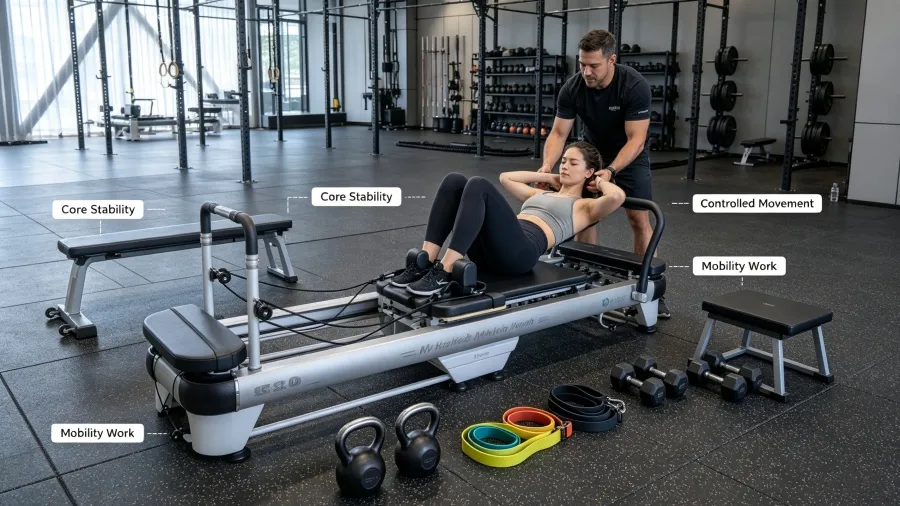
3. Programmation hybride avec le reformer Pilates pour CrossFit
Les salles hybrides qui réussissent le mieux intègrent le reformer au système d'entraînement plutôt que de le traiter comme un studio Pilates rapporté. Trois modèles de programmation fonctionnent bien :
| Modèle | Fonctionnement | Idéal pour |
|---|---|---|
| Bloc récupération | 15 à 20 min de mobilité au reformer en fin de WOD | Améliorer la récupération, réduire les courbatures |
| Cours de mobilité dédiés | Séances de reformer dédiées à la souplesse et au gainage | Adhérents recherchant un entraînement structuré à faible impact |
| Journées de récupération active | Travail au reformer les jours de repos | Maintenir l'engagement des adhérents entre les séances lourdes |
Les salles qui intègrent le travail au reformer dans le déroulé de leurs cours existants enregistrent la meilleure utilisation : c'est cette intégration qui fait la différence entre un programme de reformer Pilates pour CrossFit rentable et un équipement à l'arrêt. Utilisé pour la récupération CrossFit, le reformer entre dans la routine quotidienne au lieu de rester inutilisé une fois l'effet de nouveauté passé.
4. Aménagement de l'espace dans une salle de fitness fonctionnel
Les salles de fitness fonctionnel manquent généralement de place, l'espace au sol étant consacré aux structures, aux racks et au gazon libre. Les reformers ont besoin d'une zone définie : environ 2,4 x 0,9 m par machine, dégagement compris, à prévoir dès la conception de l'implantation du reformer Pilates pour CrossFit. Privilégiez un angle ou un mur latéral qui ne gêne ni les trajectoires de barre ni la circulation des cours.
La poussière et la magnésie sont les principales contraintes du milieu. Éloignez les reformers des postes de magnésie et couvrez-les hors utilisation si la salle propose des entraînements poussiéreux. Un reformer Pilates destiné aux environnements CrossFit doit être équipé d'un revêtement facile à nettoyer, résistant à la sueur, à la magnésie et aux produits d'entretien professionnels.
5. Formation du personnel et certification des instructeurs
Les cours de reformer exigent des instructeurs formés. Les coachs CrossFit ne sont pas qualifiés d'office pour enseigner le Pilates, et les enjeux de sécurité sont plus élevés avec des athlètes forts mais peu formés à la mobilité. Trois options : recruter un instructeur Pilates certifié à temps partiel, certifier un coach déjà en poste ou démarrer avec une programmation enregistrée.
Commencez par un pilote réduit : un reformer, un instructeur formé et deux à trois cours par semaine, afin d'affiner votre programmation de reformer Pilates pour CrossFit avant de passer à l'échelle. Mesurez la fréquentation et les retours des adhérents avant de déployer un programme complet. Les données du pilote vous indiqueront le modèle de programmation adapté à votre clientèle.
6. Points de sécurité du reformer en CrossFit
Les athlètes qui découvrent le reformer ont besoin d'instructions claires sur la résistance des ressorts, le contrôle du chariot et les limites de la machine. Affichez visiblement les capacités de charge, apposez des autocollants explicatifs sur chaque machine et imposez une séance d'initiation avant toute utilisation autonome.
Liability coverage should be reviewed: confirm your gym’s policy covers equipment-based wellness activities. Follow the same safety standards used for commercial studio reformers, including daily inspection checklists and documented maintenance.
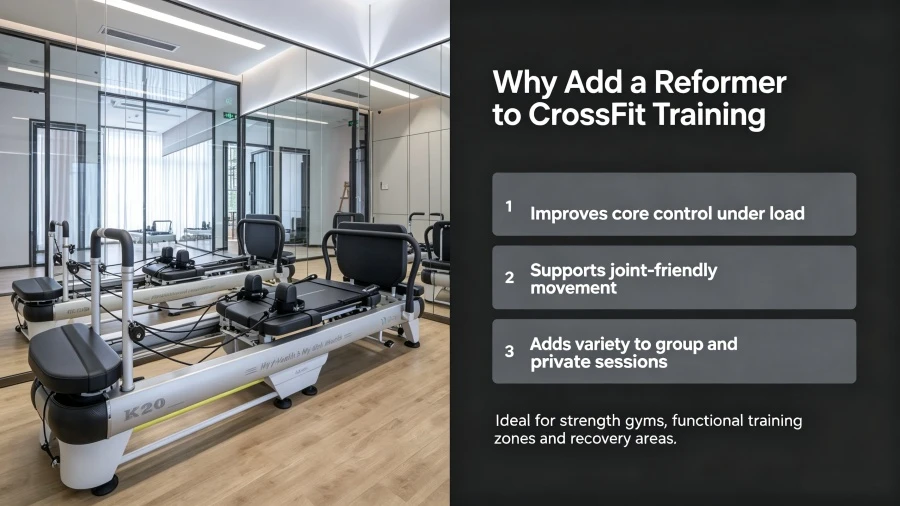
7. Retour sur investissement pour la salle hybride
L'économie d'un ajout de reformer Pilates pour CrossFit plaide en faveur de la programmation hybride. Un reformer utilisé pour les blocs de récupération et des cours dédiés génère des revenus sur plusieurs segments d'adhérents. Les gérants constatent généralement un retour sur investissement du matériel dès la première année lorsque les reformers tournent à plus de 60 % d'utilisation.
| Source de revenus | Exemple | Impact |
|---|---|---|
| Cours de reformer dédiés | 4 cours par semaine à tarif premium | Nouvelle source de revenus |
| Bloc récupération en option | Inclus dans l'abonnement | Fidélisation améliorée |
| Remplissage des heures creuses | Séances de midi et de soirée | Meilleure utilisation de la surface |
Au-delà des revenus directs, la programmation reformer différencie la salle de ses concurrents et attire des adhérents qui s'entraîneraient sinon dans un studio Pilates distinct.
8. S'approvisionner en reformers de qualité professionnelle
Source a pilates reformer for crossfit use from a factory-direct manufacturer that builds commercial-grade machines: Q235 steel frames, 50,000-cycle springs, roller bearing carriages, and 3-year warranties on frame and machine. Megacore’s commercial range meets these specifications, with each unit backed by a quality inspection certificate and test report (report number GZHL2601000020601SP).
Commandez si possible des unités de démonstration, et vérifiez que le fabricant assure pièces détachées et garantie à la hauteur de l'intensité d'usage d'une salle de fitness fonctionnel.
Questions fréquentes
Q1 : Les athlètes CrossFit peuvent-ils utiliser un reformer en toute sécurité ?
Oui, avec une instruction adaptée. Les reformers offrent une résistance à ressorts qui développe le contrôle articulaire et la mobilité sans impact. Une séance d'initiation portant sur la résistance des ressorts et le contrôle du chariot est indispensable pour les athlètes qui découvrent la machine.
Q2 : Combien de reformers faut-il dans une salle de fitness fonctionnel ?
La plupart des salles démarrent avec 1 à 2 reformers pour un pilote, puis passent à 4 à 6 unités lorsque la fréquentation justifie l'investissement et que la surface le permet.
Q3 : Qu'est-ce qui rend un reformer adapté à une salle de sport ?
Un châssis en acier renforcé (homologué 350 kg), des ressorts en acier à haute teneur en carbone, un chariot sur roulements, une base large et stable et un revêtement facile à nettoyer. La résistance à la poussière et l'entretien sans outil sont essentiels dans les espaces de fitness fonctionnel.
Q4 : Faut-il un instructeur Pilates certifié ?
Oui, pour des cours structurés. Recrutez un instructeur certifié à temps partiel, certifiez un coach déjà en poste ou démarrez avec une programmation enregistrée. Le niveau de sécurité dépend de la qualité de l'enseignement.
Q5 : Quelle surface faut-il pour une zone de reformers ?
Environ 2,4 x 0,9 m par machine, dégagement compris. Une zone de 2 reformers tient dans 14 à 19 m², souvent dans un angle ou contre un mur latéral, à l'écart des trajectoires de barre.
Q6 : Quelle garantie est associée aux reformers professionnels ?
Les reformers professionnels Megacore bénéficient d'une garantie de 3 ans sur le châssis et la machine, accompagnée d'un certificat de contrôle qualité et d'un rapport d'essai (rapport n° GZHL2601000020601SP).
Conclusion
Un reformer Pilates pensé pour les environnements CrossFit est un ajout stratégique pour les salles de fitness fonctionnel : il améliore la récupération, crée une source de revenus premium et différencie la salle sur un marché concurrentiel. Choisissez du matériel de qualité professionnelle, formez correctement vos instructeurs et testez avant de passer à l'échelle.
Commencez avec une machine et un créneau, mesurez la réponse et laissez les données guider le déploiement d'un programme hybride complet.
Demandez les tarifs des reformers CrossFit à Megacore
Guides associés
- Pilates Reformer Boxing & Core
- Reformer Pilates pour le bien-être en entreprise
- Guide des cours de reformer en groupe
- Guide de nettoyage du reformer Pilates
Références du secteur : Normes professionnelles de la Pilates Method Alliance, Directives de sécurité au travail de l'OSHA, et CDC – Maîtrise des infections liées à l'environnement.
Gyms with high floor turnover usually pick from the commercial reformer lineup.