
When investing in commercial Pilates reformers, the difference between equipment that lasts five years and equipment that lasts fifteen comes down to one thing: quality control. Every studio owner has heard stories of reformers that develop squeaky carriages, rusted springs, or peeling upholstery within months of purchase. These failures are almost always traceable to gaps in the factory’s quality control process.
This guide explains how professional Pilates reformer manufacturers like Megacore implement quality control throughout production — from raw material inspection to final packaging — so you know exactly what to look for when evaluating equipment suppliers.
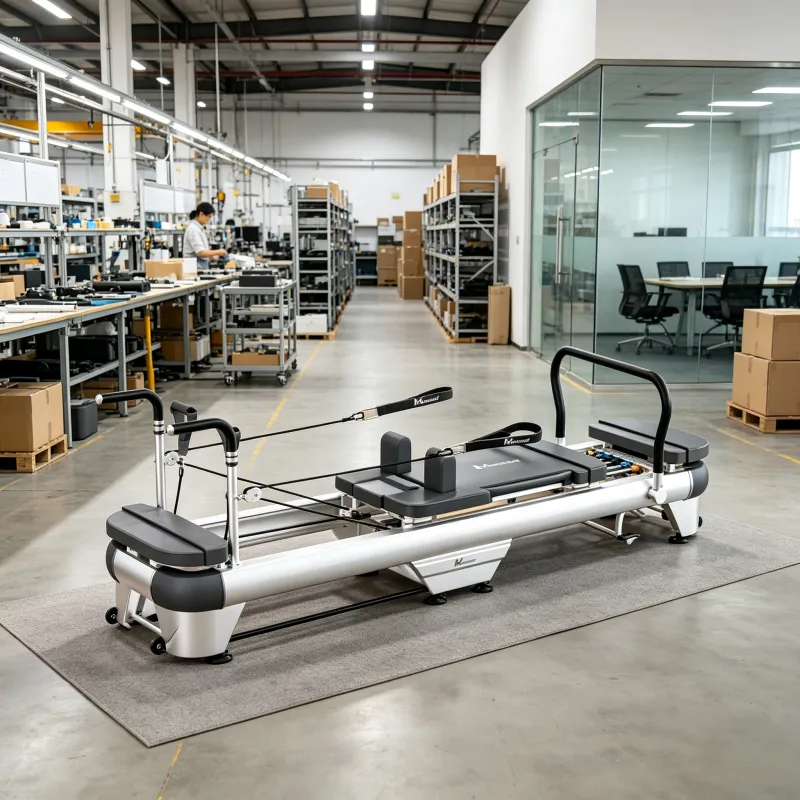
1. Raw Material Inspection
Quality begins with materials. Every Pilates reformer quality control process starts at the receiving dock, where incoming raw materials are inspected against documented specifications before any production begins. This first line of defense prevents substandard materials from entering the production line in the first place.
For steel frames, manufacturers should test each batch for thickness tolerance, tensile strength, and surface finish. These raw material checks are the foundation of any serious pilates reformer quality control program. Megacore uses Q235 commercial-grade steel with a documented thickness of 2.5mm for frame rails and structural components. Incoming steel coils are measured with calipers and tested for consistency across the full width. Any batch falling outside the ±0.1mm tolerance is rejected before it reaches the cutting station.
For aluminum components, the alloy grade (typically 6061-T6 or equivalent) must be verified against material certificates. Every coil and extrusion batch is logged with its certificate number, so a specific reformer can always be traced back to the material it was built from. This traceability is part of why the quality inspection certificate GZHL2601000020601SP carries weight — it documents the full material chain, not just the final test.
Marine-grade vinyl for upholstery undergoes thickness testing, color consistency checks, and burn testing to confirm fire-retardant properties. Sealed cartridge bearings are tested for rotational smoothness and noise levels before assembly — a critical step that directly affects the smooth glide feel of the finished reformer.
2. Welding and Frame Construction
The frame is the backbone of any Pilates reformer, and weld quality determines its structural integrity. A rigorous Pilates reformer quality control program includes visual inspection of every weld joint, followed by dimensional verification of the assembled frame.
Professional manufacturers use certified welders who follow documented welding procedures. Before a welder is approved for production work, their test pieces are sectioned and examined under magnification to verify penetration depth.
In production, random frames are pulled from the line and sectioned the same way, so weld quality stays consistent instead of drifting over time. After welding, frames are checked for squareness, twist, and dimensional accuracy. Megacore uses a custom jig system that holds the frame in precise alignment during welding, then measures the completed frame against a master template. Frames that fail the dimensional check — typically less than 2% of production — are either reworked or scrapped.
Post-weld treatment is equally important: frames are stress-relieved to prevent warping, then ground and polished to create a smooth surface for powder coating. Each frame carries a traceable serial number tied to its production batch, enabling root cause analysis if issues are discovered later.
3. Powder Coating and Surface Finish
Surface finish quality directly affects both appearance and durability. A proper Pilates reformer quality control program for powder coating includes multiple inspection points: surface preparation, coating thickness, adhesion, and color consistency.
Before powder coating, frames undergo chemical pretreatment to remove oil, rust, and contaminants. The pretreatment quality is verified with a water break test — if water beads on the surface, the part must be re-cleaned. After coating, thickness is measured with an electronic gauge at three points on each frame. Megacore targets 60-100 microns coating thickness, with a minimum acceptable thickness of 50 microns on any surface.
Adhesion testing uses a cross-hatch tape test per ASTM D3359 standards. Color consistency is verified against a master sample using spectrophotometer readings. The quality inspection standards documented in certification GZHL2601000020601SP include all of these test methods, providing independent verification of the coating process.
4. Spring and Bearing Testing
Springs and bearings are the most stressed components on any reformer. A thorough Pilates reformer quality control program tests both before assembly and after final installation.
Each spring batch should be tested for load consistency — the force required to extend the spring should fall within a published tolerance across all springs in the batch. Megacore tests every spring batch on a calibrated tension tester, measuring load at 50% and 100% extension. Springs that vary by more than 5% from the specification are discarded.
Bearings are tested for rotational resistance and noise. Sealed cartridge bearings used in Megacore reformers are rated for 500,000 meters of use, tested on a custom rig that simulates three years of studio operation in 72 hours. Bearing noise is measured with a decibel meter — anything above 50dB at operating speed triggers rejection.
For reference, the guide on commercial reformer noise levels explains why bearing quality directly affects the client experience. A reformer that passes every functional test also gets a final ride check: the carriage is rolled the full length of the rails while an inspector listens for any click, grind, or uneven resistance. This simple step catches assembly issues that instruments alone can miss.
5. Upholstery and Foam Testing
Upholstery quality determines how a reformer looks and feels after years of daily use. A complete Pilates reformer quality control program tests both the raw materials and the finished upholstery assembly.
High-density foam (35kg/m³ density in Megacore reformers) is tested for compression set — how much it recovers after repeated loading. Foam with poor recovery leads to permanent indentations in carriage pads within months. The foam is also tested for density consistency across the full sheet and for off-gassing that could create odors in a closed studio environment.
Marine-grade vinyl undergoes tensile strength testing (minimum 15 MPa), tear resistance, and accelerated UV aging tests. Colorfastness is verified by rubbing a solvent-soaked cloth across the surface — any color transfer indicates a failing batch. After upholstery assembly, each carriage pad and shoulder rest is visually inspected for wrinkles, bubbles, and seam quality before being approved for final assembly.
6. Final Assembly and Functional Testing
The final stage of Pilates reformer quality control brings all components together and tests the assembled machine as a complete system. This is where hidden issues — parts that fit individually but don’t work together — are caught before the reformer ships to your studio.
Each assembled reformer goes through a functional test checklist that mirrors the pilates reformer quality control requirements buyers should expect from any commercial supplier:
- Carriage glide test — smooth, silent movement across full rail length
- Spring engagement — each spring hooks securely and releases smoothly
- Rope and strap operation — even tension, no fraying at connection points
- Footbar adjustment — locks securely at each position
- Shoulder rest movement — smooth adjustment without binding
- Safety check — all bolts torqued to specification, no sharp edges
- Noise evaluation — overall operating noise below 50dB measured at 1 meter
Every reformer that passes functional testing receives a quality stamp and is logged by serial number in the production database. Units that fail any checkpoint are tagged, logged, and returned to the appropriate production stage for rework. Megacore’s factory rejects approximately 3% of units at final inspection — a number that is tracked weekly and used to drive continuous improvement in upstream processes. The complete testing protocol is documented in quality certification GZHL2601000020601SP.
| QC Checkpoint | What Is Tested | Rejection Criteria |
|---|---|---|
| Raw material receiving | Steel thickness, alloy grade, vinyl burn test | ±0.1mm tolerance exceeded, missing certificates |
| Welding and frame | Weld joints, squareness, twist | Visible defects, out-of-square frame |
| Powder coating | Adhesion (ASTM D3359), color consistency | Cross-hatch flaking, color drift |
| Springs and bearings | Load at 50%/100% extension, noise level | ±5% load variance, above 50dB |
| Upholstery and foam | Foam compression set, vinyl tensile, seams | Permanent indentation, seam defects |
| Final assembly | Carriage glide, spring engagement, safety | Any functional failure, noise above 50dB |
| Packaging | 30cm drop test on all corners | Any damage to contents |
7. Packaging and Shipment Inspection
Even a perfectly built reformer can arrive damaged if packaging is inadequate. The final Pilates reformer quality control gate is packaging inspection, where the packed unit is tested for transport survival.
Professional manufacturers use multi-layer packaging, and the packing standard is part of pilates reformer quality control from the moment the unit leaves the line: a protective film wrap, foam corner blocks, a corrugated cardboard inner box, and a heavy-duty outer carton. Megacore drop-tests packed reformers from 30cm onto each corner and edge, then inspects the contents for damage. Any packaging design that fails this test is redesigned before shipment.
Before closing the carton, each unit is photographed with its serial number visible. These photos serve as evidence of the unit’s condition before shipment, protecting both the buyer and seller in case of transit damage claims.
Export shipments include a packing list, inspection certificate referencing GZHL2601000020601SP, and a warranty registration card. Containers are loaded with the heaviest cartons at the base and the packing plan is photographed before sealing, which protects the buyer if a claim arises after arrival. A factory that documents the loading process is a factory that expects every unit to arrive in the same condition it left.

Domande frequenti
Q: What quality certifications should a Pilates reformer manufacturer have?
A: Look for documented quality inspection standards like certification GZHL2601000020601SP, which covers raw material testing, weld inspection, powder coating adhesion, spring load testing, and final assembly verification. Independent certifications from organizations like the Pilates Method Alliance provide additional quality benchmarks for commercial equipment.
Q: How can I verify factory quality control before ordering?
A: Request a factory audit or video tour showing the QC checkpoints described above. Ask for test reports from recent production batches. Reputable manufacturers will provide documentation without hesitation. Better yet, visit the factory in person — Megacore welcomes studio owners to tour their Guangzhou facility and see the quality control process first hand.
Q: What warranty should I expect from a quality-controlled reformer?
A: Megacore offers a 3-year warranty covering both frame and entire machine. This warranty is backed by the documented quality control process — when every production step is tested and recorded, the manufacturer can confidently stand behind the product.
Q: Is Pilates reformer quality control the same for all manufacturers?
A: No. Quality control varies dramatically between manufacturers. Less rigorous factories may skip raw material testing, reduce weld inspection to visual-only checks, and eliminate functional testing entirely. This is why two reformers that look identical on paper can perform completely differently in a studio environment. Requesting documented QC procedures is the only way to know what you are getting.
Q: How often are quality control processes updated?
A: Professional manufacturers review QC processes quarterly and update them based on defect data, customer feedback, and new industry standards. Megacore’s quality team meets weekly to review inspection data and identify trends that require process adjustments.
9. Why Pilates Reformer Quality Control Matters for Your Studio
A reformer built under rigorous quality control is an investment in your studio’s reputation, and pilates reformer quality control is exactly what separates equipment that performs from equipment that only looks the part. in your studio’s reputation. Every smooth glide, every quiet operation, every spring that returns consistent resistance class after class — these are the results of a quality control process that leaves nothing to chance.
When evaluating equipment suppliers, ask for their quality control documentation. Look for the depth and detail of their testing procedures. A manufacturer that can show you their raw material inspection protocols, weld quality standards, powder coating test results, and functional testing checklists is a manufacturer that stands behind their product. The certification GZHL2601000020601SP provides an independent reference point for these quality standards.
Quality control is not a single inspection at the end of the line; it is a chain of checks that runs from the receiving dock to the shipping container. Every checkpoint in that chain exists to protect one thing: the performance your clients feel in every class. Megacore Pilates welcomes studio owners to learn more about their quality control process. With factory-direct pricing, documented QC procedures, and a 3-year warranty backing every reformer, the commitment to quality is measurable and verifiable. Contact the team to schedule a factory tour or request quality documentation for your next equipment order.
Altre risorse: Guida all'acquisto del Reformer Pilates 2026 | Equipment Warranty Guide | Frame Materials Guide