Pilates reformer weight capacity is one of the most overlooked specifications when purchasing equipment for commercial use. Studio owners often focus on spring resistance, carriage glide, and included accessories while ignoring the frame’s structural limits. A reformer with inadequate weight capacity poses safety risks, voids insurance coverage, and wears out prematurely under daily studio use.


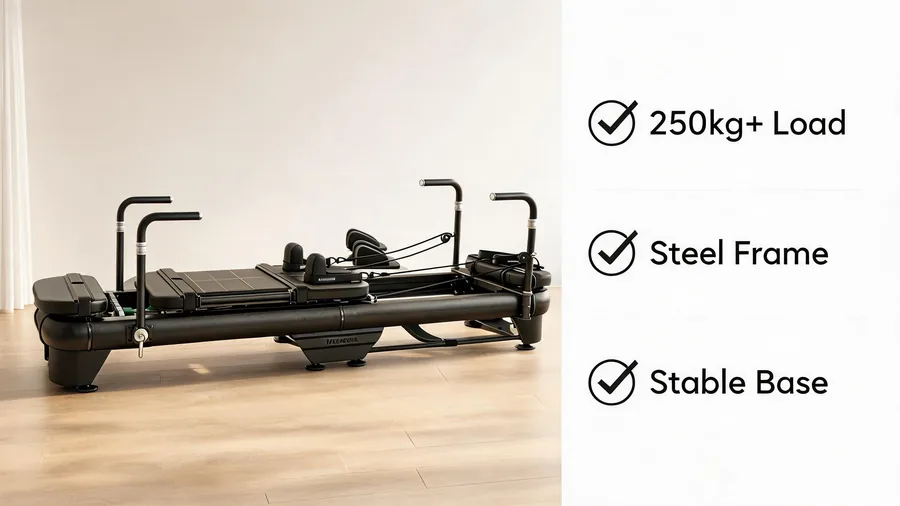
This guide explains weight capacity ratings, what determines a frame’s load limit, and why 250 kg+ steel frames are the ピラティス・メソッド・アライアンス industry benchmark for commercial Pilates studios.
1. What Pilates Reformer Weight Capacity Means
Weight capacity refers to the maximum static and dynamic load the reformer frame can support without structural deformation. Static load is the user’s body weight at rest on the carriage. Dynamic load includes the forces generated during movement — jumping on the jump board, explosive leg presses, and eccentric braking forces from heavy spring resistance.
Dynamic loads can be 2.5–3.5 times the user’s static body weight. A 100 kg user performing jump board exercises generates approximately 280–350 kg of peak force on the frame and carriage bearings. This is the reason commercial reformers require frame capacities of 250 kg or higher — the static rating is a baseline, not a real-world limit.
2. Pilates Reformer Weight Capacity: Frame Materials
Three frame materials dominate the reformer market, each with distinct weight capacity characteristics:
Powder-Coated Carbon Steel (Standard Commercial):
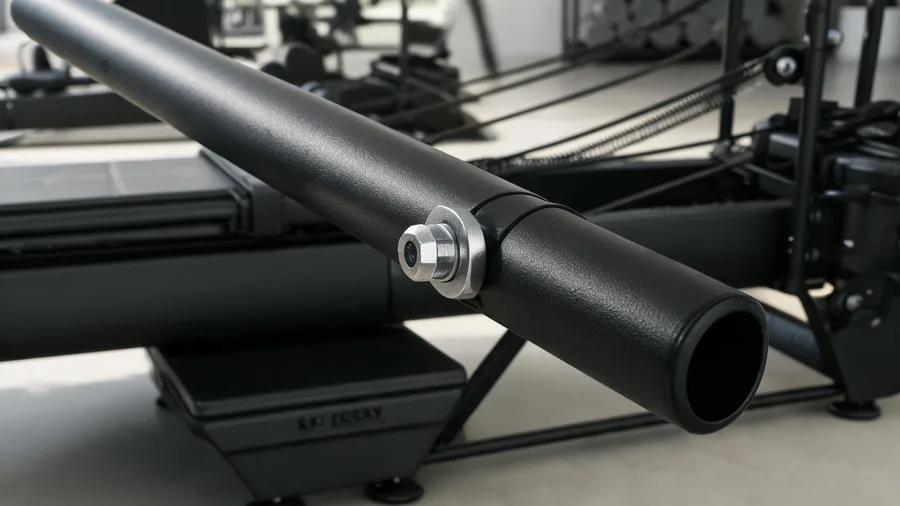
Weight capacity 200–350 kg. Wall thickness 2.0–3.0 mm. Used in 90% of studio reformers worldwide. Offers the best strength-to-cost ratio. Requires corrosion-resistant coating in humid environments.
Stainless Steel (Premium Commercial):
Weight capacity 300–450 kg. Wall thickness 2.5–3.5 mm. Approximately 40–60% more expensive than carbon steel. Preferred for coastal studios, outdoor wellness facilities, and premium brands. Zero rust risk.
Anodised Aluminium (Lightweight / Home):
Weight capacity 120–180 kg. Wall thickness 3.0–5.0 mm (aluminium requires thicker walls for equivalent strength). Suitable for home use but not recommended for daily commercial rotation. Aluminium frames show wear faster under high-frequency use.
For a studio expecting 15–30 client sessions per day, carbon steel with minimum 2.5 mm wall thickness is the recommended specification. Guangzhou manufacturers typically use Q235B or Q345B structural steel for commercial frames.
3. Why Pilates Reformer Weight Capacity Matters
Understanding Pilates reformer weight capacity is essential for studio owners managing diverse client body types and class intensities. Higher weight capacity means stronger frames and longer equipment life.
Client inclusivity:
Studios serving diverse body types need reformers that accommodate clients up to 150 kg safely, with dynamic load headroom. A 250 kg rated frame provides that margin in pilates reformer weight capacity.
Jump board safety:
Jump board exercises generate repetitive high-impact loads. A frame rated below 250 kg may develop weld fatigue within 6–12 months of daily jump board classes.
Spring tension integrity:
The frame must withstand the combined pull of multiple heavy springs without bowing or flexing. Frame deflection as small as 2 mm changes spring alignment and creates uneven resistance.
Longevity:
A properly specified 250 kg+ frame lasts 15–20 years in commercial use. Frames rated below 200 kg typically show structural issues — creaking, carriage misalignment, or corner weld cracking — within 3–5 years. Higher Pilates reformer weight capacity ratings correlate directly with longer frame lifespan and reduced maintenance costs over the equipment life cycle.
4. Testing Pilates Reformer Weight Capacity
Quality manufacturers test frames using static load machines that apply increasing weight until deformation occurs. The pass/fail threshold is typically set at 1.5 times the rated capacity. A frame rated for 250 kg must withstand 375 kg of static load without permanent deformation.
Dynamic testing involves automated carriage cycling under a weighted dummy at varying speeds — typically 100,000 cycles minimum. This simulates 3–5 years of studio use in controlled conditions. Quality inspection certificate GZHL2601000020601SP includes both static load and dynamic cycle test results for the frame assembly.
Weld quality is verified through magnetic particle inspection (MPI) or dye penetrant testing. Poor weld penetration is the most common failure point in sub-standard reformers. Inspection reports should show weld depth-to-thickness ratios above 80%.
5. Carriage and Bearings in Pilates Reformer Weight Capacity
Weight capacity is not solely a frame specification. The carriage, bearing system, and rail assembly must match the frame rating. Key considerations:
Carriage platform thickness — minimum 12 mm plywood with high-pressure laminate (HPL) surface or 15 mm bamboo. Thinner carriages flex under load, causing uneven glide. Bearing count — commercial reformers should have a minimum of 4 sealed roller bearings per carriage, with larger-diameter bearings (20 mm+) distributing load more evenly. Rail material — stainless steel or hardened steel rails, minimum 3 mm thickness. Chrome-plated rails on home-grade reformers wear grooves under daily use, creating rough carriage movement.
6. Pilates Reformer Weight Capacity and Warranty
A manufacturer warranty on the frame is a strong indicator of Pilates reformer weight capacity confidence. A 3-year structural warranty on a 250 kg rated frame shows engineering commitment. Always review the warranty terms for load-related exclusions before purchasing.
Frame warranties are typically conditional on weight capacity compliance. A studio reformer used with clients exceeding the frame rating voids the warranty. Manufacturers with 3-year frame warranties (such as the standard factory-backed coverage from Guangzhou producers) explicitly state maximum user weight in the warranty terms.
When comparing warranty offers, check whether the warranty covers frame deformation, weld failure, and carriage rail damage. Some warranties exclude carriage components and cover only the steel frame. Read the exclusions carefully before ordering.
7. Pilates Reformer Weight Capacity: Summary
Weight capacity is a non-negotiable specification for commercial Pilates reformers. A 250 kg+ steel frame with proper bearing support and quality welds ensures safety, durability, and versatility for all client body types. When evaluating reformers from different suppliers, request the static and dynamic load test reports — not just the marketing specification. A reformer that passes rigorous load testing will serve your studio reliably for 15 years or more. The Best Pilates Reformers for Commercia Comparing Heavy Duty Pilates Reformer: W
Pilates reformer weight capacity: Frequently Asked Questions
このピラティス器具は、エントリーレベルの他社製品と何が違うのでしょうか?
その違いは、素材と構造にあります。業務用グレードの機器は、全金属製のフレーム、密閉型ベアリング、および校正済みのスプリングを採用しています。一方、エントリーモデルは、より軽量な素材を使用しているため、劣化が早くなります。高品質なリフォーマーは5~10年以上使用できますが、エントリーモデルのリフォーマーは1~2年で買い替えが必要になることがよくあります。.
この機器が自分の具体的なニーズに合っているかどうか、どうすればわかりますか?
Consider your primary use case: studio vs home, client demographics, class volume, and budget. Studio owners should prioritize durability and maintenance access. Home users should prioritize space efficiency and ease of use. Match the equipment specifications to your specific requirements rather than buying general-purpose.
評判の良いメーカーからは、どのような保証やサポートが期待できるのでしょうか?
業務用機器には、少なくとも2年間の構造保証と1年間の部品保証が付帯している必要があります。Megacoreのようなメーカー直販企業は、多くの場合、保証期間の延長や直接的な技術サポートを提供しています。購入前には、必ず書面による保証書類の提示を求めてください。.
Pilates reformer weight capacity: Conclusion
適切な機器を選ぶことは、ピラティスの練習やビジネスにおいて大きな違いをもたらします。スタジオの開設、既存のマシンの更新、あるいは自宅での練習環境の整備のいずれであっても、自身の具体的なニーズに合った高品質な機器への投資こそが、長期的な満足感と成果の基盤となります。.
Choose Reformers with the Right Pilates Reformer Weight Capacity
Contact us to discuss Pilates reformer weight capacity requirements for your commercial studio. We can help you select equipment that meets your load needs.
Understanding Pilates reformer weight capacity helps studio owners select safe and durable commercial equipment.