
Pilates reformer financing rarely gets the attention it deserves. Studio owners spend weeks comparing spring gauges and frame welds, then sign whatever payment plan the dealer slides across the table. That order is backwards. The terms you accept decide whether your studio absorbs a slow January, whether you can add four machines next spring without a new credit application, and how much revenue leaves the business before you pay an instructor.
Below are the four ways most studios pay for reformers, what each costs in practice, and how to structure a deal that survives a normal year. Prices appear only as inputs to the math. For the price picture itself, start with our breakdown of commercial pilates reformer cost.
Every figure below is an illustrative assumption, not a quote. Rates move with your credit profile, your country, and the lender.
1. Why Studio Owners Finance Reformers at All
A reformer fleet is the largest capital purchase most studios make. Twelve mid-range commercial machines plus accessories and freight can land between $30,000 and $45,000 before you charge for a class. Few first-time owners have that in savings.
Financing exists because equipment and revenue arrive on different clocks. The machines must be installed before you can sell memberships against them, and revenue builds over months. A payment plan stretches the cost across the period when the equipment is earning.
There is a second reason unrelated to cash. Reserves protect a studio from what always happens: a lease deposit, a slow month, a top instructor leaving, a furnace dying in February. A studio with $40,000 in the bank and $40,000 of new debt is more fragile than one with $20,000 in the bank and $24,000 financed. The second absorbs a surprise. The first cannot.
Our guide to starting a Pilates studio covers what comes before this decision, and the studio equipment checklist shows what else competes for the same budget.
2. The Four Ways to Pay: A Quick Overview
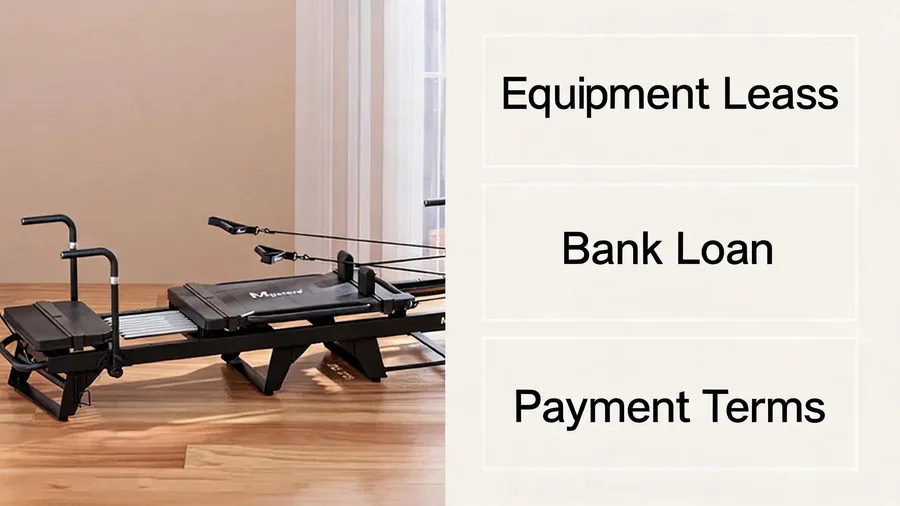
Almost every arrangement falls into one of four buckets. The labels overlap, so focus on the mechanics rather than the name.
Equipment leasing rents the machine for a fixed term, usually 24 to 60 months. You pay monthly, use the equipment, and at the end return it, buy it out, or renew. Ownership stays with the lessor.
Equipment loans lend you money to buy the machines outright. You own them from day one and repay with interest over a set term. Speed and paperwork separate a bank from a specialist lender.
Buy now, pay later (BNPL) splits a smaller purchase into short installments, often 6 to 24 months and sometimes at zero percent. It suits a single reformer, not a twelve-machine build-out.
Manufacturer payment terms are the schedule your supplier offers directly: a deposit now, the balance on delivery or in stages. A supplier arrangement, not a credit product, and the option most owners never ask about.
3. Equipment Leasing: Structure, Terms, and Who It Fits
A lease is a rental with a defined exit. You commit to a term, a monthly payment, and end-of-term options. The lessor keeps title, which is why leases are easier to approve than loans and the paperwork is shorter.
What the payment actually covers
Lease payments are built from the equipment cost, the lessor’s funding cost, the term, and the residual value assumed at the end. A lease with a $1 buyout and one with a 10 percent residual produce different monthly numbers, and lenders rarely say which you are offered.
Operating vs capital treatment
Classification depends on the lease terms and your accounting standard. A lease that transfers ownership risk looks like a purchase; a short rental looks like an expense. Do not assume a lease keeps debt off your balance sheet, and lenders treat the payments as obligations regardless of the label.
Who it fits
Leasing suits owners who want predictable outgoings, plan to refresh every four to five years, and would rather not tie up cash in depreciating assets. It also fits thin credit with steady revenue, since lessors weigh the equipment as collateral.
4. Equipment Loans: When Bank Debt Makes Sense
Keep the machines for their full working life and a loan usually costs less in total. You pay interest, but you own the asset, you can depreciate it, and you face no residual surprise in year four.
When a loan wins
Long holding periods, strong credit, and a wish to modify or resell freely all point toward a loan. Leases often restrict alterations and location changes. Loans rarely do, because the equipment is already yours.
What lenders look at
Specialist lenders weigh time in business, revenue, and resale value. Banks look harder at personal credit, existing debt, and financials. A two-year-old studio with clean books and a signed space lease is a stronger borrower than most owners assume.
Read our comparison of new versus used reformers before borrowing for a used fleet. Lenders price used equipment differently, and the resale value they assume changes your terms.
5. BNPL and Point-of-Sale Financing
BNPL is a short-term installment plan attached to a checkout page. For one reformer, a set of springs, or an accessories order, it is the fastest way to smooth cash flow. Approval takes minutes and often does not touch your business credit file.
The limits matter more than the convenience. Ticket sizes are capped well below the cost of a full fleet, zero-percent periods are short, and a missed installment can trigger deferred interest that wipes out the benefit.
Use BNPL for the marginal purchase, not the core build-out. Twelve machines on a BNPL schedule is not a strategy, it is a stack of consumer obligations that complicates every future credit application.
6. Manufacturer Payment Terms: The Option Most Owners Ignore
Ask your supplier what schedule they can offer before you sign with a lender. Factories that ship direct often work on 50 percent deposit and 50 percent before dispatch, or in three installments tied to production milestones. This is the cheapest money available, because nobody charges interest.
Terms will not stretch over five years, but they do bridge the gap between order and first class, often the gap that hurts. Pair them with a smaller loan or lease for the rest and your cost of credit drops.
Supplier direct installments vs third-party leasing companies
A supplier installment plan is a commercial arrangement between you and the factory. No credit product, no third party, and terms that depend on the relationship and order size.
A third-party leasing company is an independent lender. It buys the equipment and leases it to you, carrying the credit risk, which is why it approves faster and charges more. It also handles returns and end-of-term logistics, useful if you plan to upgrade. Direct terms are cheaper and less flexible; third-party leases are pricier and more structured.
7. Financing vs Buying Outright: The Cash-Flow Case
Buying outright is not the conservative default. It converts liquid cash into an illiquid asset that starts losing value the day it is installed. That is fine with surplus capital and no better use for it, expensive when those dollars could fund marketing that fills classes or sit in reserve.
Run the comparison on opportunity cost. If borrowing costs 8 to 12 percent a year and the cash would earn nothing once tied up in a reformer, financing is close to free after accounting for the reserve it preserves. Reverse the logic if your borrowing rate is high and margins thin. The crossover point moves with your numbers.
Our reformer ROI calculator walks through the payback math, and it pairs with the payment schedule you choose.
Three questions settle it: Do you have three months of expenses in reserve after the purchase? Is your borrowing rate below the return from spending that cash elsewhere? Will the equipment stay busy for the full term? Three yeses favor cash, any no favors financing.
8. The Four Paths Compared
This table summarizes how the four options differ on the terms that matter to a studio. Ranges are typical market figures, not offers, and your numbers depend on credit, country, and order size.
| Feature | Equipment Lease | Equipment Loan | BNPL | Manufacturer Terms |
|---|---|---|---|---|
| Typical down payment | 0–10% | 10–30% | 0% | 30–50% |
| Typical term | 24–60 months | 24–72 months | 6–24 months | Order to delivery, up to 3 installments |
| Indicative cost of credit | Effective rate often 8–16% | 7–15% APR | 0% promo, then 15–30% equivalent | Effectively 0% |
| Ownership during term | Lessor | You | You | You |
| Balance sheet effect | Usually an obligation; classification depends on terms | Loan liability, asset recorded | Short-term liability, often small | Trade payable until settled |
| Approval speed | Fast, days | Slower, 1–3 weeks | Minutes | Negotiated with the order |
| Best suited to | Owners who refresh equipment every 4–5 years | Owners keeping machines for their full life | Single machines and accessory orders | Any size order, when you can pay quickly |
Manufacturer terms and BNPL cover the short gap between order and revenue. Leases and loans carry the multi-year cost. Most purchases use one from each group.
9. What the Real Numbers Look Like: A 12-Reformer Example
Here is a worked example for a studio equipping twelve machines. Every input is an assumption, so swap in your own figures.
Assumptions: twelve mid-range reformers at $2,600 each, accessories at $400 per machine, freight and installation at $350 per machine. Total project cost $40,200. Financing covers 80 percent, with the rest paid as a deposit. Rates are illustrative, and the tier matches the mid-range band in our price versus quality comparison.
| Line Item | Assumption | Amount |
|---|---|---|
| Reformers (12 × $2,600) | Mid-range commercial tier | $31,200 |
| Accessories (12 × $400) | Boxes, jump boards, spare springs | $4,800 |
| Freight and installation (12 × $350) | Sea freight plus setup | $4,200 |
| Total project cost | Delivered and installed | $40,200 |
| Deposit (20%) | Cash at order | $8,040 |
| Amount financed | 80% of project | $32,160 |
| Lease, 48 months, $1 buyout | Indicative rate factor, illustrative | ≈ $780/month |
| Loan, 60 months at 9% APR | Indicative rate, illustrative | ≈ $668/month |
| Total cost of credit over term | Lease approx. $5,280; loan approx. $7,920 | Varies |
| Ownership at end of term | Lease: buyout or return; loan: yours | Varies |
Put those payments beside revenue. Twelve reformers running six classes a day at $32 a spot is roughly $25,000 a month at full occupancy. A $780 lease payment is a little over three percent of that, and six or seven percent in a half-empty month, still manageable.
If you are weighing ten machines against fourteen, our guide to how many reformers a studio needs settles the capacity question before you finance the wrong number. Compare that with the cost of a megaformer if a higher-intensity format is part of the plan.
10. How to Get Approved: Documents and Approval Odds
Approval comes down to one question: will this equipment keep earning enough to cover the payment? Every document you submit supports or weakens that answer.
Documents most lenders ask for
- Business registration and proof of ownership
- Two to three years of business tax returns, or one year plus a P&L for younger companies
- Six to twelve months of bank statements
- Personal credit information for owners with a significant stake
- The equipment quote with make, model, and unit price
- Evidence of your studio location, such as a signed commercial lease
- Projected revenue and your class schedule
Three things that raise approval odds
Pay a deposit. A 20 percent down payment signals an owner with skin in the deal. It lowers the amount at risk and often improves the rate.
Show contracted revenue. Signed memberships and prepaid class packs are the strongest document you can hand a lender. Recurring revenue answers the earning question directly.
Keep the request proportionate. Financing $32,000 against $25,000 of monthly revenue reads differently than against $4,000. Keep the payment under ten percent of monthly revenue.
Pull your credit reports two months out and fix errors, which are common and cost rate points. A larger deposit beats a rejected application.
11. Depreciation, Replacement Cycles, and the Three Choices at Lease End
Reformers wear out roughly in line with depreciation. The frame holds for a decade or more, while springs, ropes, and carriage pads cycle through several replacements. That should shape how you finance.
Run machines for ten years and spread the cost over five to six, expecting a second round of spring and pad spending in years four through six. Refresh at year five and a lease aligned to that window matches payments to the period you use the equipment. Financing over seven years when you replace at year four means paying for machines you no longer run.
Parts and mid-term service are real budget lines, not surprises. Our equipment checklist lists the consumables to budget from year one.
Early payoff
Some loans carry a prepayment penalty, some do not. Some leases compute an early buyout with a formula that can exceed the remaining payments. Ask for the payoff schedule in writing and read the clause that defines the calculation. If you expect to clear the balance early, that clause matters more than the rate.
Upgrade mid-term
Most leases let you add equipment during the term instead of refinancing. Adding four machines to an existing agreement is simpler than a second credit facility, usually at your original rate. Ask upfront whether mid-term additions are allowed and on what terms.
The three choices when the lease ends
Return the equipment, buy it out at the stated price, or renew at a lower payment. Buying out suits machines still fit for daily use when the buyout sits below market resale. Returning suits an upgrade you would rather not resell. Renewing makes sense only when the residual is high and the machine has years left. Decide on condition and the buyout figure, not convenience.
12. Red Flags in Pilates Reformer Financing
The financing market has good actors and predatory ones. These signals should stop a conversation.
| Red Flag | What It Usually Means | What to Do |
|---|---|---|
| Rate quoted as a “factor” with no APR disclosed | Effective cost is hidden and likely higher than it looks | Ask for the APR and total cost of credit in writing |
| No payoff schedule provided | Early exit will be expensive or unpredictable | Walk away until you see the formula in writing |
| Verbal promises about end-of-term options | Terms may not match what you were told | Get every end-of-term option into the contract itself |
| Pressure to sign the same day | Good terms survive a night of review | Take the document home and read the exit clauses |
| Automatic renewal buried in the fine print | You may pay for months you did not agree to | Confirm the cancellation notice window in writing |
| Payment close to or above monthly revenue | The structure cannot survive a slow quarter | Reduce the fleet size or increase the deposit |
| Personal guarantee demanded with no negotiation | Common for small business, but the scope matters | Limit the guarantee where possible and review with an advisor |
The test is simple. If you cannot explain your deal to another studio owner in three sentences, total cost and exit terms included, you do not understand it well enough to sign.
Frequently Asked Questions
Is leasing or buying a Pilates reformer better for a new studio?
Leasing suits studios that want lower upfront cost and predictable payments, especially when equipment is refreshed every four to five years. A loan costs less in total and fits owners who keep their machines long term.
What credit score do I need for pilates reformer financing?
Specialist lenders often work with scores in the 600s when the business shows steady revenue and the machines have resale value. Banks want stronger personal credit and more documentation. A larger deposit offsets a thinner file.
Can I finance used Pilates reformers?
Yes, though terms run shorter and rates higher because lenders assume faster depreciation. Some cap used-equipment financing below the value of new machines. Compare the total cost against new equipment first.
What happens at the end of a reformer lease?
You have three choices: return the equipment, buy it out at the stated price, or renew. The pick depends on the machines’ condition and whether the buyout sits below market resale.
Is a $1 buyout lease a good deal?
A $1 buyout lease lets you own the equipment at the end for a nominal sum, but payments run higher than a residual lease over the same term. It works if you plan to keep the machines. If you expect to return them, choose a residual lease.
Can I pay off equipment financing early?
Sometimes, and the cost depends on the contract. Loans may carry a prepayment penalty, and leases often use a buyout formula rather than charging the remaining payments. Ask for the payoff schedule before signing.
Do BNPL plans work for commercial reformers?
They cover a single reformer, spare springs, or an accessories order. Ticket caps make them impractical for a full build-out, and a missed installment can trigger deferred interest that erases the benefit.
What documents will a lender ask for?
Expect business registration, tax returns or a P&L, bank statements, personal credit information, the equipment quote, proof of studio location, and a revenue projection. Signed membership agreements strengthen the file.
Bottom Line
Financing is not a fallback for studios that cannot afford equipment. It matches cost to the months when the equipment earns and keeps reserves intact. Choose a lease to refresh, a loan to hold, manufacturer terms to bridge the gap to first revenue, and BNPL only for the small stuff.
Get the rate, the total cost of credit, and the exit terms in writing before you sign, and keep the payment under about ten percent of monthly revenue. Then fill the classes, because the schedule pays for the machines. For the next steps, see our membership pricing guide and best reformers for studios.
Industry references: Pilates Method Alliance and FTC business guidance on credit and financing.
Related Guides
- Commercial Pilates Reformer Cost: 2026 Price Tiers
- Pilates Reformer Price vs Quality: $800 vs $3,000
- Pilates Reformer ROI Calculator
- How to Start a Pilates Studio
- New vs Used Pilates Reformer
If you are financing a fit-out, start from the machine spec rather than the monthly payment: commercial Pilates reformers priced per class usually cost less over five years.