
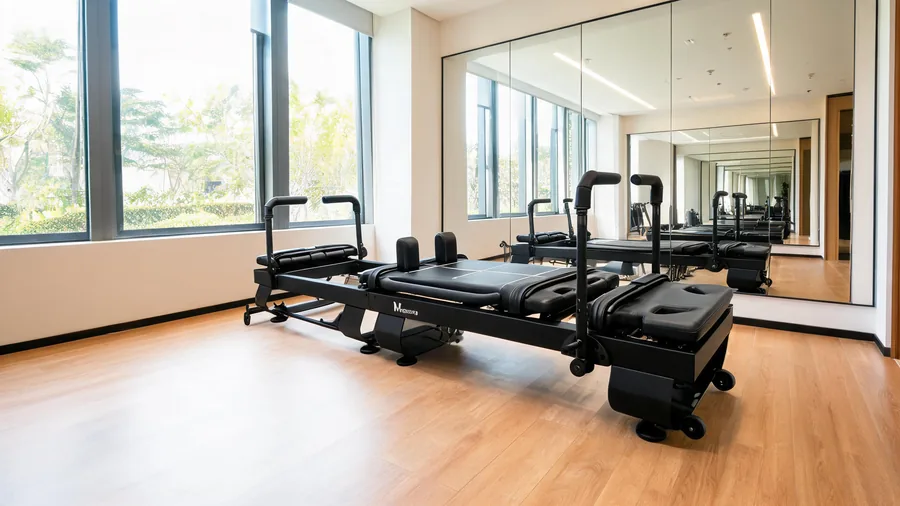
Elite athletes across numerous sports are incorporating Pilates reformer for athletes training into their conditioning programs to gain competitive advantages in strength, flexibility, and overall performance. The spring-based resistance system provides unique training benefits that complement traditional weight training and sport-specific practice. This guide explores how athletic programs can integrate reformer training to improve outcomes and reduce injury risk across various competitive disciplines and training environments at every level of athletic development.

The Pilates reformer for athletes offers variable resistance that adapts to each movement’s strength curve, providing consistent muscle engagement throughout the full range of motion. Unlike free weights where resistance is constant, spring resistance increases as the spring stretches, matching the body’s natural strength curve and providing optimal loading throughout each exercise. This unique resistance profile is one of the key reasons professional sports teams and elite athletes are adding reformer work to their training schedules and recovery protocols.
1. Why Athletes Are Turning to Reformer Training
Professional athletes and sports teams are increasingly incorporating reformer training into their conditioning programs because it addresses specific gaps in traditional athletic training. Traditional weight training develops concentric strength but often neglects eccentric control and stability. The spring-based resistance of the reformer challenges both concentric and eccentric phases of movement, building the balanced muscle development that athletes need for explosive performance and injury resilience across all competitive activities and training cycles. This balanced approach is particularly valuable for athletes in sports that require both power and precision such as gymnastics martial arts and dance. Standard weight training develops concentric strength but often neglects eccentric control and stability. The spring-based resistance of the reformer challenges both concentric and eccentric phases of movement, building the balanced muscle development that athletes need for explosive performance and injury resilience across all competitive activities and training cycles.
Another factor driving adoption of Pilates reformer for athletes training is the low-impact nature of reformer training. Athletes subject their bodies to tremendous stress during competition and practice, and finding effective training modalities that do not add to that joint stress is essential for long-term athletic development. The Pilates reformer for athletes provides high-intensity conditioning without the impact forces of running, jumping, or heavy weight training, making it ideal for in-season maintenance training and recovery-focused sessions between competitions and training blocks.
2. Strength Gains Through Variable Resistance
The reformer’s spring system delivers variable resistance that matches the body’s natural strength curve. Muscles are weakest at the extremes of their range of motion and strongest in the mid-range. Traditional free weights provide constant resistance throughout the movement, meaning the load is limited by the weakest point in the range. Spring resistance increases as the spring stretches, providing lighter resistance at the movement extremes and heavier resistance at the strongest mid-range position, allowing for more complete muscle activation and development.
This variable resistance is particularly valuable for athletes who need balanced strength development across their full range of motion. For example, a football player working on hip extension on the reformer experiences resistance that matches their strength curve, building functional strength that translates directly to sprinting acceleration and jumping performance. The consistent feedback from the spring system also improves proprioception and body awareness during dynamic athletic movements across multiple planes of motion. For example, a football player working on hip extension on the reformer experiences resistance that matches their strength curve, building functional strength that translates directly to sprinting acceleration, jumping power, and change-of-direction performance on the field. The consistent feedback from the spring system also improves proprioception and body awareness during dynamic athletic movements and training drills.
3. Flexibility and Range of Motion Improvements
Flexibility is a critical component of athletic performance that is often underserved by traditional strength training programs. The Pilates reformer for athletes addresses this gap through controlled stretching under variable spring resistance. The reformer’s spring-loaded carriage allows athletes to actively stretch through full ranges of motion while maintaining muscle engagement, combining the benefits of flexibility training with strength development in a single movement. This active flexibility approach is more effective for athletic performance than passive stretching because it conditions muscles to work through their full range under load.
Athletes who train on the reformer consistently show improvements in hip mobility, spinal flexibility, and shoulder range of motion. Better mobility enables athletes to move through more efficient movement patterns with reduced compensation that can lead to injury over time. These gains directly impact sport performance — better hip mobility improves sprinting mechanics, increased spinal flexibility enhances rotational power in throwing and swinging sports, and improved shoulder range reduces injury risk in overhead athletes such as baseball pitchers, volleyball players, and tennis competitors training at high intensities.
4. Performance Gains Across Sports
Research and practical experience show that athletes who regularly incorporate Pilates reformer for athletes training into their programs experience measurable performance improvements across multiple fitness parameters and competitive metrics simultaneously. Studies report improvements in vertical jump height, sprint speed, agility test times, and muscular endurance after 8 to 12 weeks of consistent reformer training. These gains result from the combination of strength development, flexibility improvement, and enhanced neuromuscular coordination that reformer training provides concurrently.
Sport-specific benefits vary by discipline. Runners experience improved stride efficiency and reduced ground contact time during each stride cycle. Soccer and basketball players show better change-of-direction ability and reduced injury rates across their competitive seasons and training schedules. Golfers gain rotational power and core stability that translates to increased club head speed and more consistent ball striking. Swimmers develop improved latissimus dorsi strength and shoulder stability that enhances pull-through power and reduces the risk of repetitive strain injuries common in competitive swimming.
Sport-specific performance benefits of Pilates reformer for athletes training programs.
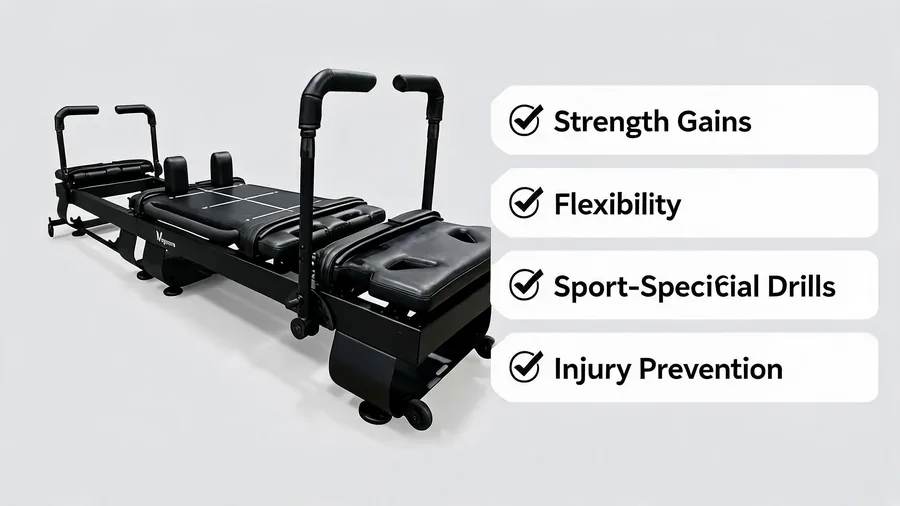
| Sport | Reformer Benefit | Performance Metric |
|---|---|---|
| Running/Track | Stride efficiency | Faster sprint times |
| Soccer/Basketball | Change of direction | Reduced injury rate |
| Golf | Rotational power | Increased club speed |
| Swimming | Lat and core strength | Improved pull power |
| Baseball/Tennis | Shoulder stability | Lower injury risk |
| Cycling | Hip mobility | Better power transfer |
5. Sport-Specific Reformer Programming
Effective Pilates reformer for athletes programming follows periodization principles similar to traditional strength training. Off-season programs focus on building foundational strength and addressing muscle imbalances identified during movement screening. Pre-season training emphasizes power development and sport-specific movement patterns. In-season programs maintain strength and flexibility while prioritizing recovery and injury prevention across all training phases and competition schedules.
Each Pilates reformer for athletes training phase uses different spring tensions, rep ranges, and movement tempos to achieve specific adaptation goals. Off-season work uses heavier spring loads with controlled tempos for strength development. Pre-season training incorporates faster tempos and more dynamic movement patterns to develop power and reactivity for competition readiness. In-season sessions use lighter springs with focus on mobility, recovery, and maintenance of neuromuscular coordination throughout the competitive calendar and demanding practice schedules.
6. Integration with Existing Training Programs
The Pilates reformer for athletes integrates most effectively as a supplemental training modality rather than a replacement for sport-specific practice and traditional strength work. Athletes typically schedule 2 to 3 reformer sessions per week during the off-season, reducing to 1 to 2 sessions during the competitive season. Sessions lasting 45 to 60 minutes provide sufficient stimulus for strength and flexibility gains without interfering with recovery from primary training activities and competition demands throughout the week.
Timing of reformer sessions matters for optimal results. Many strength coaches schedule reformer work on recovery days or as an active recovery session following intense training. The low-impact nature of reformer training makes it excellent for maintaining training volume without adding joint stress during heavy training phases when cumulative fatigue is highest. The low-impact nature of reformer training makes it excellent for maintaining training volume without adding joint stress. Some programs use short reformer sessions as a warm-up before weight training to activate core musculature and improve movement quality during subsequent exercises in the training session.
7. Recovery and Injury Prevention Benefits
Injury prevention is one of the most compelling reasons to incorporate Pilates reformer for athletes training into their programs. The Pilates Method Alliance recognizes that controlled resistance training on the reformer strengthens stabilizing musculature around joints, reducing the risk of common athletic injuries such as hamstring strains, ACL tears, and shoulder impingement. The balanced muscle development achieved through reformer training corrects strength imbalances that often lead to overuse injuries in athletes.
Beyond injury prevention, the Pilates reformer for athletes is an excellent tool for active recovery and rehabilitation. Athletes returning from injury can begin controlled movement on the reformer earlier than they can return to full weight training. Athletes returning from injury can begin controlled movement on the reformer earlier than they can return to full weight training, accelerating the rehabilitation timeline while maintaining conditioning. The spring resistance can be precisely adjusted to match the athlete’s current capacity, allowing for progressive loading that follows the healing process and prevents re-injury during the critical return-to-sport phase of recovery.
8. Equipment Considerations for Athletic Training
Commercial-grade reformers designed for athletic training should meet higher durability standards than home-use equipment because athletes typically train at higher intensities and with greater frequency. Frame stability is critical for athletic training applications where athletes generate explosive power that requires a solid foundation that does not wobble or shift during dynamic movements. Commercial reformers with reinforced steel frames and heavy-duty spring systems are better suited for athletic training applications than lighter recreational models designed for occasional home use. Frame stability is critical — athletes generating explosive power on the reformer need a solid foundation that does not wobble or shift during dynamic movements. Commercial reformers with reinforced frames and heavy-duty spring systems are better suited for athletic training applications than lighter recreational models.
Spring range is another important consideration for Pilates reformer for athletes programming. Athletic training requires a broader spring tension range than general fitness reformer work because athletes need both very light resistance for mobility work and very heavy resistance for strength development. A reformer with adjustable spring configurations allows coaches to program progressive overload that matches the athlete developing strength and conditioning levels across the training cycle. Commercial reformers offering 4 to 5 spring options provide the versatility needed for athletic programming, while home-use reformers with 2 to 3 spring options may not offer sufficient range for advanced athletic training applications in professional environments. The Pilates Method Alliance provides additional guidance on equipment specifications for athletic and performance training applications in commercial studio environments.
9. Getting Started with Athletic Reformer Training
Coaches and athletes interested in adding Pilates reformer for athletes training should start with an assessment of current movement quality and identify specific performance goals for their Pilates reformer for athletes program. Working with a certified reformer instructor who understands athletic training principles helps ensure programs are designed appropriately for the athlete’s sport, position, training history, and current conditioning level. Many professional sports teams employ dedicated Pilates instructors who specialize in athletic performance training and injury prevention programming.
Investing in commercial-grade reformers from a reputable manufacturer ensures the equipment performs consistently under the demanding conditions of athletic training delivered by professional sports teams and elite training facilities working with high-performance athletes across multiple competitive disciplines and training environments. Factory-direct purchasing provides access to customized spring configurations and frame specifications that match the specific needs of athletic training programs. Athletes who commit to consistent reformer training typically see measurable performance improvements within 8 to 12 weeks, with continued gains as training volume and complexity increase over time within their progressive programming structure.
Related Guides
- Pilates Reformer Buying Guide 2026
- Commercial Pilates Reformers Guide
- Reformer Weight Capacity Guide
- Reformer Safety Standards Guide
- Studio Equipment Checklist
Training facilities that run back-to-back sessions pick from the studio-grade reformers.