
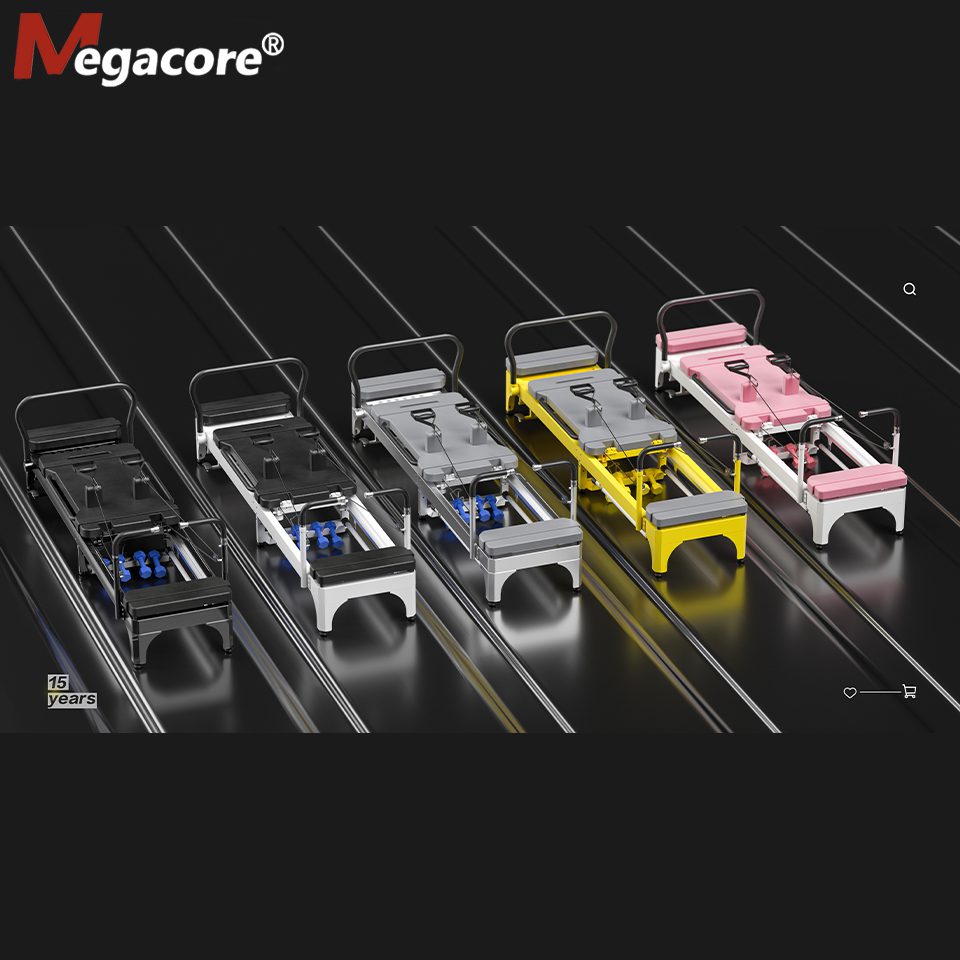
Group reformer classes are the highest-revenue format for most Pilates studios. A well-planned group class accommodates more clients per instructor hour while maintaining safety and quality. The key variables are reformer count, layout configuration, instructor positioning, and class flow design.
This guide provides practical recommendations for determining how many reformers to install and how to arrange them for optimal group class instruction.
Determining Reformer Count
The number of reformers in a group class depends on: instructor-to-client ratio (typically 1:6 to 1:8 for reformer classes; 1:4 for mixed-level classes), room dimensions (each reformer station requires 2.5 × 1.5 m minimum), class pricing model (higher ratio = lower per-client cost but potentially lower satisfaction), and instructor experience (new instructors manage smaller groups).
For most boutique studios, 6–8 reformers per instructor is the sweet spot. At ¥250–350 per class per client, an 8-reformer class generates ¥2,000–2,800 per session — strong economics with a single instructor. Larger studios may run 12–16 reformers with two instructors (one lead, one assistant).
Layout Configurations
Parallel Rows (Staggered):
Reformers arranged in two parallel rows, with the second row staggered so that reformers align with the gaps in the first row. Configuration: 6 reformers = 2 rows of 3, staggered. 8 reformers = 2 rows of 4, staggered. 12 reformers = 3 rows of 4, staggered.Advantages: instructor can see all clients from a central position; staggered rows provide clear sightlines; and all reformers face the same direction (footbars toward instructor). Required room width: 5–6 m. Required room length: 8–12 m depending on row count.
U-Shape:
Reformers arranged along three walls, forming a U-shape. The instructor stands in the open end. Configuration: 6–8 reformers maximum (limited by wall perimeter). Advantages: instructor sees all clients without turning; each client has a wall behind them (visual focus). Required room: minimum 6 × 7 m. Best for: studios in irregular-shaped rooms or spaces with columns.
Circle (Diamond):
Reformers arranged in a circle or diamond pattern, all facing outward or inward. Configuration: 6–8 reformers per circle. Advantages: creates community feel; clients can see each other. Disadvantages: instructor sightlines are compromised; some clients have backs to the instructor. Best for: experienced clients in advanced classes where spot-correction is minimal.Instructor Positioning and Movement
The instructor’s movement path should allow access to every reformer within 3–5 steps. Key positions: central command point — a marked position (tape or mat) where the instructor stands for class-wide cues, circuit path — a defined walking route that passes within arm’s reach of each reformer, and spot-corner — a designated area near each reformer where the instructor stands for hands-on corrections.
For audio clarity, consider a wireless microphone system. A headset mic with a small amplifier (¥500–1,500) ensures the instructor’s voice reaches all clients without straining, especially in rooms with hard surfaces that create echo.
Class Flow Design for Group Settings
Efficient class flow minimises transition time and maximises exercise time. Recommended structure for a 50-minute group class: arrival and set-up (5 minutes) — clients arrive, adjust springs and footbar, perform brief self-rolled; warm-up (8 minutes) — footwork on the reformer with light springs; main sequence (30 minutes) — 5–6 exercise blocks, each lasting 4–6 minutes, with 30-second transition between blocks; peak exercise (5 minutes) — the most challenging exercise of the class, typically a standing or jump board series; and cool-down and de-set-up (7 minutes) — stretching, breathing, return springs to neutral.
Transition management: cue the next exercise 30 seconds before the transition. Use consistent naming for exercises so clients recognise the next movement. Assign each reformer a colour or number for spring configuration reference — ‘Red springs for stations 1–4, blue for stations 5–8.’
Equipment Considerations for Group Classes
All reformers in a group class should be identical or functionally equivalent. Sprung tension configurations should match across all reformers — different spring ages or types create uneven client experiences.
Each reformer should have: a complete set of colour-coded springs, a box and jump board (stored on or near the reformer), a mat for standing exercises, and a small towel and water bottle holder attached to the frame.
Accessory organisation: a wall-mounted rack near the reformer area holds boxes, jump boards, and platform extenders. Colour-coding (matching the reformer station number) helps clients find their accessories quickly.
Safety Considerations
Group class safety starts with layout: minimum 1.5 m clearance at the footbar end for standing exercises and lunges; minimum 0.8 m clearance at the head end for carriage travel; no extension cords or cables crossing walkways; non-slip flooring in the instructor pathway; and emergency stop procedures communicated during the first class.
Instructors should have a clear view of the footbar, carriage, and rope handles for every client. Layouts that create blind spots (e.g., reformers behind columns or in corners) should be avoided or limited to experienced clients.
Summary
Group reformer classes are the economic engine of most Pilates studios. Six to eight reformers per instructor in a staggered parallel row layout provides the best balance of capacity, sightlines, and class flow. Identical equipment across all stations, organised accessory storage, and thoughtful transition management maximise class quality and client satisfaction. A well-planned group class generates ¥2,000–2,800 per session while delivering an engaging, safe experience. How Many Reformers Do You Need to Open a Pilates Reformer Dimensions & Space How Many Reformers Do You Need to Open a Pilates Reformer Dimensions & Space