
Most people arrive at a Pilates reformer for back pain from the same place. Their back hurts, a physio or a friend mentioned Pilates, and the internet promptly told them two opposite things. One side promises core work will fix it. The other warns that anyone with a disc problem should never go near a reformer. Both are oversimplifications, and neither helps you decide anything.
The honest version is more useful. A reformer is a load-management tool. It supports your body in a controlled position, lets you dial resistance up or down, and lets you train the muscles that stabilise a spine without the compression that comes from standing exercise. For some backs that is exactly what the doctor ordered. For others, at the wrong time, it sets recovery back weeks.
This guide covers which back problems a reformer genuinely helps, how to set one up when your back is sensitive, which machine features matter if you run a clinic or a studio that serves people with back pain, and the cases where you should wait. I have kept it concrete, because “consult a professional” is true but not very actionable on its own.
1. What a Reformer Actually Does for a Bad Back
A reformer gives you three things a mat cannot.
Support. When you lie on the carriage, the machine holds your torso. You are not fighting gravity to keep a neutral spine. That matters because most flare-ups in back exercise come from losing position under load, not from the exercise itself.
Adjustable resistance. Springs are not weights. You can start at a tension so light it barely moves the carriage, which is impossible with a dumbbell. That gradient is the whole point for a back that is still healing.
Feedback. The carriage moves when you do. It tells you and your instructor whether your movement is smooth or whether you are bracing and yanking. A jerky carriage usually means a guarded back.
What it does not do is “fix” a spine. No exercise does that. What it can do is build the deep abdominal and back muscles that share the load, improve how you move, and give you a way to exercise without the pounding of running or the axial load of heavy squats.
2. Which Back Pain It Helps, and Which It Does Not
Back pain is not one condition. The reformer suits some and not others.
Usually a good fit: chronic non-specific low back pain, general deconditioning, postural pain from desk work, and the recovery phase after a resolved acute episode. This is where the research on Pilates for low back pain is strongest, and where most clinicians feel comfortable progressing clients.
Case by case, with a clinician: disc-related pain, sciatica, and stenosis. A reformer can absolutely be part of the plan, but the direction of movement matters enormously. Some disc presentations feel better with flexion, others with extension, and picking wrong is how people end up worse. This is where an instructor and a physio need to be talking to each other.
Not until cleared: acute severe pain, suspected fracture, unhealed surgical sites, and any back pain with red-flag symptoms such as loss of bladder control, progressive weakness, or numbness in the saddle area. Those need a doctor first, and no amount of reformer work substitutes for that.
If you are a studio owner reading this, that middle category is your bread and butter. It is also where liability lives, so it pays to have a screening routine (more on that below).
3. The Springs Matter More Than the Exercise
Ask most people how to make a back-friendly reformer workout, and they will name exercises. The spring setting usually matters more.
On a reformer, springs do two jobs that pull in opposite directions. They provide resistance, and they provide support, because they pull the carriage toward the foot bar and give you something to stabilise against. Heavy springs can mean less strain on a sensitive back in the right position, not more, because they offer more support. This trips up beginners constantly. The instinct is to go light. Sometimes the honest answer is a heavier spring and a smaller range.
The principle most clinicians use: pick the spring that lets you complete the movement without your ribs flaring, your pelvis tucking, or your back rounding. If the carriage does the work for you because the spring is too heavy, drop it. If you cannot feel where your spine is, the spring is too light.
Springs also wear. A studio reformer with thousands of hours on it has springs that no longer match their colour coding, which makes any “start on the green spring” instruction unreliable. If you are setting up a machine for rehab work and cannot remember when the springs were last changed, that is a maintenance issue, not a training one. Our guia de tensão das molas covers how to check and replace them.
4. How to Set Up a Reformer When the Back Is Sensitive
Before the first movement, the setup decides most of the outcome. Here is a starting point that clinicians tend to agree on. Adjust it to the person in front of you, not to the chart.
| Setting | Sensitive-back default | Porquê |
|---|---|---|
| Apoio de cabeça | Flat or slightly raised | Less neck and upper-back strain when lying down |
| Foot bar position | Start where the knees are bent near 90° | Keeps the low back supported on the carriage |
| Carga da mola | Two medium springs to begin | Enough support to feel the spine, not so much you brace |
| Amplitude de movimento | Shorter than feels impressive | Staying in a pain-free arc beats stretching into pain |
| Session length | 20 to 30 minutes at first | Backs often react hours later, not during |
The single most useful rule is about timing, not technique: judge the session by how you feel the next morning, not by how it felt while you were doing it. Backs are slow to complain. A workout that felt fine at 6pm can leave you stiff at 8am, and that lag is why people overshoot in week one.
5. Movements That Are Usually Safe to Start With
This is not a prescription, and it does not replace a clinician who has seen the person. But for a general deconditioned back, the early sessions usually lean on these:
Footwork. Lying down, feet on the bar, pushing the carriage out and in. It teaches the body to move the spine while the carriage supports it.
Bridging. Lifting the hips off the carriage with the back supported. Good for glutes and hamstrings, which quietly do a lot of the work of protecting a low back.
Leg circles and single-leg work. Building control with one leg at a time, which exposes and then fixes side-to-side differences.
Short-box seated work. Once lying down is comfortable, seated balance work teaches the deep abdominal muscles to hold the spine upright. This often feels harder than it looks, which is the point.
What these share is that none of them loads the spine while it is flexed and unsupported. That is the common thread to hold onto when you or your client progresses.
6. Equipment Features That Matter for Back-Friendly Work
If you are buying a reformer for a clinic, a rehab practice, or a studio with a lot of older clients, a few features matter more than the marketing suggests.
| Característica | Why it matters for backs |
|---|---|
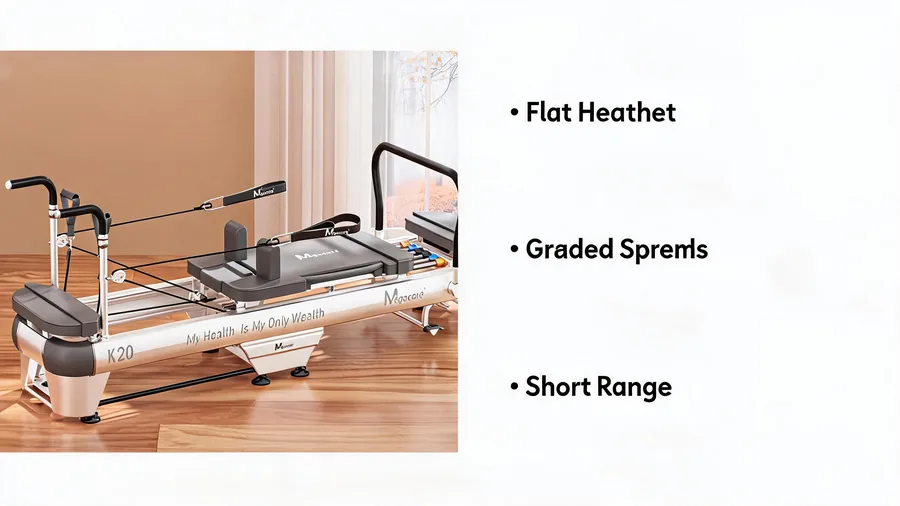
| Adjustable headrest | Neck and upper-back comfort for clients who cannot lie flat |
| Smooth, low-friction carriage | A jerky carriage makes people brace, which is the opposite of what you want |
| Graded spring set | Lets you fine-tune support, not just pick light or heavy |
| Good padding | Thin or worn foam on a weight-bearing spine is a genuine problem |
| Stable base | A machine that shifts under load erodes trust, and trust is what lets people relax |
Notice how much of that is about the machine’s manners rather than its specs. For rehab work, a smooth and predictable carriage matters more than a headline weight rating. If you are weighing options, our guide to heavy-duty reformers explains where structural quality shows up, and our piece on carriage pads covers the padding question in detail.
7. If You Are Buying for a Clinic or Studio
Selling to clients with back pain is good business. It is also the part of your business most likely to end up in a dispute, so a little process goes a long way.
Screen before you sell. A short intake that asks about red flags, previous surgery, and what movements currently hurt costs you ten minutes and protects everyone. Keep it on file.
Train your instructors on the medical side. Anyone running back-pain clients should be able to recognise when to stop and refer. This is not about pretending to be a physio. It is about knowing your edge.
Choose a machine you can maintain. Springs, straps, wheels, and padding are all consumables on a machine that gets therapeutic use. A supplier who cannot ship parts quickly turns a working reformer into a paperweight. See our physical therapy reformer guide for how clinics tend to spec them.
Think about size and layout. Rehab clients often need more space around the machine for a therapist to stand and cue. That planning has more to do with room dimensions than with the reformer itself, which is the subject of our guia de requisitos de espaço.
8. When You Should Not Use a Reformer Yet
There is an idea that working through back pain makes it stronger. Sometimes that is right during rehab. During an acute flare it is usually wrong, and a reformer is a poor place to test the theory.
Wait, and get advice, if any of these is true: the pain is new and severe, it started after a fall or impact, it wakes you at night, it comes with numbness or weakness in a leg, or there are any of the red-flag symptoms mentioned earlier. In those cases the reformer is not the tool yet, and no instructor should be talking someone into a session.
The pragmatic line most sensible studios draw: if the client cannot get through an ordinary day without pain, they are not ready to load a reformer. Once daily life is manageable, progressive reformer work becomes far more reasonable.
9. Progressing Without Flaring Up
The trap in back rehab is not doing too little. It is doing a good week and then a great one.
Change one variable at a time, whether that is spring tension, range, or number of repetitions. Give each change a couple of sessions and watch the next-morning response before adding more. When something does flare, the useful move is to step back to the last setting that worked rather than to stop entirely, because stopping means starting the confidence climb over again.
Keep a simple log. Date, what you did, spring setting, and how you felt the next day. Patterns show up in that log within a few weeks, and they are far more reliable than memory. Most people who plateau on a reformer are not undertraining. They are quietly repeating a movement that irritates one specific spot, and the log is how you catch it.
Perguntas frequentes
Is a Pilates reformer good for lower back pain?
For chronic, non-specific low back pain and general deconditioning, yes, and the evidence for Pilates here is reasonably strong. A reformer supports the torso, lets you dial resistance down to almost nothing, and trains the muscles that stabilise the spine without compressing it. For disc-related pain, sciatica, or stenosis it can still help, but the direction of movement matters a lot and a clinician should guide the early sessions.
What spring setting is best for back pain on a reformer?
Use the spring load that lets you finish the movement without your ribs flaring, your pelvis tucking, or your back rounding. Beginners assume lighter is always safer, but springs also provide support, so a sensitive back sometimes does better on a heavier spring with a shorter range. If the carriage does the work for you, go lighter. If you cannot feel your spine, go heavier.
Can reformer Pilates make back pain worse?
It can, usually for one of three reasons: working through an acute flare, choosing the wrong direction of movement for a disc problem, or progressing too fast. Backs also react with a delay, so a session that feels fine can leave you stiff the next morning. Judge each session by how you feel the day after, change one variable at a time, and step back rather than stopping when something flares.
How often should you use a reformer for back pain?
Two or three sessions a week is a common starting point, with 20 to 30 minutes per session at the beginning. Consistency matters more than intensity, and daily short sessions often beat one long one for a back that is still settling. Add frequency before you add load, and watch the next-morning response before increasing either.
Which reformer features matter most for a sensitive back?
An adjustable headrest, a smooth and predictable carriage, a graded spring set, supportive padding, and a stable base. Much of that is about how the machine behaves rather than its headline specs. A jerky carriage makes people brace, and bracing is the opposite of what a healing back needs, so carriage quality is worth more than a bigger weight rating.
Should I buy a reformer if I have a bad back?
If a clinician has cleared you for exercise and you will actually use it, a home reformer can work well, because the low-load, supported position is hard to replicate with free weights or a mat. Choose a machine with a graded spring set and a smooth carriage rather than the cheapest option, and start conservatively. If your back is still in an acute phase, wait and get advice first.
Do you need an instructor to use a reformer for back pain?
For the first several sessions, yes, or at least a clinician-designed programme. Back pain is one area where the direction of movement and the spring setting matter enough that guessing is a real risk. Once you have a routine that works and you know your own warning signs, home sessions between studio visits are perfectly reasonable.
Guias relacionados
- Choosing a reformer for physical therapy
- How reformer spring tension works
- Reformer Pilates for older clients
- Weight capacity on commercial reformers
- Carriage pads and upholstery
For clinical and rehab rooms, the commercial lineup covers the models with lower carriage heights.