
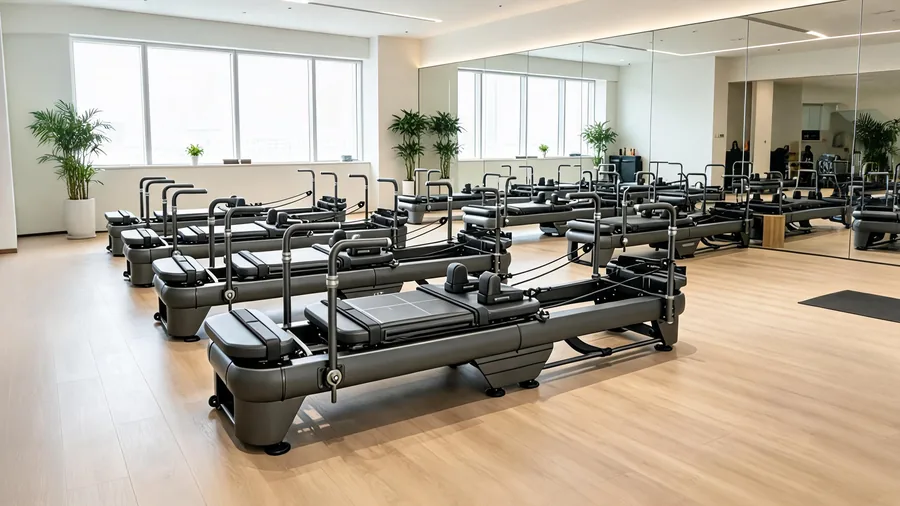
Most pilates reformer core exercises look almost too simple from the outside. You lie down, press the carriage away, bring it back. Nothing about footwork or the hundred reads as a strength test. Then you try to hold your ribcage down for twenty controlled reps and find out exactly where your trunk gives up.
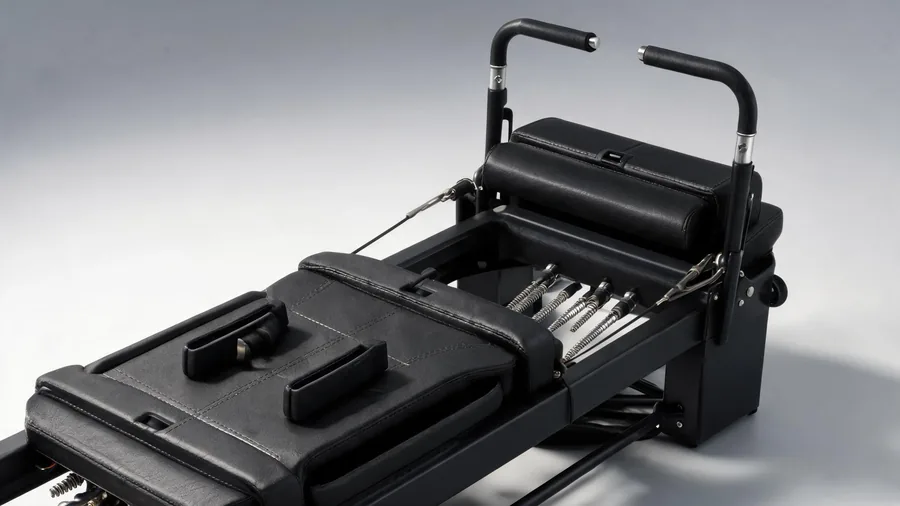
That gap between “looks easy” and “actually hard” is the point. The springs add resistance in positions you rarely find on a mat, and the moving carriage hands you a hundred chances per session to cheat with momentum. Most people spend their first year getting stronger at the cheat.
What follows is the technique that changes the most, in the order I would coach it. Then how to dose the work, the mistakes worth fixing first, and what the machine under your body has to do with any of it. Instructors can run the same list as a class checklist.
1. Why Core Training Feels Different on a Reformer
Reformer core work is not mat work on a sliding platform. Three mechanical differences do most of the work.
The load is progressive and bidirectional. A mat gives you body weight, which barely changes. Springs get heavier as they stretch, and they pull the carriage back whether you ask them to or not. You are never only pushing.
You work in closed-chain positions. Feet or hands stay planted while your trunk manages the moving parts. That lets you load the trunk in supine, seated, and standing patterns that would turn into a balance test on the floor.
The carriage is an unstable surface. Even a well-built carriage rocks slightly side to side, and a worn one rocks a lot. Managing that instability recruits the deep stabilisers that hold your spine still while your limbs move, which is the definition of core work anyway.
Those three factors explain why a client who can hold a plank for two minutes often falls apart in footwork. The comparison is covered in more detail in our reformer vs mat pilates guide. For strength specifically, the reformer wins on load tolerance and the mat wins as a test of whether that strength survives without springs helping.
2. Secret 1: Control the Return, Not the Push
Everyone focuses on the part where the carriage travels away. That is the easy half, because the springs are helping you. The real work happens as the carriage comes back toward the stopper. Your muscles are lengthening under load there, and that eccentric phase is where most strength adaptation lives.
Watch a group class and you can see the pattern. Clients push out with intent and let the carriage snap home. The push gets a full second of attention; the return gets whatever the springs decide.
One change to make this week: on footwork, take four full seconds to let the carriage return. Count out loud if you have to. Most people find out they have been outsourcing the return to the springs for years. If you want a single fix from this whole article, take this one.
3. Secret 2: Breathe Out on the Effort
Inhaling during exertion is a natural instinct, and it is backwards for this work. Exhale as the carriage moves away, and exhale through the hardest part of the rep. The exhale engages the deep abdominal wall and builds intra-abdominal pressure, which is what actually stabilises your spine while your legs or arms are loaded.
Breath also controls rib position. The ribs want to flare on effort, and a flared ribcage puts your lower back into extension before your hips have finished the movement. A deliberate exhale keeps the ribcage stacked over the pelvis.
The tell is visible in any class. People holding their breath go red, then lose their rib position on the last three reps. People breathing out on effort hold the same shape from rep one to rep twenty. If you are working with a group, cue the exhale as a count rather than a correction. It lands better and it fixes the same problem.
4. Secret 3: Stop Chasing Maximum Range
The full length of the reformer is not a goal. It is a maximum. There is a point in every exercise where the next inch of movement comes from your lower back arching rather than your hips or shoulders working. That inch is not progress. It is compensation, and you are rehearsing it every rep.
Shorten the range until you can hold your ribcage and pelvis in the same position at the end of the movement as at the start. Build control at that length for a few weeks, then let the range grow on its own. This feels like going backwards for about three weeks. Then it stops feeling that way, and the control you gained transfers to everything else you do on the machine.
Range is also where equipment condition shows up. A carriage with drag or a stopper that sits high forces a shorter range whether you want it or not, and clients often read that restriction as their own tightness. Our reformer safety standards guide covers the spec checks worth doing before you blame a client’s mobility.
5. Secret 4: Treat Every Footwork Variation as Its Own Exercise
Footwork is treated as a warm-up by most clients and as a diagnostic by good teachers. Toes, arches, heels, tendon stretch, each done parallel and turned out. That is not one exercise repeated ten times. It is ten distinct exercises that load different parts of the leg and ask for different things from your trunk.
Toes on the bar loads the calf and ankle. Heels puts the load through the hamstrings and demands more hip extension control. Tendon stretch is where most people lose their pelvis first, because the legs are long and the leverage is against them. Turned out versions add a rotational demand your trunk has to resist.
If you have been running footwork on autopilot, spend a month treating each variation as its own movement. Notice which ones you rush and which ones make your hips shift. That list tells you exactly where your weak links are, and it is more useful than any general strength test. The สมาคมวิธีการพิลาทิส keeps the classical repertoire and teacher standards in one place if you want to compare naming and sequencing across schools.
6. Secret 5: Choose Springs for the Goal, Not the Ego
Heavier is not automatically harder. Heavy springs make the push harder and the return easier, because the carriage comes back faster and you spend less time resisting it. Lighter springs make the push easier and the return much harder, which is where the control work actually sits.
For trunk stability, the useful middle ground is a resistance light enough that you can control the return for a full four seconds and heavy enough that the push does not feel like a warm-up. That setting changes by exercise, and it changes for the same exercise on a tired day. Adjust it rather than defaulting to “one red and one blue forever.”
It helps to know what your springs are actually rated at instead of trusting the colour code. Colours vary between manufacturers, and springs lose tension with age, so a red spring on a five-year-old machine may not load the way a red spring did when it shipped. Our spring tension guide walks through how to test them.
7. Secret 6: Add the Anti-Rotation Work You Have Been Skipping
Straight-plane core work gets all the attention. The exercises that resist rotation and side-bending are the ones that pay off in daily life, because resisting a twist is what your trunk does when you carry a suitcase, lift a child, or reach across a car seat.
On the reformer that means single-arm and single-leg variations, side-lying work, and anything where your hips want to twist and you refuse to let them. One arm in a strap while the other stays free will expose a trunk that has been relying on both sides working together. Side-lying leg work exposes it from the other direction.
These are less satisfying to perform and they show up on camera far less than footwork. Do them anyway, and do them about twice as often as you currently do. If you are training through or recovering from an injury, the reformer work used in physical therapy is largely built on exactly this kind of controlled, anti-rotation loading.
8. Secret 7: Make the Carriage Quiet
This one sounds like a party trick and works like a diagnostic. Move the carriage through a set without letting it clack into either stopper. No bounce at the finish, no slam on the return.
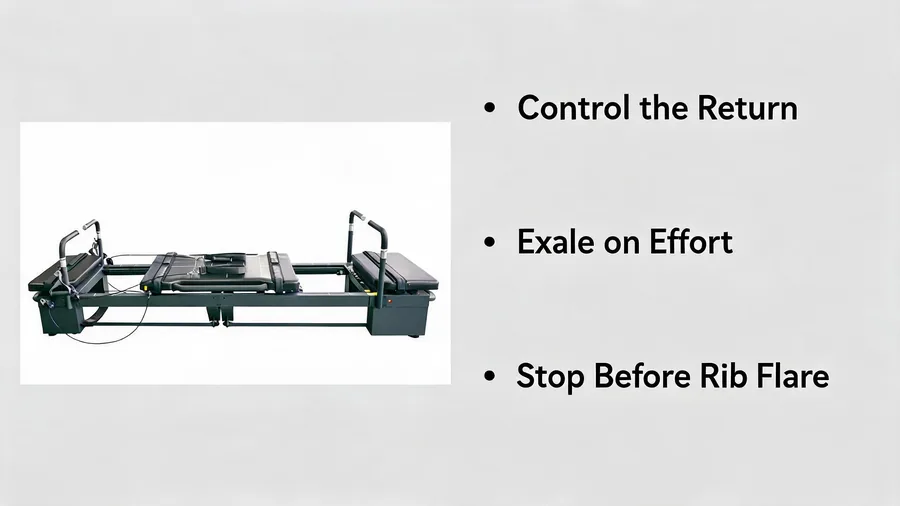
A quiet carriage means you decelerated before the end of the range and controlled the moment of contact. Most people cannot do it at their normal speed, because the springs have been absorbing that final phase for them. Slow down until you can do the whole set silently, then build speed back up while keeping it quiet.
It is the fastest way to find out whether your control is real or whether the springs have been covering for you. If the machine itself rattles and clacks no matter how carefully you move, that is a separate issue and it is worth diagnosing on its own. Our reformer noise levels guide explains which sounds come from technique and which come from worn bearings or loose hardware.
9. How to Dose the Work: Sets and Reps
Core work on a reformer is usually under-dosed in group classes and over-dosed in home practice. The table below is a starting point, not a prescription. Move up a level when you can hold form without breathing hard through the last rep, not when you get bored.
| Level | Sets per exercise | Reps | Return tempo | Typical spring setting | Total core time per session |
|---|---|---|---|---|---|
| Beginner (0-3 months) | 2-3 | 8-10 | 4 seconds | 1-2 medium springs | 10-15 minutes |
| Intermediate (3-12 months) | 3 | 10-12 | 3-4 seconds | 2 medium, mixed for variation | 15-20 minutes |
| Advanced (12+ months) | 3-4 | 12-15 | 2-3 seconds | Lighter springs for control work, heavier for load | 20-25 minutes |
Two rules matter more than the numbers. First, rest 30 to 60 seconds between sets; this is strength work, not a cardio circuit, and rushing the rest is the most common way to lose the technique you just built. Second, if the last two reps of a set look different from the first two, stop the set there regardless of what the plan says.
The weekly volume sits comfortably inside the CDC physical activity guidelines for adults, which recommend muscle-strengthening work on at least two days a week alongside 150 minutes of moderate aerobic activity. Core work on a reformer counts toward the strength side of that total.
Beginners with long-standing back sensitivity often do better on fewer reps and longer holds. Clients over 60 or returning after a break can use the same structure at lower volume. There is a fuller template in our reformer pilates for seniors guide if you are coaching an older or deconditioned group.
10. Common Mistakes to Fix First
These are the errors I see most often in studio classes, roughly in order of how much they cost the trainee.
| ความผิดพลาด | What it looks like | Why it matters | แก้ไข |
|---|---|---|---|
| Letting the springs return the carriage | Loud, fast return; client relaxes on the way back | Skips the eccentric phase where strength is built | Count a four-second return out loud |
| Holding the breath on effort | Red face, ribs flare, form collapses late in the set | Loses intra-abdominal pressure and spine position | Exhale as the carriage travels away |
| Chasing maximum range | Lower back arches at the end of the movement | Rehearses compensation instead of control | Shorten range until ribcage and pelvis stay stacked |
| Coasting through footwork | Same speed and same intent for all ten variations | Misses the diagnostic value of each variation | Treat each footwork position as a separate exercise |
| Springs chosen for ego | Heaviest springs on every exercise, every session | Makes the push hard and the return easier, which is backwards | Pick load that lets you control a four-second return |
| Skipping anti-rotation work | Only straight-plane exercises, always symmetrical | Leaves the muscles that protect the spine untrained | Add single-arm, single-leg, and side-lying work weekly |
| Clacking into the stoppers | Carriage bangs at both ends of the range | Signals uncontrolled deceleration and joint impact | Slow down until the carriage runs silently |
If you fix only the top three, most clients notice a difference in lower-back comfort within a month. The rest tend to sort themselves out once the return tempo and the breathing are under control.
11. How Your Equipment Affects Core Training
Some of this is technique and some of it is the machine underneath you. Three specifications matter more than the rest for core work.
Carriage stability and bearing quality. A carriage with side-to-side play makes it impossible to tell whether your hips are shifting or the machine is. Precision in the equipment lets you feel precision in your body. Studios running eight classes a day wear out bearings years before the frame shows any sign of trouble, and the symptom is always described as “the reformer feels loose.” What to look for in an everyday machine is covered in our เครื่องปฏิรูปพิลาทิสเชิงพาณิชย์ overview.
Spring consistency. Springs that have lost tension give you an inconsistent load, which means you cannot judge effort from one week to the next. That is a training problem as much as a maintenance one, because progress depends on knowing what a given resistance actually feels like.
The carriage pad. A pad that is too thick or too soft reduces the feedback you get through your back and hips, and feedback is how you learn to hold position. Most commercial pads sit between one and 1.5 inches for exactly this reason. Our carriage pad guide covers the thickness and material trade-offs in detail.
If you are coaching or training on a machine that rocks, squeaks, or runs on springs of unknown age, fix that before adding another class to your week. Our heavy-duty range is built for studios where the same unit runs every day without drifting out of spec.
คำถามที่พบบ่อย
How long does it take to build a strong core on a reformer?
Expect three to four weeks before everyday movement feels different, and eight to twelve weeks of consistent twice-weekly practice before strength changes become obvious. Control-based strength builds slower than people expect and holds longer than they expect. The trajectory is steady rather than dramatic.
Should I feel my abs burning after every session?
No. Burning is a sign of fatigue, not effectiveness, and the deep stabilising muscles do not produce much of a burn even when they are working properly. If you only count a session as successful when you are sore, you will keep selecting load over control.
Why does my lower back hurt after reformer core work?
Almost always one of three things: letting the ribcage flare at the end of the range, holding your breath through the hard reps, or using springs heavy enough that the return becomes a collapse rather than a controlled lengthening. The first two are technique. The third is a setting.
How heavy should the springs be for core exercises?
Heavy enough that the push is real work, light enough that you can slow the return to about four seconds. That usually means one or two medium springs for beginners and a mix of light and medium for more advanced control work. Heavier is not the same as harder for the trunk, because heavy springs make the return much easier.
Can beginners do these pilates reformer core exercises?
Yes, with reduced range and volume. Start with two sets of eight on footwork and the basic abdominal series, focus on the four-second return and the exhale, and ignore how far the carriage travels for the first month. Beginners who master tempo early progress faster than those who chase heavy springs.
Do I need a reformer at home to make progress?
No, but it helps with consistency, which is what actually drives progress. If home practice is realistic for you, a home-use reformer is built for lower weekly hours than a studio unit and will hold up fine for personal training volumes.
Is it normal for the carriage to make noise during core work?
Some sound is unavoidable, but clacking into the stoppers usually means the carriage is not being decelerated before the end of the range, which is a technique problem. Rattling, grinding, or squeaking that continues no matter how slowly you move points to worn bearings or loose hardware rather than your control.
How often should I train core on the reformer?
Two or three quality sessions a week beats five rushed ones. The deep stabilisers respond to control and frequency rather than to heavy loading to failure, so spreading the work out and keeping the tempo honest gets better results than stacking volume into one long session.